The Little Preacher from Troy
Chapter 1
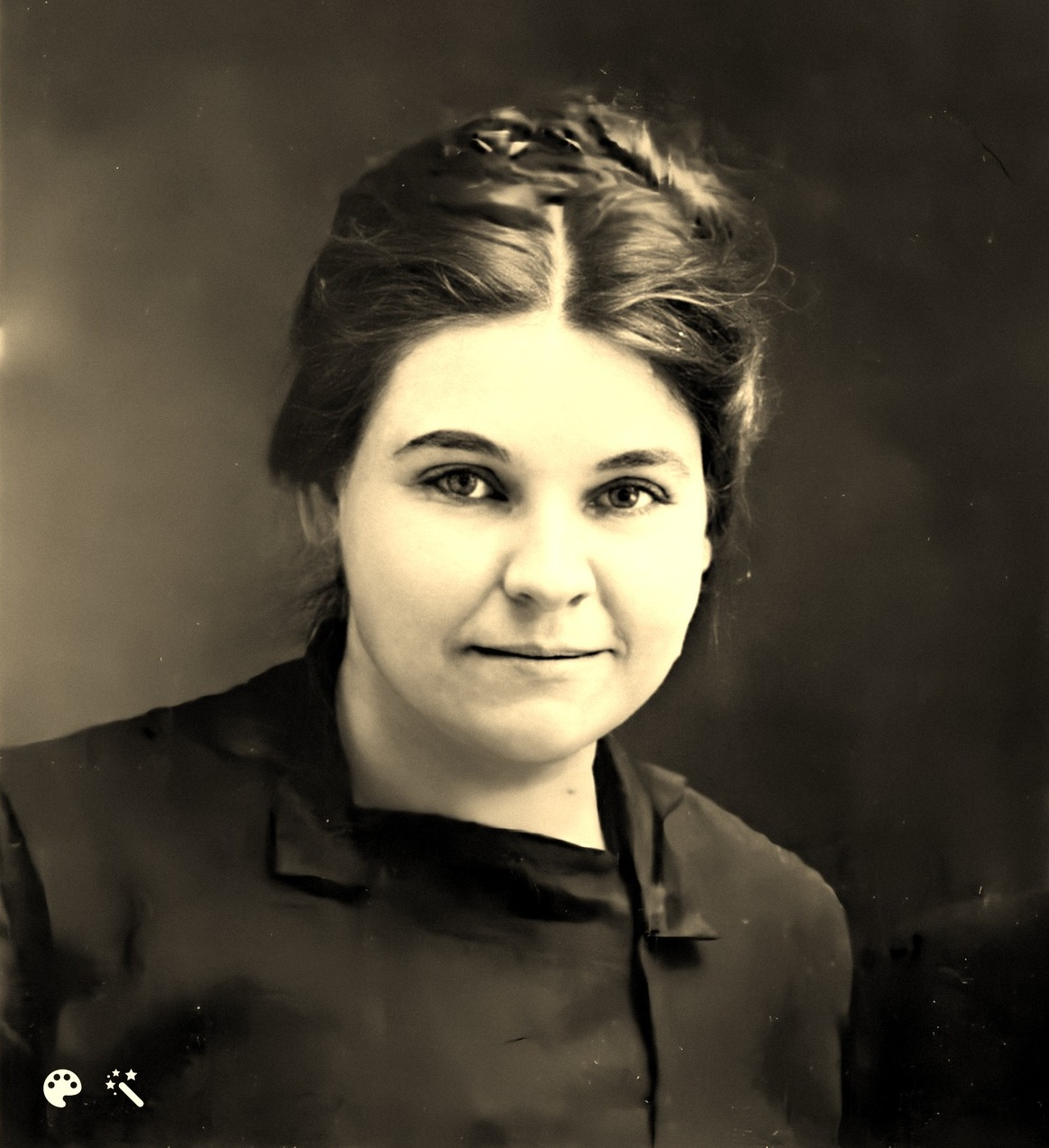
Since it has been suggested that I open my history bag and reveal its contents, I too think it might be well to do this before my memory fails me, so I cannot “tell it like it is.” It is said that the past makes the present, so I will refer to my knowledge of how I came to be here.
Through research, I learned that my Lester ancestors were of the family of the Earls of Lester, in England, but they left their country of England in 1764 to live in North Ireland on estates granted to them for military service by the King. In the early 1700’s they, with three hundred others, came to America and settled in what is now Washington County, New York. Many years later, my grandfather, David, moved to Sterling, New York. Here my father was born in 1849. In 1856, when seven years of age, his mother, Angelina, was widowed and left with small children. My father, David, was put in the care of someone and taken by boat down the Erie Canal to Troy, New York. There some relatives from Washington County met him and they drove sixty miles with horse and buggy to Argyle. There he worked with and for his uncle until in his teens, when he returned to some place around Oswego, New York. There he afterward married Angelia Shutts in March, 1869 and had two children; Abie, who died when an infant, and Simeon. Simeon grew to manhood and became prominent in YMCA work. David’s wife, Angelia Shutts, died soon after the baby died. His maternal grandmother, Grandma Shutts, took care of him until he grew up and married Lena Clute of Hannibal, New York, in 1873 when they were both in their teens.
And now, where do I come into the picture? My father, David William Lester, had a brother George, who lived in Oswego, New York. He had married a girl whose name was Mary Geisel. When David was about to marry his first wife, Angelia Shutts, in 1869, he went to Oswego to buy his wedding clothes. While there he called at his brother George’s home. George’s wife’s sister happened to be there too. When she learned that the young man was about to be married, she remarked, “I wish I was the one to get him.” She was only about thirteen, while he was eighteen. It was said in fun, but she kind of meant it too. This was Elizabeth Geisel, of whom much more will be said later.
After the death of David’s first wife, Angelia, on January 10, 1874, again it “happened” (or was it planned?) he was at his brother’s house but was now a widower. Elizabeth was there too. After a courtship, Elizabeth Geisel became the wife of David Lester on April 7, 1875 and later the mother of nine children: Nellie, Ida, Clara, Robert, Hattie, Leon, Bessie, Eva and Roy. I am one of those nine children, Bessie.
My mother’s parents, Ludwig and Mary Geisel, had both come from Germany to America early in the eighteenth century. Grandma came from Saxony and Grandpa from Hess. One story my mother told me that I never forgot was that when they came over to America, one of Grandma’s sisters died at sea. It was the custom then not to keep a dead body aboard the ship because sharks would follow the ship, so she, just a young girl, was buried in the waters of the ocean.
My German grandparents, Ludwig and Mary Fisher Geisel were married after coming to America and made their home in Oswego. My grandfather was what they called a millwright in those days. When the Civil War broke out he enlisted and was in the Army for three years; this, in spite of the fact that he left Germany because he didn’t believe in conscription, and also by this time he had several children.
Building in Albany several times and showed us the flag of the regiment in which he served, and the uniforms they wore. Later, after the war had ended, around 1864, the dread disease “quick consumption” or TB, as it is now called, invaded the family and all but three of the nine children and the father were under the sod in the old Riverside Cemetery in Oswego. My mother, Aunt Emma Williamson in Auburn and Uncle Frank Geisel in Oswego were all that remained. After my family had moved to Cohoes, New York, around 1890, and later to Lansingburgh, around 1901, each summer my mother took Eva, Roy and I, the three youngest, by train from Albany to Syracuse where we visited Aunt Emma at Auburn, Uncle Frank at Oswego and Aunt Kate, a great aunt, in the country near Syracuse, where we enjoyed going. On some of these trips we also visited my father’s brothers George and John Lester, who was a merchant in Oswego, and dear Aunt Betsy Rider, my father’s sister; also my cousin John Lester, who was train dispatcher in Syracuse New Central downtown railroad station.
Now returning to my family history. I wasn’t here yet when my parents, and the children they had then (Ida, Clara, Hattie, Rob and Leon) moved to Cohoes, New York from Oswego about 1890.
When I finish with this story, you may wonder why we moved so much. Common people had to work then and had to settle near their work. They had no autos, or buses, and not many trolley cars, so if you were not affluent enough to have a beautiful home and servants, you just had to use your own means of locomotion or move close to your work.
In 1890 or 1891, my father’s work took him to Eastern New York. By this time they had five children, mentioned before. One of their children, Nellie, had died sometime before this at eighteen months old. Four months before I was born (the seventh child) in 1893, Leon, the youngest, only three years old, had scarlet fever and died after three or four days’ illness. This was a very hard blow to my parents. I have heard them tell about the great recession and the hard times of 1893 in our country and to hear and read about that time reminds of our own day and time in which we live. All this made it much more difficult to have the death of one child take place so near the birth of another.
But, according to what I have heard, I received a joyous welcome on July 10, 1893 and I am glad of my heritage and that my parents had long ago given themselves to Christ and had served Him many years.
I was about two or three years old, around 1895, when we moved to Lee, Massachusetts. Although not very old then, many experiences there are clear in my mind. From our front window, I could see the train station and see them unload the baggage car. One day I saw a long, heavy box taken from the train and I asked my mother what was in that box. She explained, “It is a dead lady.” I asked, “What is a dead lady?” She answered, “It is a dead lady whom they have brought to Lee to bury her in the cemetery.” I was stunned. Soon after, I was missing. They searched everywhere to find me. Finally they found me under a tree some distance from home, crying. When I was questioned what I was doing there, and why my tears, all I could say was, “I don’t want to die. I don’t want to die.”
The Westinghouse summer home was out in the country nearby and on the Fourth of July they put on a celebration. I remember my mother pushing a baby carriage with my baby sister Eva in it and I walking beside, walking in deep dust, to go to the great celebration. This was around 1897.
There was an African Church in the town. The Sunday School Superintendent, Clifford Jetter, was a very nice fellow, at least I was fond of him, even if he wasn’t my color. I was then about three or three-and-a-half years old.
One day I really embarrassed my family greatly by taking Clifford’s hand in mine and saying, “Clifford, are you black like this all over?” Once they put on an entertainment in a hall. Clifford knew that I had learned some little pieces to speak and he asked my mother if she thought I would speak a piece on the program. My mother confessed later to having some misgivings but told him to ask me if I would. I gladly consented and spoke my piece before a colored audience without any fears.
In 1897 or 1898, my father’s work took him back to Cohoes again. Soon I was attending Sunday School in the primary class at the Methodist Church. I did enjoy this Sunday School so much. I attended there until I was eight years old and have many pleasant memories of those days. They thought I could sing so they had me sing some solos. I remember singing “I’ll Be a Sunbeam for Jesus” when about five years old, in 1898, on Easter Sunday in the large pulpit where the lilies stood so high I could hardly see over them.
The Spanish-American War was on about that time (1898). My oldest sister, Ida, was “keeping company” with a young man who fought in that war. One day, while playing outside, I saw a soldier come down the street. He wore a long grey coat with a cape on it and a small cap with cross-guns in the front. I knew him by his uniform. He was on furlough.
Sometime after this, where our back fence was the dividing line between our yard and the French Priest’s home, I could see through to the road in front of the house and I saw a beautiful carriage stop and a couple got out. The man had on a tall silk hat and long coat-tails. The lady was dressed in a ruffly black silk dress. I was excited and asked someone who they were. I was told that it was Teddy Roosevelt and his wife, come to visit the French Priest, who was her relative. Teddy Roosevelt was Governor of New York State at that time and of course lived at Albany and it wasn’t a very long drive from Albany to Cohoes.
Cohoes had many interesting features. Very large knitting mills had attracted many people from many different countries. There was a large Polish population who had built a Polish church. Many French people had settled there from Quebec and had built a French Catholic church. There was also a large Irish population and they had a very large Irish Catholic church. Most of the people had come to work in the knitting mills. They all lived and worked together. Many owned their own homes. I went to school and played with the children from these homes.
Another interesting thing was that there were so many waterways passing through such a small city. The Hudson River passed along the extreme eastern part, a branch of the Mohawk passed around what was termed The Island-part of the city. A few blocks farther uptown was the Erie Canal and farther up the hill, still in the city, was the Champlain Canal. Many times I have stood on the bridges and watched the canal boats on which people were living. These boats were being towed on the towpath by teams of strong horses walking or being driven by cursing canal men.
The Village of Lansingburgh was on the east bank of the Hudson, with a long bridge connecting it with Cohoes. All bridges on the Hudson, down to New York City, were toll bridges. In winter the river froze solid and people used to cross on the ice rather than pay two cents to walk across the bridge, even at night. There was a wooden covered bridge between Lansingburgh and Waterford, which the Dutch built. It was said that Washington once crossed there. In early 1900 I watched that bridge burn and fall into the river with six firemen on it. Some were injured, so had to go to the hospital.
On Labor Day, 1899, my mother and the younger children, Eva, Roy and I, visited some friends, the Barringers, in Lansingburgh. In the evening we started back to Cohoes. We had to wait on the corner for a trolley to cross the bridge. In summer the trolleys were open with seats running across and running boards on each side where we climbed up to the seats. We waited and waited until we were very tired and finally decided to walk across the bridge, as it wasn’t far to our house from the bridge.
We had only been home a few minutes when my older brother, Robert, who hadn’t been with us, rushed in out of breath and said, “Oh! Are you here?” My mother tried to quiet him down as he explained that there had been a terrible accident at the railroad crossing. The trolly we decided not to wait for had been rammed by a train at the crossing. The watchman, who was supposed to flag the trains was in the little house sound asleep and did not do his duty. My brother explained that he thought that we must have taken that trolley and he wildly searched for us and in doing so, he stepped on a dead body and then another. When he didn’t find us he hurried home and was excited to find us there. Five people were killed and twenty-five injured.
In the fall of 1901 when I was about eight years old, my family moved across the Hudson to what was then the Village of Lansingburgh but is now North Troy, New York. This whole area was steeped in American history. It was settled in those early times before there were any states, when the Hollanders had built manors up the Hudson from New York City. The Lansings had settled on the east of the Hudson, north of where the Mohawk River enters the Hudson. When we moved there, it was a quaint old burg. There were brickyards here and there, which accounted for whole streets paved with brick and houses, built next to the sidewalks with alleyways between, were all brick. Here I could study history without sitting in a classroom. So much had happened around there was recorded in the historic records. The district in which I lived had a very old school, the Comstock School, which I attended for five years, from third grade through the seventh, from 1901 to 1905. It was very different from today’s school. It was very old then. Grooves were worn deep into the wooden stairs. There were no halls. Each room went clear across the building and was entered or left through doors leading into the back of the next room. There was no water in the building, also no toilets. The building was two stories high and half a block long. When it warmed up in the spring, each room would have a pitcher and to quench their thirst, some boy was sent to a neighbor’s well for water. This, the teacher would pass around. We all drank out of the same cup, and I’m here yet to tell the story. There were “outhouses” and we had to raise our hands and receive permission to go “across the yard.” We had no gyms; hardly knew what the word meant, but a “physical culture” teacher came to our room once a week and taught us the “art” of touching the floor with our fingertips, standing first on one foot and then the other. One exercise we especially liked was stretching one arm forward from the shoulder and then the other, because that gave us a chance to give the one ahead of us a lot more than a pat on the shoulder.
Our teachers were real dyed-in-the-wool schoolmarms. Many of them ruled with a rod of iron or at least wood. A boy was passing out the writing books whose name was Willie Groesbeck. I had a bright idea and whispered to the girl ahead of me to say when he gave her her book, “Thank you, Groesbeck Willie,” right up good and loud and I would do the same. We carried it out with precision. And what did we get for it? Several whacks with a ruler from the teacher, Miss Comstock, in front of the whole class.
Way back before they had a graded public school, there was built what was called The Seminary, which was close by the grade school. The building is still standing, kept in good repair, and my only living sister, Eva Sandall, has an apartment there. When it was the Seminary, young people came there to school, who had no schools where they lived. It probably dates back into the 1700 era.
In our school we also had the “drawing teacher”, Miss Pickering. She awakened within me an interest in drawing and painting. I used to enjoy drawing faces with different shaped noses, lips, chins, foreheads, eyelids and hair. As a youngster, I could amuse myself a long time doing this.
While I was still in grade school, Old Home Week was held (about 1908) in Troy, New York. By this time Lansingburgh had been annexed to Troy. A contest with cash prizes was promoted in the schools of Troy by the Chamber of Commerce. The project for the grade schools was to draw a design for a pin, like the pins they used to wear at election time. The pin was to advertise the celebration. The high schools were to design a poster and the colleges, a post card.
At first I paid no attention to the offer but when I learned that a boy in my room, Robert Miter, was entering the contest and his mother told my mother she was sure he would win, I decided he wouldn’t and so went to work on it. One rule was to use only two colors. I thought, “White isn’t a color so I will use red, white and blue.” I decided to have the background blue. Troy was “The Collar City” of the world then. So in the center I put a collar, front view, and outlined it with red, leaving the collar white. In the center of the collar I drew a log cabin, also in red, which would emphasize the “Old Home.” On one side of the collar front I printed “Old Home Week,” on the other, “Troy, New York.” Around the edge I put “We welcome all, both great and small,” and at the bottom, the date; each in white on blue background. After some time of waiting, I was notified to be present at the meeting of the Chamber of Commerce and receive my prize of $10, which seemed like a lot of money then; also, my picture was in the paper. I opened my first bank account with that $10. Now in my later years, I still enjoy drawing and painting.
In that old Comstock school, I also got a good foundation for what music studies I have taken since. We had a wonderful teacher of vocal music, J.B. Shirley. He was a tall, blond Scotsman with blue eyes and a smile that we kids loved. He taught us the names of the lines and spaces, the names of the notes, time signatures, clefts, and had us write music when we were in third grade. He taught us to sing two-part harmony. I feel he had a great part in creating the love for music I have always had and have today. Each year we looked forward to the big celebration which was held on Decoration Day in Oakwood Cemetery which was about fifteen blocks long and probably that wide and which stood on a high hill overlooking several cities on the Hudson River. A large stand with several rows of seats was built across from the military plot. A platform with a roof was built on the plot where many notables were seated who came with the parade from the City of Troy and were led by Doring’s Military Band. Certain children were picked from the five grade schools to sing at this event. They were in the tiers of seats across from the soldiers’ plot. Of course J.B. Shirley, who had trained us, led us in our singing. Several songs were his own compositions. I was selected to sing with this group each year. I consider this one of the highlights in my life.
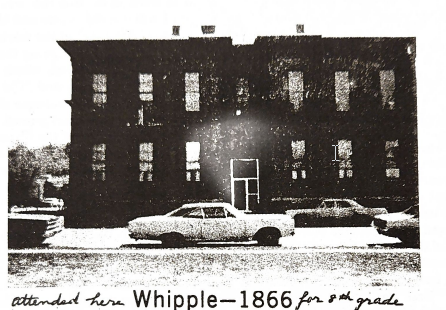
I attended Comstock School till I finished seventh grade, around 1907, then went to Whipple School which was much farther from my home. I liked my teacher here and never intended to make trouble for her but I guess I did sometimes. Her name was Miss Wands. Once when I was supposed to be studying, a poetical spirit seemed to be working in me and I began writing:
“Miss Wands is a lady that dresses in black, She wears a comb in her hair in the back, She’s always working from morning till night, Mending books so they will stick tight. She teaches the eighth grade in the Whipple School, In summer her room is nice and cool For she opens the windows and doors all around And the first thing you hear Is the barking of a hound.”
Then I started one about the girl across the aisle:
“Mildred Durant is tall and thin, She looks to me like a tall hat pin.”
I got that far, when I felt the teacher’s hand on my shoulder. She said, “Give me that paper and you do your work.” Out of the corner of my eye, I could see her reading it and I wondered what she would do to me, but I guessed that she decided to leave well enough alone. So I got by with that.
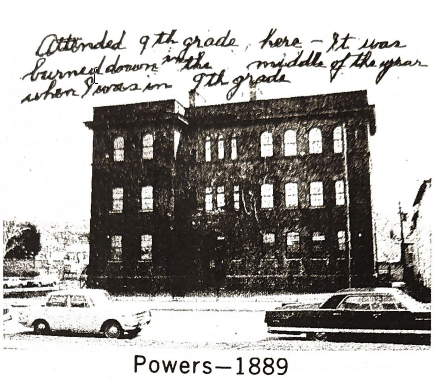
For ninth grade I was transferred to the Powers School. The one memory I have of that time was that one Friday I was caught talking. My name was written on the board to stay after school for punishment. I told the teacher I couldn’t stay because I had to take my music lesson after school. She said very decisively, “You’ll stay on Monday then.” Saturday night the bells began to ring and sure enough, our school was aflame all over. I went and stood with some of my classmates to watch it. In no time at all the whole building collapsed and tumbled to the ground. When I saw the walls and blackboard from my room go down from the second floor to the basement, I knew my name had gone down in history and I remarked, “I’ll never have to stay for that.”
Regent exams started on Monday. All who passed were allowed to go into high school in January instead of June. I passed, but I didn’t know what subjects to take as we could only take three, so I chose algebra, physiology and English.
In 1903, when I was about ten years old, my half-brother, Simeon, mentioned in the beginning of my story, had been YMCA Secretary at Rome, New York, but having accepted the position of Boy’s Work Director of the YMCA in Troy, New York, he moved to North Troy. He had one boy, Dale, one year younger than I was and about this time the second boy, Louis, arrived. He and his wife, Lena, had always wanted a girl and I, being many years younger than my brother and only one year older than his boy, they liked to have me with them and took me on many trips with them. I also helped take care of the baby, and did other odd jobs. Some time before, my folks had bought a piano and I was determined to take music lessons. My older sister, Hattie was already taking lessons and was working so she could pay for them. My brother, Simeon, began paying me for helping and I lined a few other jobs up so I earned my lessons from then on for six or seven years.
My brother, Simeon, held a businessmen’s banquet every Tuesday night at the Y. He got the bright idea that I should play the grand piano that was in the banquet hall while the men ate. Some of the “ritzy” women of the city used to be there, too, and they ate after the men. At my brother Simmie’s house they had a book on table etiquette and I spent much time studying it because of having to eat with those rich ladies. I was still doing this when I went into high school.
That was a time when some great changes came into my life that influenced all my future.