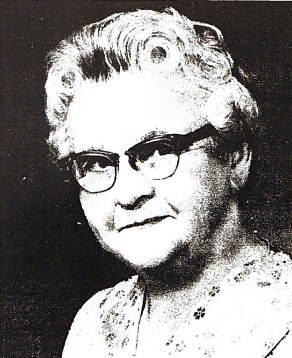
The Little Preacher from Troy: All Chapters
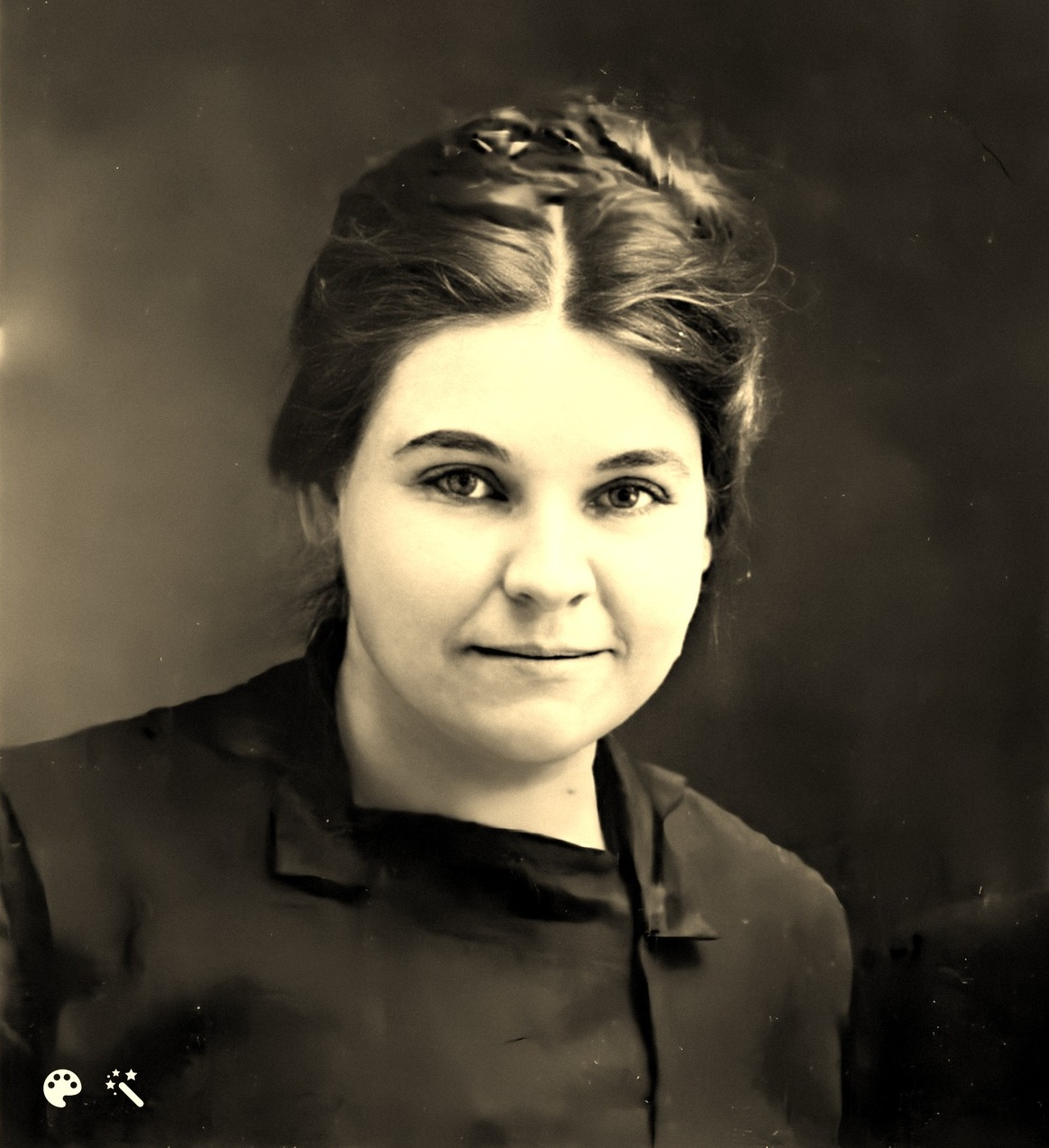
Chapter 1
Since it has been suggested that I open my history bag and reveal its contents, I too think it might be well to do this before my memory fails me, so I cannot “tell it like it is.” It is said that the past makes the present, so I will refer to my knowledge of how I came to be here.
Through research, I learned that my Lester ancestors were of the family of the Earls of Lester, in England, but they left their country of England in 1764 to live in North Ireland on estates granted to them for military service by the King. In the early 1700’s they, with three hundred others, came to America and settled in what is now Washington County, New York. Many years later, my grandfather, David, moved to Sterling, New York. Here my father was born in 1849. In 1856, when seven years of age, his mother, Angelina, was widowed and left with small children. My father, David, was put in the care of someone and taken by boat down the Erie Canal to Troy, New York. There some relatives from Washington County met him and they drove sixty miles with horse and buggy to Argyle. There he worked with and for his uncle until in his teens, when he returned to some place around Oswego, New York. There he afterward married Angelia Shutts in March, 1869 and had two children; Abie, who died when an infant, and Simeon. Simeon grew to manhood and became prominent in YMCA work. David’s wife, Angelia Shutts, died soon after the baby died. His maternal grandmother, Grandma Shutts, took care of him until he grew up and married Lena Clute of Hannibal, New York, in 1873 when they were both in their teens.
And now, where do I come into the picture? My father, David William Lester, had a brother George, who lived in Oswego, New York. He had married a girl whose name was Mary Geisel. When David was about to marry his first wife, Angelia Shutts, in 1869, he went to Oswego to buy his wedding clothes. While there he called at his brother George’s home. George’s wife’s sister happened to be there too. When she learned that the young man was about to be married, she remarked, “I wish I was the one to get him.” She was only about thirteen, while he was eighteen. It was said in fun, but she kind of meant it too. This was Elizabeth Geisel, of whom much more will be said later.
After the death of David’s first wife, Angelia, on January 10, 1874, again it “happened” (or was it planned?) he was at his brother’s house but was now a widower. Elizabeth was there too. After a courtship, Elizabeth Geisel became the wife of David Lester on April 7, 1875 and later the mother of nine children: Nellie, Ida, Clara, Robert, Hattie, Leon, Bessie, Eva and Roy. I am one of those nine children, Bessie.
My mother’s parents, Ludwig and Mary Geisel, had both come from Germany to America early in the eighteenth century. Grandma came from Saxony and Grandpa from Hess. One story my mother told me that I never forgot was that when they came over to America, one of Grandma’s sisters died at sea. It was the custom then not to keep a dead body aboard the ship because sharks would follow the ship, so she, just a young girl, was buried in the waters of the ocean.
My German grandparents, Ludwig and Mary Fisher Geisel were married after coming to America and made their home in Oswego. My grandfather was what they called a millwright in those days. When the Civil War broke out he enlisted and was in the Army for three years; this, in spite of the fact that he left Germany because he didn’t believe in conscription, and also by this time he had several children.
Building in Albany several times and showed us the flag of the regiment in which he served, and the uniforms they wore. Later, after the war had ended, around 1864, the dread disease “quick consumption” or TB, as it is now called, invaded the family and all but three of the nine children and the father were under the sod in the old Riverside Cemetery in Oswego. My mother, Aunt Emma Williamson in Auburn and Uncle Frank Geisel in Oswego were all that remained. After my family had moved to Cohoes, New York, around 1890, and later to Lansingburgh, around 1901, each summer my mother took Eva, Roy and I, the three youngest, by train from Albany to Syracuse where we visited Aunt Emma at Auburn, Uncle Frank at Oswego and Aunt Kate, a great aunt, in the country near Syracuse, where we enjoyed going. On some of these trips we also visited my father’s brothers George and John Lester, who was a merchant in Oswego, and dear Aunt Betsy Rider, my father’s sister; also my cousin John Lester, who was train dispatcher in Syracuse New Central downtown railroad station.
Now returning to my family history. I wasn’t here yet when my parents, and the children they had then (Ida, Clara, Hattie, Rob and Leon) moved to Cohoes, New York from Oswego about 1890.
When I finish with this story, you may wonder why we moved so much. Common people had to work then and had to settle near their work. They had no autos, or buses, and not many trolley cars, so if you were not affluent enough to have a beautiful home and servants, you just had to use your own means of locomotion or move close to your work.
In 1890 or 1891, my father’s work took him to Eastern New York. By this time they had five children, mentioned before. One of their children, Nellie, had died sometime before this at eighteen months old. Four months before I was born (the seventh child) in 1893, Leon, the youngest, only three years old, had scarlet fever and died after three or four days’ illness. This was a very hard blow to my parents. I have heard them tell about the great recession and the hard times of 1893 in our country and to hear and read about that time reminds of our own day and time in which we live. All this made it much more difficult to have the death of one child take place so near the birth of another.
But, according to what I have heard, I received a joyous welcome on July 10, 1893 and I am glad of my heritage and that my parents had long ago given themselves to Christ and had served Him many years.
I was about two or three years old, around 1895, when we moved to Lee, Massachusetts. Although not very old then, many experiences there are clear in my mind. From our front window, I could see the train station and see them unload the baggage car. One day I saw a long, heavy box taken from the train and I asked my mother what was in that box. She explained, “It is a dead lady.” I asked, “What is a dead lady?” She answered, “It is a dead lady whom they have brought to Lee to bury her in the cemetery.” I was stunned. Soon after, I was missing. They searched everywhere to find me. Finally they found me under a tree some distance from home, crying. When I was questioned what I was doing there, and why my tears, all I could say was, “I don’t want to die. I don’t want to die.”
The Westinghouse summer home was out in the country nearby and on the Fourth of July they put on a celebration. I remember my mother pushing a baby carriage with my baby sister Eva in it and I walking beside, walking in deep dust, to go to the great celebration. This was around 1897.
There was an African Church in the town. The Sunday School Superintendent, Clifford Jetter, was a very nice fellow, at least I was fond of him, even if he wasn’t my color. I was then about three or three-and-a-half years old.
One day I really embarrassed my family greatly by taking Clifford’s hand in mine and saying, “Clifford, are you black like this all over?” Once they put on an entertainment in a hall. Clifford knew that I had learned some little pieces to speak and he asked my mother if she thought I would speak a piece on the program. My mother confessed later to having some misgivings but told him to ask me if I would. I gladly consented and spoke my piece before a colored audience without any fears.
In 1897 or 1898, my father’s work took him back to Cohoes again. Soon I was attending Sunday School in the primary class at the Methodist Church. I did enjoy this Sunday School so much. I attended there until I was eight years old and have many pleasant memories of those days. They thought I could sing so they had me sing some solos. I remember singing “I’ll Be a Sunbeam for Jesus” when about five years old, in 1898, on Easter Sunday in the large pulpit where the lilies stood so high I could hardly see over them.
The Spanish-American War was on about that time (1898). My oldest sister, Ida, was “keeping company” with a young man who fought in that war. One day, while playing outside, I saw a soldier come down the street. He wore a long grey coat with a cape on it and a small cap with cross-guns in the front. I knew him by his uniform. He was on furlough.
Sometime after this, where our back fence was the dividing line between our yard and the French Priest’s home, I could see through to the road in front of the house and I saw a beautiful carriage stop and a couple got out. The man had on a tall silk hat and long coat-tails. The lady was dressed in a ruffly black silk dress. I was excited and asked someone who they were. I was told that it was Teddy Roosevelt and his wife, come to visit the French Priest, who was her relative. Teddy Roosevelt was Governor of New York State at that time and of course lived at Albany and it wasn’t a very long drive from Albany to Cohoes.
Cohoes had many interesting features. Very large knitting mills had attracted many people from many different countries. There was a large Polish population who had built a Polish church. Many French people had settled there from Quebec and had built a French Catholic church. There was also a large Irish population and they had a very large Irish Catholic church. Most of the people had come to work in the knitting mills. They all lived and worked together. Many owned their own homes. I went to school and played with the children from these homes.
Another interesting thing was that there were so many waterways passing through such a small city. The Hudson River passed along the extreme eastern part, a branch of the Mohawk passed around what was termed The Island-part of the city. A few blocks farther uptown was the Erie Canal and farther up the hill, still in the city, was the Champlain Canal. Many times I have stood on the bridges and watched the canal boats on which people were living. These boats were being towed on the towpath by teams of strong horses walking or being driven by cursing canal men.
The Village of Lansingburgh was on the east bank of the Hudson, with a long bridge connecting it with Cohoes. All bridges on the Hudson, down to New York City, were toll bridges. In winter the river froze solid and people used to cross on the ice rather than pay two cents to walk across the bridge, even at night. There was a wooden covered bridge between Lansingburgh and Waterford, which the Dutch built. It was said that Washington once crossed there. In early 1900 I watched that bridge burn and fall into the river with six firemen on it. Some were injured, so had to go to the hospital.
On Labor Day, 1899, my mother and the younger children, Eva, Roy and I, visited some friends, the Barringers, in Lansingburgh. In the evening we started back to Cohoes. We had to wait on the corner for a trolley to cross the bridge. In summer the trolleys were open with seats running across and running boards on each side where we climbed up to the seats. We waited and waited until we were very tired and finally decided to walk across the bridge, as it wasn’t far to our house from the bridge.
We had only been home a few minutes when my older brother, Robert, who hadn’t been with us, rushed in out of breath and said, “Oh! Are you here?” My mother tried to quiet him down as he explained that there had been a terrible accident at the railroad crossing. The trolly we decided not to wait for had been rammed by a train at the crossing. The watchman, who was supposed to flag the trains was in the little house sound asleep and did not do his duty. My brother explained that he thought that we must have taken that trolley and he wildly searched for us and in doing so, he stepped on a dead body and then another. When he didn’t find us he hurried home and was excited to find us there. Five people were killed and twenty-five injured.
In the fall of 1901 when I was about eight years old, my family moved across the Hudson to what was then the Village of Lansingburgh but is now North Troy, New York. This whole area was steeped in American history. It was settled in those early times before there were any states, when the Hollanders had built manors up the Hudson from New York City. The Lansings had settled on the east of the Hudson, north of where the Mohawk River enters the Hudson. When we moved there, it was a quaint old burg. There were brickyards here and there, which accounted for whole streets paved with brick and houses, built next to the sidewalks with alleyways between, were all brick. Here I could study history without sitting in a classroom. So much had happened around there was recorded in the historic records. The district in which I lived had a very old school, the Comstock School, which I attended for five years, from third grade through the seventh, from 1901 to 1905. It was very different from today’s school. It was very old then. Grooves were worn deep into the wooden stairs. There were no halls. Each room went clear across the building and was entered or left through doors leading into the back of the next room. There was no water in the building, also no toilets. The building was two stories high and half a block long. When it warmed up in the spring, each room would have a pitcher and to quench their thirst, some boy was sent to a neighbor’s well for water. This, the teacher would pass around. We all drank out of the same cup, and I’m here yet to tell the story. There were “outhouses” and we had to raise our hands and receive permission to go “across the yard.” We had no gyms; hardly knew what the word meant, but a “physical culture” teacher came to our room once a week and taught us the “art” of touching the floor with our fingertips, standing first on one foot and then the other. One exercise we especially liked was stretching one arm forward from the shoulder and then the other, because that gave us a chance to give the one ahead of us a lot more than a pat on the shoulder.
Our teachers were real dyed-in-the-wool schoolmarms. Many of them ruled with a rod of iron or at least wood. A boy was passing out the writing books whose name was Willie Groesbeck. I had a bright idea and whispered to the girl ahead of me to say when he gave her her book, “Thank you, Groesbeck Willie,” right up good and loud and I would do the same. We carried it out with precision. And what did we get for it? Several whacks with a ruler from the teacher, Miss Comstock, in front of the whole class.
Way back before they had a graded public school, there was built what was called The Seminary, which was close by the grade school. The building is still standing, kept in good repair, and my only living sister, Eva Sandall, has an apartment there. When it was the Seminary, young people came there to school, who had no schools where they lived. It probably dates back into the 1700 era.
In our school we also had the “drawing teacher”, Miss Pickering. She awakened within me an interest in drawing and painting. I used to enjoy drawing faces with different shaped noses, lips, chins, foreheads, eyelids and hair. As a youngster, I could amuse myself a long time doing this.
While I was still in grade school, Old Home Week was held (about 1908) in Troy, New York. By this time Lansingburgh had been annexed to Troy. A contest with cash prizes was promoted in the schools of Troy by the Chamber of Commerce. The project for the grade schools was to draw a design for a pin, like the pins they used to wear at election time. The pin was to advertise the celebration. The high schools were to design a poster and the colleges, a post card.
At first I paid no attention to the offer but when I learned that a boy in my room, Robert Miter, was entering the contest and his mother told my mother she was sure he would win, I decided he wouldn’t and so went to work on it. One rule was to use only two colors. I thought, “White isn’t a color so I will use red, white and blue.” I decided to have the background blue. Troy was “The Collar City” of the world then. So in the center I put a collar, front view, and outlined it with red, leaving the collar white. In the center of the collar I drew a log cabin, also in red, which would emphasize the “Old Home.” On one side of the collar front I printed “Old Home Week,” on the other, “Troy, New York.” Around the edge I put “We welcome all, both great and small,” and at the bottom, the date; each in white on blue background. After some time of waiting, I was notified to be present at the meeting of the Chamber of Commerce and receive my prize of $10, which seemed like a lot of money then; also, my picture was in the paper. I opened my first bank account with that $10. Now in my later years, I still enjoy drawing and painting.
In that old Comstock school, I also got a good foundation for what music studies I have taken since. We had a wonderful teacher of vocal music, J.B. Shirley. He was a tall, blond Scotsman with blue eyes and a smile that we kids loved. He taught us the names of the lines and spaces, the names of the notes, time signatures, clefts, and had us write music when we were in third grade. He taught us to sing two-part harmony. I feel he had a great part in creating the love for music I have always had and have today. Each year we looked forward to the big celebration which was held on Decoration Day in Oakwood Cemetery which was about fifteen blocks long and probably that wide and which stood on a high hill overlooking several cities on the Hudson River. A large stand with several rows of seats was built across from the military plot. A platform with a roof was built on the plot where many notables were seated who came with the parade from the City of Troy and were led by Doring’s Military Band. Certain children were picked from the five grade schools to sing at this event. They were in the tiers of seats across from the soldiers’ plot. Of course J.B. Shirley, who had trained us, led us in our singing. Several songs were his own compositions. I was selected to sing with this group each year. I consider this one of the highlights in my life.
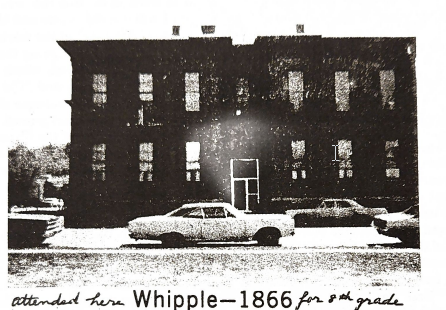
I attended Comstock School till I finished seventh grade, around 1907, then went to Whipple School which was much farther from my home. I liked my teacher here and never intended to make trouble for her but I guess I did sometimes. Her name was Miss Wands. Once when I was supposed to be studying, a poetical spirit seemed to be working in me and I began writing:
“Miss Wands is a lady that dresses in black, She wears a comb in her hair in the back, She’s always working from morning till night, Mending books so they will stick tight. She teaches the eighth grade in the Whipple School, In summer her room is nice and cool For she opens the windows and doors all around And the first thing you hear Is the barking of a hound.”
Then I started one about the girl across the aisle:
“Mildred Durant is tall and thin, She looks to me like a tall hat pin.”
I got that far, when I felt the teacher’s hand on my shoulder. She said, “Give me that paper and you do your work.” Out of the corner of my eye, I could see her reading it and I wondered what she would do to me, but I guessed that she decided to leave well enough alone. So I got by with that.
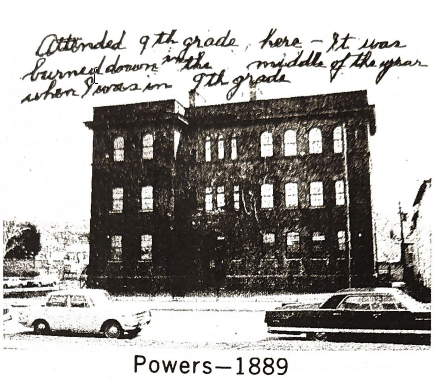
For ninth grade I was transferred to the Powers School. The one memory I have of that time was that one Friday I was caught talking. My name was written on the board to stay after school for punishment. I told the teacher I couldn’t stay because I had to take my music lesson after school. She said very decisively, “You’ll stay on Monday then.” Saturday night the bells began to ring and sure enough, our school was aflame all over. I went and stood with some of my classmates to watch it. In no time at all the whole building collapsed and tumbled to the ground. When I saw the walls and blackboard from my room go down from the second floor to the basement, I knew my name had gone down in history and I remarked, “I’ll never have to stay for that.”
Regent exams started on Monday. All who passed were allowed to go into high school in January instead of June. I passed, but I didn’t know what subjects to take as we could only take three, so I chose algebra, physiology and English.
In 1903, when I was about ten years old, my half-brother, Simeon, mentioned in the beginning of my story, had been YMCA Secretary at Rome, New York, but having accepted the position of Boy’s Work Director of the YMCA in Troy, New York, he moved to North Troy. He had one boy, Dale, one year younger than I was and about this time the second boy, Louis, arrived. He and his wife, Lena, had always wanted a girl and I, being many years younger than my brother and only one year older than his boy, they liked to have me with them and took me on many trips with them. I also helped take care of the baby, and did other odd jobs. Some time before, my folks had bought a piano and I was determined to take music lessons. My older sister, Hattie was already taking lessons and was working so she could pay for them. My brother, Simeon, began paying me for helping and I lined a few other jobs up so I earned my lessons from then on for six or seven years.
My brother, Simeon, held a businessmen’s banquet every Tuesday night at the Y. He got the bright idea that I should play the grand piano that was in the banquet hall while the men ate. Some of the “ritzy” women of the city used to be there, too, and they ate after the men. At my brother Simmie’s house they had a book on table etiquette and I spent much time studying it because of having to eat with those rich ladies. I was still doing this when I went into high school.
That was a time when some great changes came into my life that influenced all my future.
Chapter 2
When we first moved to Lansingburgh, in 1901 when I was eight years old, I went to the Methodist Sunday School. Each summer they had an excursion. All went well for a while until one Sunday they were giving each child a pack of tickets. Each Christmas a wealthy brewer, Bolton’s Brewery, bought gifts for the children of the Sunday School. The tickets were for a church supper, entertainment or something. My parents never believed the church should raise money that way, but people should give their money willingly without expecting something in return. This time I told them I didn’t want to sell tickets. When the Superintendent, Miss Weaver, heard that, before the large Sunday School she said, “Some children here are ready to go on free excursions and get presents at Christmas time, but they are not willing to do their part.” My pride was wounded. I declared I would never go there to Sunday School again or accept anything from them. I had a playmate, Blanche Van Bleck, who went to the Baptist Sunday School. She consoled me and said to come with her to their Sunday School and I’d never have to sell tickets. So that was when I switched to the Baptist Church. This was around 1902 or 1903. At about the same time our school burned, which has been mentioned before, revival meetings were started in Millis Memorial Baptist Church of North Troy, New York. This was about January of 1914. Two fine young ladies, Mae Lindsey and Ruth Talbot, were the evangelists. One did the preaching; the other led the chorus choir. They created quite a stir. It seemed everyone was attending, from the other churches and even those who paid no attention to religion. Some of my own family, my mother, Hattie, Roy, Eva, Clara and her husband Lew Grandjean were going every night. My older sister, Hattie, even joined the choir and some friends who worked with her also joined. I became curious to know what the attraction was and finally joined the chorus choir too. I went for a week and it seemed when the invitation was given, I was a target. By sunday, I so felt my need of Christ, of whom they preached and sang, that I really prayed for God to help me to become an inquirer that day or night. The invitation to come to Christ had been given that night but it seemed a power, other than my own, resisted. The inquirers had been taken into another room; others were dismissed. Downhearted, I went to the choir room to get my coat. A timid, elderly lady by the name of Miss Wiltsey was there, too. She said, “Bessie, are you a Christian?” I said, “No.” She asked, “Wouldn’t you like to be?” I said, “Yes.” She then invited me to go where the others were praying. When I got there, I dropped on my knees and wept, asking God to forgive my sins and receive me as His child and come into my heart. Right then I knew I was saved, forgiven and happy. Then a certain feeling, or call it what you will, came, and it seemed as if the Lord was telling me that I was not to make music my career, because He wanted me to be an evangelist and witness for Him. As things worked out, the very next night I was asked to take over at the piano and accompany the choir and congregation with the singing. The meetings were every night for several weeks except Saturday and I played each night. Soon after, when the special meetings closed, I was immersed and joined that church. During that time, I was just beginning my studies at the old Lansingburgh Academy but I was not there long.
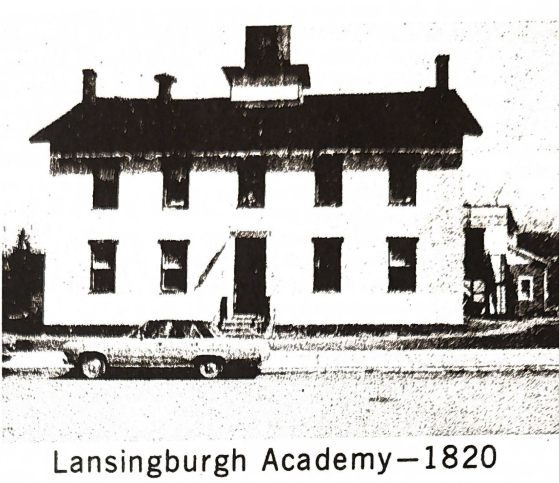
I sang in the church choir and four of us held a meeting in a mission one night a week. One would play, one sing solos or lead the singing and we took turns as speaker of the evening. Later classes were arranged at the County Orphan Asylum for the teen-age girls and once a week I had a class of them to teach. I played the piano at church and later my brother Simmie, under the YMCA, arranged for chapel services for all the orphans on Sunday afternoon at the Rensselaer County Orphan Asylum. He worked me into playing the pipe organ for that service. I would go there Wednesday nights and the matron, being an organist, gave me instruction. I began about that time to be called upon to speak at churches and chapels when I was about fifteen. This was about 1908. One Sunday in the Baptist Church of which I was a member, a lady, Miss Lena Rentz, who was assistant superintendent of quite a large collar factory, came to me and asked if I would like to work for her and offered me $6.00 a week, which was what most office help were receiving then. I jumped at the chance. I worked there for some time and really enjoyed it. My work was mostly desk work. But she bought a place in Florida and a man took her place. He was a quiet man but sometimes he smelled so strongly of liquor, I could hardly stay near the desk and some days he didn’t show up for work at all. Finally I found another job running machines, making men’s collars running things up on the wrong side of the material. It being piece work, I could make $12.00 or $13.00 a week, which seemed a lot then. I worked there till I went into evangelistic work when I was eighteen. This was a great turning point in my life. During late summer of that year of 1911, I attended the Annual Conference of the Free Methodist Church at Saratoga, New York. My mother had, with my father, been a charter member of the same church when it was organized by Bishop B.T. Roberts. There was no church of that denomination in the area where we lived, so she was a member at Saratoga. Another elderly lady, Martha Roberts, from Troy, introduced me to one of the District Superintendents as “The Little Preacher from Troy.” The District Superintendent, Rev. H.L. Crockett, asked me if I had done some preaching. Later, he came and asked if I would be willing to go out with some other young people to hold some meetings on his district. I replied that I would be willing but I didn’t know how my parents would feel about it. He took my name and address. I thought that probably nothing would come of it and went back home to my old job. One day in October of 1911 when I came in from work, my mother handed me a letter which had been opened. It gave me a shock when I read it. It was from a minister, Rev. G.B. Lane, who was pastor of a church at Clarenceville, Quebec, Canada — south of Montreal. He said they had an elderly lady, Miss Woodbury, from the Methodist Conference there and she felt the need of someone to assist with preaching, prayer groups and singing and he had heard of me through the Superintendent. He also asked that I should send word if I would come and plan to come by the Next Tuesday. This was Thursday, so I had to make a quick decision. I knew my mother would dread to have me leave and go so far from home to strangers I had never seen before. I was just eighteen. My father was anxious for me to go because he thought it was God’s plan for my life, unfolding. We sent a letter asking that they let me know who would meet me and how I would know them and saying I would take the train that left Troy at 2:00 P.M. and would arrive there at 8:00 P.M. Tuesday arrived soon. We waited for the mailman but he brought no word. It was 11:00 A.M. I was to leave downtown at 2:00 P.M. It was an anxious time. My mother sent me out to my father’s shop to learn how he felt about it. He said, “Just go ahead as you planned and you will be all right. I am convinced that this is God’s plan and He will take care of everything.” So my mother and I walked several blocks with my suitcases and boarded the trolley to the city. She put me on the train and bid me good-bye and I was off. It was a dark, gloomy October afternoon in 1911 and it seemed a long distance. After we left Burlington, Vermont, I noticed I could see the train lights flickering in a wide expanse of water on both sides of the train. I sure was frightened but learned that the tracks were on a trestle that was built through Lake Champlain. Later, I heard a man talking to a woman back of me, asking where she lived, her name and where she was going and all sorts of questions. I thought how foolish she was to tell a stranger all her business: I knew better than that. It was not long before he was standing beside my seat and asking me the same questions. He had on a uniform, and I soon learned he was the Customs Officer. It hadn’t occurred to me that I was crossing the line between the United States and Canada. After riding considerably farther, the train stopped at the town of Clarenceville. I had wondered if anyone would meet me or how I would know them. My fears were in vain. When I stepped down from the train to the platform, a man wearing a fur coat and hat came directly to me, asked if I was Bessie Lester and introduced himself as Rev. G.B. Lane, who had sent the letter. By the time he had received my request I had mailed, he said it was too late to get an answer to me before Tuesday. So he was doing as we were doing, praying it would work out all right. I was there eight weeks, from late October until late December, with prayer meetings afternoons and preaching at night. The pastor’s home was a delight to be in. Never a cross word was heard, family devotions were held each morning and each child took part in the reading of the scripture and prayer. Around the table after the evening meal, the parents prayed. Most people of that area were French, but around Clarenceville were many English people and there were several Protestant churches. While there at Clarenceville, I received a letter from the Superintendent, Rev. G.L. Skinner, of the Northern New York District asking me to work on his district all the next summer with a group of young people. Also, I was asked to go to Gouveneur, New York right after Christmas, which I did. The pastor’s wife, Mrs. Rowley, expected a baby before I would arrive, but it didn’t happen in time so it was arranged for me to hold meetings at another place on that circuit. For five weeks I was there in that north country and I knew what winter was. Part of the time I held meetings in a little schoolhouse. Each night, Mrs. Streeter, the lady I was staying with, and I would walk a mile to the schoolhouse through the deep snow and a very low temperature, for about three weeks. We had to do everything such as carrying in wood, starting the fires, lighting the lamps. I preached each night, sang solos, led the group who were there in singing. Then came the long walk home again. I would be hungry and she would set out all the milk I could drink, homemade friedcakes, homemade bread. The Streeters had a big dairy, so we had lots of milk and cream; they kept pigs, so we had ham, fried pork and bacon. Having lived in cities most of my life and paying high prices for such things, we just didn’t eat that way. When I left there, I had gained twenty-five pounds in five weeks. After I had held the meetings in the schoolhouse, then we had meetings in the church on that end of the circuit for another two weeks. It was called The California Church. From there, in early February, I went to Norwood for a time. A young couple, Rev. and Mrs. John Hessler, were the pastors there and expecting their first child. I could never forget the sweetness and dedication of this couple. She was a graduate nurse with a good salary in a Utica hospital; her husband was a graduate of Cornell University, but to promote the kingdom of God, they had “left all to follow Jesus.” I always remembered a remark she made when she took me to the room I would occupy while I was there. She had fixed a couple crates with pretty curtains around and a board on top to look like a dresser, and hung a mirror above it. Besides this, there was and change from our work in the band. Our next meeting with our group was at Massena, New York in August of 1912. A furnished house had been rented for our use while there. A large tent was put up on the lawn of an unoccupied public school. There we took turns with everything. The girls, Ethel Skelton, Anna Belle, Lillie Dolan and I, took turns getting the meals and housework, also some called afternoons while others preached at the evening service. In our rented house there was a very nice piano which we enjoyed playing and singing with its accompaniment. One hot morning when Lillie and I had to get the breakfast we found a pound of lard in the pantry all melted in a bowl. We had no refrigeration. I still had quite a lot of mischief left in me. I suggested to Lillie that when breakfast was placed on the table that dish would be there, as if it belonged there. We called the folks, including Rev. John Hessler from our church in Norwood, who had remained overnight. As they were seated and began passing things, Rev. Skelton asked if what was in the dish was a new kind of breakfast food. He said, “I’m going to try it.” We tried to stop him but he had put a spoonful into his mouth already. Well, we had a good laugh and they all enjoyed the joke. There were many things about that meeting in Massena that I still remember. There was the night a man selling medicine got the street corner assigned to us, so we took the opposite corner. A moving congregation shifted from one corner to the other, trying to digest what was being said on one corner about healing for the body, and on the other corner, about healing for the soul. The man selling healing of the body was the famous Rattlesnake Pete; he sold an oil which was supposed to cure most anything. It was called Rattlesnake Oil. Or, there was the woman we met in our house-to-house calling. She lived upstairs. When we knocked she called to us to come up. We invited her to come to the meeting that night. She said yes, she had heard about the meeting and now, as her old man was dead, she would be free to go. I doubted her intentions, but sure enough, she walked into the tent that night, clear down to the second seat. She looked as if she had just come out of an 1864 pattern book. I sort of watched her during the preaching to see how the gospel was taking effect. When the altar call was given, I went down to her and asked her if she would like to come up to the altar and pray. She said, “Yes,” and started ahead of me. To my utter amazement, instead of kneeling on the outside of the altar, she stepped inside and up on the platform with the other workers, facing the audience. In desperation, I said, “Sister, get down there and pray.” She stepped down and knelt up straight and faced the audience. By that time I didn’t know what more to do. From that time the others of my group called her my convert. We learned that she was a well-known character on the streets of Massena. After that meeting closed, the last of August, 1912, we went to Watertown, where meetings were held in a large tent. Children’s meetings were held afternoons. Those who were not involved called in the homes. Shop meetings were held during noonhour in some of the large plants, street meetings were held on the corners in the business sections, before services in the tent evenings. It was a busy life we lived. Annual Conference was held at Camden, New York, about September 1. Rev. Skelton was assigned to his first circuit. Anna Belle and I were sent as pastors to Massena and Long Sault Island, which is now almost buried in the St. Lawrence Seaway; it was about six miles from Massena. Some well-to-do members of our church, the Cobanes, were desirous of having a church on the island. They, with funds from the Conference, stood by us financially. We found a pleasant furnished apartment in town and had the use of a large room in what had been the public school. A new school had been built in its stead. On Sundays we held meetings in Massena and on Long Sault Island Wednesdays.
We had no transportation, only walking. Wednesdays we would leave Massena, after noon lunch, and walk four miles till we reached the St. Lawrence River, then walk beside the river two miles more. There we would stop at the home of an elderly couple, Mr. and Mrs. Sutton. He was Mrs. Cobane’s father and knew the St. Lawrence well. He would take us in a rowboat to Long Sault Island. It was close to the Long Sault Rapids (something like the current above Niagara Falls). He had to row upstream a mile to land opposite to where we started from. We would get out of the boat and walk two miles farther cross-lots to reach the Cobane home where we always stayed when on the island. We reached there about suppertime. After the meal we would drive two miles to the schoolhouse, where most of the people of the island would gather for the service. We alternated with the preaching and I led the singing and sang solos because Anna Belle didn’t sing.
Sometimes we went back the next day to Massena the same way we had come. Other times, if Cobanes had to drive to Massena, we would ride in the buggy to the landing, then we boarded a scow. They would drive the horse and buggy onto the scow, and row it across to main shore. Sometimes we stayed in the buggy and sometimes we got out and stood beside the buggy while crossing. When we reached the U.S. shore we would drive the other six miles to Massena. We did this until January, 1913, when the ice started floating in the river. This made it very dangerous to cross. We were given permission to leave and come back in May to finish out the conference year.
We had had a standing invitation to hold meetings in Binghamton, New York so we took that time to go. We did enjoy it very much there. It was one of our larger churches and we made some lifelong friends there. We went through the Endicott-Johnson Shoe Factory, the Binghamton State Hospital and many other interesting places.
When we left there, we separated for a time. I had a standing invitation to come to Charlottsville, near Albany, and Anna Belle had an invitation to go to Weedsport. After I left Charlottsville, I went home for a short visit and while there was hemmed in by one of the worst floods the Hudson had ever had. The water was up to the floor of the bridges and up to the second stories of some houses. Many were taken from their homes in rowboats; some from the second floor. It didn’t affect my folks too badly, as they were far enough from the river, but we couldn’t go far from our houses.
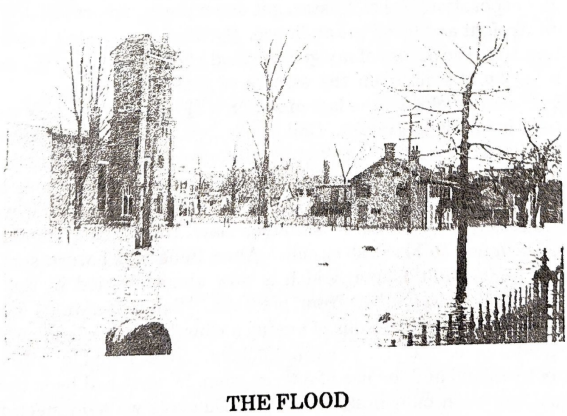 In May of 1913, Anna Belle and I went back to Massena and were there until August, the time of Conference. After that we were together for five or six years in evangelistic work.
We each tried to visit our families at Christmas time, and in early spring and a short time after Conference in the fall. Anna Belle’s parents had a beautiful home in East Williamson. There were six girls in their family; two were married; those at home were Sadie, Anna Belle (when she was not out in evangelistic work), Ida and Bessie. There were no boys in the family. Her mother used to say she wished they had a son so I could become a member of the family. I was always welcomed there whenever we stopped for a few days in our busy schedule. The mother always treated me as if I was one of the family.
During the time we were together, we visited many churches and camps. It would be interesting to know of some of our experiences during those years while we spent weeks in many of them but it would take too much time to write about them all. During that time we took part with preaching, singing, counseling at camps, and in town and cities and villages. Just to mention some: Syracuse, North Chittenango, Oneida, Rome, Utica, Herkimer, Scotch Bush in the Adirondacks, Alton, East Williamson, Binghamton, Norwich, Cortland, Corning, Caton, Northville, Wellstown, Saranac Lake, Ransomville, Akron, Tonawanda and many other places.
We were at North Chittenango for a six-weeks meeting the winter of 1914. The next winter the pastor, Rev. Oren Fero, had to leave because his wife was ill and had to go to a different climate. The District Superintendent, Rev. W.H. Clark, with the Official Board’s sanction asked us to go there and finish out the year. That meant living in the parsonage and keeping house. We enjoyed being there for that summer but supposed we would be going on in our regular field after Conference.
In May of 1913, Anna Belle and I went back to Massena and were there until August, the time of Conference. After that we were together for five or six years in evangelistic work.
We each tried to visit our families at Christmas time, and in early spring and a short time after Conference in the fall. Anna Belle’s parents had a beautiful home in East Williamson. There were six girls in their family; two were married; those at home were Sadie, Anna Belle (when she was not out in evangelistic work), Ida and Bessie. There were no boys in the family. Her mother used to say she wished they had a son so I could become a member of the family. I was always welcomed there whenever we stopped for a few days in our busy schedule. The mother always treated me as if I was one of the family.
During the time we were together, we visited many churches and camps. It would be interesting to know of some of our experiences during those years while we spent weeks in many of them but it would take too much time to write about them all. During that time we took part with preaching, singing, counseling at camps, and in town and cities and villages. Just to mention some: Syracuse, North Chittenango, Oneida, Rome, Utica, Herkimer, Scotch Bush in the Adirondacks, Alton, East Williamson, Binghamton, Norwich, Cortland, Corning, Caton, Northville, Wellstown, Saranac Lake, Ransomville, Akron, Tonawanda and many other places.
We were at North Chittenango for a six-weeks meeting the winter of 1914. The next winter the pastor, Rev. Oren Fero, had to leave because his wife was ill and had to go to a different climate. The District Superintendent, Rev. W.H. Clark, with the Official Board’s sanction asked us to go there and finish out the year. That meant living in the parsonage and keeping house. We enjoyed being there for that summer but supposed we would be going on in our regular field after Conference.
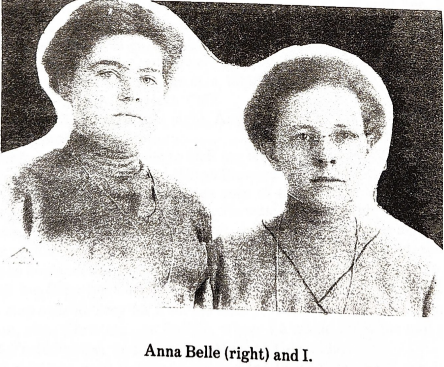 The Board asked Conference to send us back for the next year, and that was done. We were there from September of 1915 to September, 1916. So much was packed into that year. We had to preside at the board meetings, visit the homes; especially the shut-ins and the ill. We alternated with the preaching, both morning and evening services on Sunday. The church was usually filled for we were the only church in the community. We each taught a Sunday School class. Anna Belle taught the young people’s class and I had the adult class of about thirty members.
I remarked to someone that it seemed strange that so many died that year. We conducted five funeral services, largely-attended ones of prominent people, held in the church for three of them and two at the homes. Besides, I sang in quartettes at some of the funerals. I still have many wonderful memories of that place and have friends still attending church that were there at that time. I sometimes visit there and have spoken in their nice new church building.
While at Chittenango the men of the church used to cut up railroad ties for us to burn in our stoves. We were to leave for Conference on Monday before September 1st, at the end of the Conference year in August. My sister, Eva, was with us and for some reason we went into the woodshed. There we saw a large chunk of wood that hadn’t been split yet, so Anna Belle said she was going to split it to burn it all before we left. (We didn’t expect to be sent there for the next year.) She hacked at it but couldn’t make a dent in it. I said, “Give me that axe. I’ll show you how to do it.” I lifted the axe high above my head and when it came down, it hit that block on a corner and it flew up and hit me in the face, just under my eye. You can imagine how I was stunned and the nice black eye I had to wear to Conference two days later. On the train going from Syracuse to Binghamton, I overheard people’s remarks about me and they were wondering how I got it. One day they arranged all the preachers on the front steps of the church, forty-six of them, to take a Conference picture. I was not there. Someone asked where I was. Another said they had seen me go into the church. Someone was sent to find me. I was hiding in a small back room because I didn’t want to be in the picture with that black eye. They opened an aisle down the steps and placed me next to Bishop Pearce (for whom Pearce Memorial Church at North Chili, New York is named). That surely was not my “proudest moment.”
The Board asked Conference to send us back for the next year, and that was done. We were there from September of 1915 to September, 1916. So much was packed into that year. We had to preside at the board meetings, visit the homes; especially the shut-ins and the ill. We alternated with the preaching, both morning and evening services on Sunday. The church was usually filled for we were the only church in the community. We each taught a Sunday School class. Anna Belle taught the young people’s class and I had the adult class of about thirty members.
I remarked to someone that it seemed strange that so many died that year. We conducted five funeral services, largely-attended ones of prominent people, held in the church for three of them and two at the homes. Besides, I sang in quartettes at some of the funerals. I still have many wonderful memories of that place and have friends still attending church that were there at that time. I sometimes visit there and have spoken in their nice new church building.
While at Chittenango the men of the church used to cut up railroad ties for us to burn in our stoves. We were to leave for Conference on Monday before September 1st, at the end of the Conference year in August. My sister, Eva, was with us and for some reason we went into the woodshed. There we saw a large chunk of wood that hadn’t been split yet, so Anna Belle said she was going to split it to burn it all before we left. (We didn’t expect to be sent there for the next year.) She hacked at it but couldn’t make a dent in it. I said, “Give me that axe. I’ll show you how to do it.” I lifted the axe high above my head and when it came down, it hit that block on a corner and it flew up and hit me in the face, just under my eye. You can imagine how I was stunned and the nice black eye I had to wear to Conference two days later. On the train going from Syracuse to Binghamton, I overheard people’s remarks about me and they were wondering how I got it. One day they arranged all the preachers on the front steps of the church, forty-six of them, to take a Conference picture. I was not there. Someone asked where I was. Another said they had seen me go into the church. Someone was sent to find me. I was hiding in a small back room because I didn’t want to be in the picture with that black eye. They opened an aisle down the steps and placed me next to Bishop Pearce (for whom Pearce Memorial Church at North Chili, New York is named). That surely was not my “proudest moment.”
Chapter 3
It was at that same Conference I received an annual Conference Evangelist’s License. At this same Conference, I met the delegate from Clarenceville, Quebec, a young man named Clarence Hawley. I asked if he knew who would be their next preacher. He said a young man from Buffalo, New York was expected to come. He said he had graduated from Buffalo State Teacher’s College and had been teaching in Buffalo but now felt he should enter the ministry.
Later on in the next year, 1916, we held meetings in Burlington, Vermont. We heard more there about the young man from Buffalo. The preacher, Rev. W.E. Sitzer, kept trying to work on our sympathies by picturing him as “the lonely young man,” so far from his home and trying to keep house in the parsonage at Clarenceville. He thought he needed a companion and housekeeper, and we ought to have compassion for him and one of us help him out. We went about our work and forgot about him. The next Conference, in September, 1917, was at Watertown, New York. Here we saw this young man for the first time. His delegate was a young man, Clarence Hawley, from that circuit whom I had known at Clarenceville a few years before, mentioned earlier. He seemed to take a liking to Anna Belle and the first night asked to “see her home.” I had to tag along, because of course Anna Belle and I stayed together at the same place. When we were alone in our room, she asked if I had met Professor Blowers. I said, “No.” She said, “Oh, I did.” The next day, I was introduced to him. Between the services on Saturday night everyone was going to a restaurant to eat. Anna Belle’s admirer asked her to go; the young man from Buffalo, Rev. Milton Clarence Blowers, asked me to go. Because she hesitated so long between two opinions, and I had never gone anywhere or done anything without her, I thought I had to wait to give my consent until she gave hers. But the “young man from Buffalo” left. Then she consented to go. That left me to tag along alone with Clarence and Anna Belle. At the restaurant, when we were seated, I looked around and way across the room the man from Buffalo sat at a table facing me, with his cousin, Charles Blowers, a young man from North Chili.
When we reached our room that night, Anna Belle said, “You don’t need to try to get him. He has another girl.”
After Conference, I went home to visit my folks in September, 1917. I kept feeling ashamed for the way I had treated Milton Blowers. Finally, I felt I should apologize for what had happened and wrote a short note of explanation and apology.
In a few days, I had a letter from him. He was going through Troy, my home town, when he went home for Christmas and asked if he could stop over at Troy so he could get better acquainted and he could meet my family. As it happened, the next place I was going to hold meetings was Gowanda, near Buffalo. He was going to Franklinville to be with his folks for Christmas of 1917.
He did stop over at Troy for a couple of days, then went on. But I was supposed to go by train, after Christmas, to Buffalo, where he would meet me and go to meet his family at Franklinville, and go from there to Gowanda.
He had relatives near Gowanda, so decided to go there with me and stay at his relatives’ and attend the meetings over Sunday, on January 2, 1918, because Monday he had to leave for Canada and we might not see each other till the next August. During this time, while I was staying at his house in Franklinville, he asked me to marry him. I consented but we set no date. When we reached Gowanda late in the day, he found his relatives, where he had intended to stay, had left town for the weekend. So he had no place to stay and no way to get back to Franklinville.
There was a lady pastor at Gowanda. He asked her if he could stay there overnight. When I went to our room, Anna Belle said, “You must give him up. He has another girl and the pastor is very displeased at his coming to town with you. He has fooled other girls and he’ll fool you too.”
I was so used to coming under to others, I thought, “I must call this off and write to him that it can go no further.” So he had hardly reached Clarenceville, Quebec when he received my letter.
Things went on as usual in our work until I thought things through for myself. Then I felt I had wronged him, so I wrote and we renewed our engagement secretly. I picked up my mail at the post office after that and no one knew I was writing to him, till after the next Conference which was the next August. We didn’t see each other from January till August of 1918.
After the 1918 Conference we planned our wedding for Thanksgiving Day of that year, November 26, 1918 and Rev. William H. Clark, afterward Bishop in the Free Methodist Church, was to perform the ceremony at my mother’s home in Troy.
After Conference I remained at home at my mother’s and went to work as a forelady in a collar factory to get money to finance my wedding. My father had died on July 27, 1915 at age sixty-five while I was at Chittenango; all the family were married and in their own homes except my younger sister, Eva, who lived with my mother.
Bishop Clark was a very close friend of my parents. They had been taken into the Free Methodist Church by B.T. Roberts. He had visited in our home many times while I was growing up. He was, at the time, Milton’s District Elder, so we asked him to perform the ceremony. He had also been the pastor of the Oswego, New York Free Methodist Church where my parents were members before they moved to Cohoes.
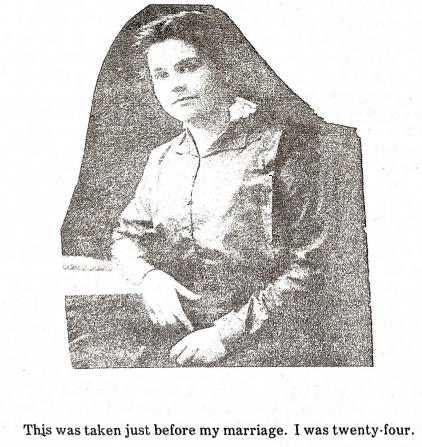 The wedding was held at my mother’s home. The folks upstairs were away and allowed us to use their apartment before the wedding, so the bridal party could come down the front stairs into the parlor. I made a pretty white dress for my wedding dress and a pretty blue dress for traveling. In the front hall was a large table with gifts on it. My brother Roy was the best man and my sister Eva was maid of honor. It was a pretty wedding, though simple. I wanted it that way. There was a wedding cake and other cakes, ice cream, tea and coffee. All my family were there. Of course, my father had passed away. Only one of Milton’s family was there, his sister Myrtle Hamilton who now lives in Rushford, New York. She had been helping Milton at Clarenceville, but she was on her way home to Franklinville, now that I would be the “Lady of the Manse.”
When Rev. Clark was about to leave to return to his home in Rome, New York, suddenly there was a burst of laughter all over the house. Everyone seemed to be in on the joke but the bride and groom. We finally learned that Rev. Clark had brought us a beautiful blanket as a gift. It was taken from the suitcase in which he had brought it and placed with the other gifts. Someone had taken the suitcase upstairs and it was placed near the luggage of the bridal pair. When Rev. Clark found it, it was filled with bricks. Someone thought they were playing a joke on us.
We were scheduled to leave Troy at 6:00 P.M. on a train going to Burlington, Vermont, where we were to stay overnight and go on to Clarenceville, Quebec the next day. We bid the folks good-bye at the house and my brother-in-law, Lew Grandjean, was to get us to the station in Troy in his car. As we left the house, he headed north instead of south. He tried to convince us we couldn’t get the train downtown in Troy because it was too late, but must take the train at another station. I argued with him that the train didn’t ever stop at that station. Finally I persuaded him to head for Troy. When we got further downtown he left the paved street and took us several blocks out of our way over cobblestone pavements. Finally we pulled up at the train station and as I got out of the car, I was pelted with rice. It was in the rim of my hat and someone pulled back the collar of my coat and put some down my neck, which I had to endure for the next several hours. Lew had sidetracked us to allow the wedding guests to congregate at the station before our arrival there. They followed us out to the train. There was rice all around our seat on the train. When they had to get off the train, they got on the baggage cart and some pushed it way to the end of the station platform.
Rev. and Mrs. Sitzer, close friends of mine, gave us a royal welcome at the Free Methodist parsonage at Burlington, Vermont that night. It was nearly midnight when we got there. The next morning we left there and finally arrived at the Clarenceville parsonage, after quite a long train ride, and about nine miles with horse and buggy.
We had two preaching appointments and the first Sunday, November 29, 1918, we had to be at the one which was a great distance away. We had to go before Sunday and stay at the Holden home. On Sunday, we had a service there in the morning and quite a distance to the Tittemore home for the evening service.
This was the home of missionary Lucy Tittemore. It was now December 1st of 1918 and the long road leading up to the house was frozen in the snowy and muddy ruts. Just ahead of us one of our members, Mr. Whitney, was driving a frisky horse and he was riding in an open “cutter.” Suddenly the horse started to run out of control. Mr. Whitney was thrown out and injured. A doctor was called and a sleigh with a cot and blankets was prepared. After the doctor had done what he could, they placed him in the sleigh and my husband, being an excellent horseman, took off, driving the horse on a five or six mile trip.
This happening put me in a very awkward position. I had never met these people at this end of the circuit, I was the preacher’s new wife and had to preach, pray, sing — I won’t say die, but I sure felt stranded. Milton didn’t get back till evening service was over. We stayed there overnight and next day went to the injured man’s home and helped take care of him. Milton made some kind of contraption fastened to the top of the room, so he could raise himself in bed. He had some broken bones, which the doctor had set. So that was my first Sunday as a preacher’s wife.
Milton had some furniture, such as a parlor suite and a bedroom suite; there was dining furniture that belonged to the parsonage, stoves, etc., so when my mother shipped our beautiful wedding gifts, we had a lovely home, when we could be there to enjoy it.
As it was, we spent a week at our own home and drove with horse and buggy or cutter, according to the weather, twenty-five miles to the other end of the circuit, where we also spent a week before we returned home. While there we stayed at the Holden home, which was a very large house and farm, where several people were employed and lived. We had many and varied experiences driving either through snow or mud, for there were few paved roads then.
During that year of 1919, my husband decided to go to the Genesee Conference, which was held at Potomac Avenue Free Methodist Church in Buffalo, New York. When the appointments were read, we were sent to the Olean church. This was a new church. They had bought it from another denomination. There was no parsonage. The former pastor owned his own home where he lived in Olean. Arrangements were made for us to live in a part of the former preacher’s home. It was not an ideal arrangement. They had the front parlor, we had the back parlor, we had the dining room and we both used the same kitchen and the same sink. They had the cupboards in the kitchen; we had a small pantry. Upstairs, we had one bedroom and a very small room which was used as a study. Both families used the same bathroom.
This arrangement held till about March; we had moved there in September. Then the landlord decided that they would have all the downstairs and we would have the front bedroom upstairs for our parlor, which was a small room. We would still have the next bedroom down the hall for our bedroom, and the back bedroom which was also small, for a kitchen. We would still have the little den.
There was neither stove, sink or cupboard in the back bedroom. Daddy bought a little gas plate to cook on and made a cupboard out of wooden boxes. I had to carry all water from and to the bathroom for kitchen use.
We had just nicely gotten placed there when the church bought a parsonage near the church. It was quite a long walk from where we lived to the church; of course we had no car. There would be quite a long wait until we could move. The new parsonage was only a block from the church.
One day in late March or early April, we stopped in the new parsonage and asked the occupants how soon they would be moving. They mentioned that the Superintendent and one of the officials from the church had been there and that they were planning to rent out the upstairs rooms, two of them, to some of the railroad men who had to stay overnight in Olean, as that was the end of the line for some of them. That would have left us with one small room downstairs, not large enough for bed and dresser. We had been married nearly two years and were expecting a new baby. My mother, who was a practical nurse, was planning to come from Troy to take care of me. We did not go to the hospitals then as they do now. The arrangement, as had been planned, would leave us without one real bedroom and no place for my mother to stay, or the baby. It also left no place for any parsonage guests who might be there for a continued time. This was something we just could not agree to.
After several meetings, they finally consented to let us use the smaller bedroom upstairs. This did not help much. Secondhand furniture, such as beds, mattresses and dressers were bought for that front room. The beds and dressers needed refinishing, walls needed papering, floors needed refinishing, and who did it? my beloved husband. After this was all done and the room was bright and shining, it was closed. We had no trouble about the room because no one ever tried to rent it. It looked so nice after the refurbishing. When my mother, who had quite a sense of humor, came, she would sometimes open the door carefully and look in and say, “I was just viewing the corpse”.
For the first part of the Conference year 1919-1920, my husband and I alternated with the preaching as we had done since we were married.
In the spring of 1920, a member of our church, Mr. La Quay, who was teaching industrial arts in the Olean High School, told my husband he was going elsewhere and the job would be available to him if he would apply. Milton, as has been mentioned before, had graduated from Buffalo State Teacher’s College and had taught in Buffalo before entering the ministry. He applied and got the job. We were in a bind and had to make a change because of the new baby that was coming.
We bought a new house in a new part of the town; in fact, the workmen were just leaving that night as we moved in. My mother had been with us for a time and so helped us to get moved and settled. On November 2, 1920, Election Day, our first child was born. We named him Vernon Alvin. He weighed 11-½ pounds and was a beautiful child. Of course we were very proud of him. He was healthy and developed into a very lively boy. While at Olean we often went to Grandma Blowers’ on weekends. It was about twenty miles north of Olean.
The wedding was held at my mother’s home. The folks upstairs were away and allowed us to use their apartment before the wedding, so the bridal party could come down the front stairs into the parlor. I made a pretty white dress for my wedding dress and a pretty blue dress for traveling. In the front hall was a large table with gifts on it. My brother Roy was the best man and my sister Eva was maid of honor. It was a pretty wedding, though simple. I wanted it that way. There was a wedding cake and other cakes, ice cream, tea and coffee. All my family were there. Of course, my father had passed away. Only one of Milton’s family was there, his sister Myrtle Hamilton who now lives in Rushford, New York. She had been helping Milton at Clarenceville, but she was on her way home to Franklinville, now that I would be the “Lady of the Manse.”
When Rev. Clark was about to leave to return to his home in Rome, New York, suddenly there was a burst of laughter all over the house. Everyone seemed to be in on the joke but the bride and groom. We finally learned that Rev. Clark had brought us a beautiful blanket as a gift. It was taken from the suitcase in which he had brought it and placed with the other gifts. Someone had taken the suitcase upstairs and it was placed near the luggage of the bridal pair. When Rev. Clark found it, it was filled with bricks. Someone thought they were playing a joke on us.
We were scheduled to leave Troy at 6:00 P.M. on a train going to Burlington, Vermont, where we were to stay overnight and go on to Clarenceville, Quebec the next day. We bid the folks good-bye at the house and my brother-in-law, Lew Grandjean, was to get us to the station in Troy in his car. As we left the house, he headed north instead of south. He tried to convince us we couldn’t get the train downtown in Troy because it was too late, but must take the train at another station. I argued with him that the train didn’t ever stop at that station. Finally I persuaded him to head for Troy. When we got further downtown he left the paved street and took us several blocks out of our way over cobblestone pavements. Finally we pulled up at the train station and as I got out of the car, I was pelted with rice. It was in the rim of my hat and someone pulled back the collar of my coat and put some down my neck, which I had to endure for the next several hours. Lew had sidetracked us to allow the wedding guests to congregate at the station before our arrival there. They followed us out to the train. There was rice all around our seat on the train. When they had to get off the train, they got on the baggage cart and some pushed it way to the end of the station platform.
Rev. and Mrs. Sitzer, close friends of mine, gave us a royal welcome at the Free Methodist parsonage at Burlington, Vermont that night. It was nearly midnight when we got there. The next morning we left there and finally arrived at the Clarenceville parsonage, after quite a long train ride, and about nine miles with horse and buggy.
We had two preaching appointments and the first Sunday, November 29, 1918, we had to be at the one which was a great distance away. We had to go before Sunday and stay at the Holden home. On Sunday, we had a service there in the morning and quite a distance to the Tittemore home for the evening service.
This was the home of missionary Lucy Tittemore. It was now December 1st of 1918 and the long road leading up to the house was frozen in the snowy and muddy ruts. Just ahead of us one of our members, Mr. Whitney, was driving a frisky horse and he was riding in an open “cutter.” Suddenly the horse started to run out of control. Mr. Whitney was thrown out and injured. A doctor was called and a sleigh with a cot and blankets was prepared. After the doctor had done what he could, they placed him in the sleigh and my husband, being an excellent horseman, took off, driving the horse on a five or six mile trip.
This happening put me in a very awkward position. I had never met these people at this end of the circuit, I was the preacher’s new wife and had to preach, pray, sing — I won’t say die, but I sure felt stranded. Milton didn’t get back till evening service was over. We stayed there overnight and next day went to the injured man’s home and helped take care of him. Milton made some kind of contraption fastened to the top of the room, so he could raise himself in bed. He had some broken bones, which the doctor had set. So that was my first Sunday as a preacher’s wife.
Milton had some furniture, such as a parlor suite and a bedroom suite; there was dining furniture that belonged to the parsonage, stoves, etc., so when my mother shipped our beautiful wedding gifts, we had a lovely home, when we could be there to enjoy it.
As it was, we spent a week at our own home and drove with horse and buggy or cutter, according to the weather, twenty-five miles to the other end of the circuit, where we also spent a week before we returned home. While there we stayed at the Holden home, which was a very large house and farm, where several people were employed and lived. We had many and varied experiences driving either through snow or mud, for there were few paved roads then.
During that year of 1919, my husband decided to go to the Genesee Conference, which was held at Potomac Avenue Free Methodist Church in Buffalo, New York. When the appointments were read, we were sent to the Olean church. This was a new church. They had bought it from another denomination. There was no parsonage. The former pastor owned his own home where he lived in Olean. Arrangements were made for us to live in a part of the former preacher’s home. It was not an ideal arrangement. They had the front parlor, we had the back parlor, we had the dining room and we both used the same kitchen and the same sink. They had the cupboards in the kitchen; we had a small pantry. Upstairs, we had one bedroom and a very small room which was used as a study. Both families used the same bathroom.
This arrangement held till about March; we had moved there in September. Then the landlord decided that they would have all the downstairs and we would have the front bedroom upstairs for our parlor, which was a small room. We would still have the next bedroom down the hall for our bedroom, and the back bedroom which was also small, for a kitchen. We would still have the little den.
There was neither stove, sink or cupboard in the back bedroom. Daddy bought a little gas plate to cook on and made a cupboard out of wooden boxes. I had to carry all water from and to the bathroom for kitchen use.
We had just nicely gotten placed there when the church bought a parsonage near the church. It was quite a long walk from where we lived to the church; of course we had no car. There would be quite a long wait until we could move. The new parsonage was only a block from the church.
One day in late March or early April, we stopped in the new parsonage and asked the occupants how soon they would be moving. They mentioned that the Superintendent and one of the officials from the church had been there and that they were planning to rent out the upstairs rooms, two of them, to some of the railroad men who had to stay overnight in Olean, as that was the end of the line for some of them. That would have left us with one small room downstairs, not large enough for bed and dresser. We had been married nearly two years and were expecting a new baby. My mother, who was a practical nurse, was planning to come from Troy to take care of me. We did not go to the hospitals then as they do now. The arrangement, as had been planned, would leave us without one real bedroom and no place for my mother to stay, or the baby. It also left no place for any parsonage guests who might be there for a continued time. This was something we just could not agree to.
After several meetings, they finally consented to let us use the smaller bedroom upstairs. This did not help much. Secondhand furniture, such as beds, mattresses and dressers were bought for that front room. The beds and dressers needed refinishing, walls needed papering, floors needed refinishing, and who did it? my beloved husband. After this was all done and the room was bright and shining, it was closed. We had no trouble about the room because no one ever tried to rent it. It looked so nice after the refurbishing. When my mother, who had quite a sense of humor, came, she would sometimes open the door carefully and look in and say, “I was just viewing the corpse”.
For the first part of the Conference year 1919-1920, my husband and I alternated with the preaching as we had done since we were married.
In the spring of 1920, a member of our church, Mr. La Quay, who was teaching industrial arts in the Olean High School, told my husband he was going elsewhere and the job would be available to him if he would apply. Milton, as has been mentioned before, had graduated from Buffalo State Teacher’s College and had taught in Buffalo before entering the ministry. He applied and got the job. We were in a bind and had to make a change because of the new baby that was coming.
We bought a new house in a new part of the town; in fact, the workmen were just leaving that night as we moved in. My mother had been with us for a time and so helped us to get moved and settled. On November 2, 1920, Election Day, our first child was born. We named him Vernon Alvin. He weighed 11-½ pounds and was a beautiful child. Of course we were very proud of him. He was healthy and developed into a very lively boy. While at Olean we often went to Grandma Blowers’ on weekends. It was about twenty miles north of Olean.
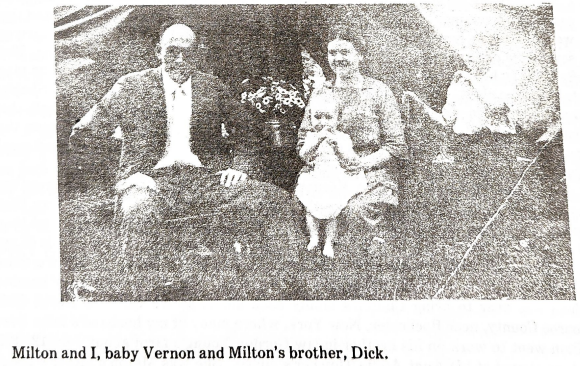 When Vernon was about a year old, I received the shocking news that my mother had died very suddenly with a heart attack. Of course that meant a long trip to Troy to attend the funeral. She had been to three church services that day, had come home Sunday night and was gone soon after reaching home. My youngest sister, Eva Sandall, had recently married and my mother was living with her and her husband. The funeral was held at their home and the burial was in a new cemetery on the hill in Troy. Soon after, my father’s casket was moved from Oakwood Cemetery to the same one where my mother was buried. More of my family, Clara, Rob, Hattie and others, have been buried there since.
A few months later, on March 14, 1922, my second child was born; a girl this time. She weighed 10-¼ pounds. She had long dark hair which reached the neck of her gown. Vernon was brought in to see her and he buried his head in her hair and kept saying, “Little Dee, little Dee”. Although she was named Ethelyn Marjorie, at this present time everyone calls her “Dee”.
With two small babies, sixteen months apart, my life was centered mostly at home. It was quite a change from my former life but we had a car and often went to Franklinville, district meetings and camp meetings. Milton planned to go to Oswego State Teacher’s College for a summer course. His brother Clinton and wife Minnie and children June, Marion and Eunice decided to go too. Clinton didn’t have a car then. Dee was then about three months old and Clinton’s baby girl, Eunice (now Eunice Warwick) was the same age.
On the day before we left, I put Vernon on the side porch to play. We were all at Grandma Blowers’. I had much to do to get ready to go. I heard him crying and opened the door and there he stood with his tongue out of his mouth, trying to cry. He held a small pitcher in his hand. I saw right away what had happened. At Grandma’s they had a gasoline lamp which they filled out on that porch, using a pitcher. Some gasoline had been left in the pitcher and Vernon had drunk some of it. Believe me, I was scared! I ran to two neighbors’ to see if they had any ipecac. I gave him some, then ran down the street to the doctor’s office. I rushed in out of breath and told him what had happened. He asked what I had done. I told him. He said, “I couldn’t do any more if I came down. Go home, run your finger down his throat till he brings it up.” I rushed back home and as I opened the door I knew he had found relief, for the whole house smelled of gasoline.
The next day we started for Oswego, on the Fourth of July, 1922. We had ordered tents, as the summer students tented in the grove near the college. We expected they would be ready for occupancy when we arrived but no tent! Some had arrived, some were on the road somewhere. They were using the policy “First Come, First Served,” so here we were, ten of us with the children, and night coming on no place to go for the night. Finally they told us to go into the empty rooms in the old Sheldon home. They loaned us some cots and so we had to get along. Out in the long hall, they found some wooden doors, put them up on “horses” which we covered and made that our dining area. We had a small oil stove with one wick in it on which we cooked meals for all of us. Both Milton and Clinton had to start classes the next day.
Because of the dose of gasoline, Vernon kept having vomiting spells and there was no way to wash clothes, only to take them down a long flight of stairs, carry them around to the back of the house to the well where we had to rub them hard to get them clean with soap and hard well water and that was cold. After a week of this it was more than we could take, with two small babies, so we decided to leave. We didn’t want to go way home to Olean because we would have to drive so far after summer school was over to bring Clinton’s family back home, so we came to North Chili, Monroe County, near Rochester, New York, where many of my husband’s folks lived. Milton went to work on his brother-in-law Gordon Young’s farm about July 12, 1922 and we stayed at his Aunt Addie Thurber’s house. She was Milton’s father’s sister. She and her husband, Uncle Charles Thurber, had retired from the ministry in Genesee Conference. They and their teen-age daughter, Miriam, now Miriam Rose, were living at North Chili. She used to help me when we would take the babies out in a borrowed carriage. We spent a pleasant summer. Milton stayed nights at Aunt Addie’s. We finally got Clinton’s family and took them with us to our home in Olean. From there they moved to Michigan in August, 1922, where Minnie, Clinton’s wife, afterwards taught music at Spring Arbor College.
As for us, my husband taught again there in Olean in 1922, 1923, and 1924. With the two babies, my housework and other duties, I kept very busy. Milton always liked to go home to Franklinville and I went until I thought I was taking chances, for at the close of the next school year, I was expecting my third child. School had just closed for summer and it being a warm day, Milton wanted me to go again to Franklinville for the weekend. I was afraid I might take sick up there and we already had our doctor and nurse in Olean on whom we were depending. He said, “Let’s go; if anything happens up there, Mother can take care of you.” I said, “That’s just what I don’t want to happen.” But he won and we went. Sunday night I had to ask him to call a local doctor. He came and stayed all night. I wasn’t going anywhere about that time. The next morning about 7:00 o’clock, at just about the time several of Milton’s sisters, who were teachers, were hurrying around, getting ready to leave for the summer at Chautauqua, my third baby was born on July 2, 1923, a boy we named Eldon Pearce. My husband had a lady come in and help as there was too much for Grandma Blowers to do.
As soon as I was able to be around, Grandma and the boys, Dick and Stan, went to camp meeting at Salamanca. It was decided that the next Sunday we would go to the camp. It was very early when we got up and got there to have breakfast with Grandma as she had requested. Vernon left the table before we had finished and I thought he was playing in front of the tent. When I looked for him, he couldn’t be found anywhere on the campground. I couldn’t help but think of the river and the railroad which were not far away. We searched everywhere but he seemed to be nowhere. Finally we went off the grounds and away up the road we saw Dick and Stan, Milton’s two younger brothers, coming with Vernon between them. It was a hot July morning and Vernon’s face looked so red and he was very hot and tired and exhausted. The boys had taken him way up the road to a farm to see the cows.
That was a hard day for me. I wasn’t very strong and with the work of getting up so early and feeding all the youngsters, bathing and dressing them, the long trip to the camp, carrying babies around all day, when it came time to go home I felt as if I had “had it.” But it wasn’t all over yet. Going home over a country road, cars were coming toward us with bright lights that blinded Milton, so for a second, he didn’t see the road. I felt the car go down on my side and heard stones tumble down the bank and splash in the water. I was terribly frightened. We were hung on a bank just above a creek. Other cars pulled alongside and when the people in them saw me with the three little ones, they got me out of the car and into theirs. The men helped to get the car up on the road again. It wasn’t damaged and no one was hurt, for which we thanked God, but I felt by the time we reached home that that had been quite a day! I was so thankful when I had the children all bedded down for the night.
When Vernon was about a year old, I received the shocking news that my mother had died very suddenly with a heart attack. Of course that meant a long trip to Troy to attend the funeral. She had been to three church services that day, had come home Sunday night and was gone soon after reaching home. My youngest sister, Eva Sandall, had recently married and my mother was living with her and her husband. The funeral was held at their home and the burial was in a new cemetery on the hill in Troy. Soon after, my father’s casket was moved from Oakwood Cemetery to the same one where my mother was buried. More of my family, Clara, Rob, Hattie and others, have been buried there since.
A few months later, on March 14, 1922, my second child was born; a girl this time. She weighed 10-¼ pounds. She had long dark hair which reached the neck of her gown. Vernon was brought in to see her and he buried his head in her hair and kept saying, “Little Dee, little Dee”. Although she was named Ethelyn Marjorie, at this present time everyone calls her “Dee”.
With two small babies, sixteen months apart, my life was centered mostly at home. It was quite a change from my former life but we had a car and often went to Franklinville, district meetings and camp meetings. Milton planned to go to Oswego State Teacher’s College for a summer course. His brother Clinton and wife Minnie and children June, Marion and Eunice decided to go too. Clinton didn’t have a car then. Dee was then about three months old and Clinton’s baby girl, Eunice (now Eunice Warwick) was the same age.
On the day before we left, I put Vernon on the side porch to play. We were all at Grandma Blowers’. I had much to do to get ready to go. I heard him crying and opened the door and there he stood with his tongue out of his mouth, trying to cry. He held a small pitcher in his hand. I saw right away what had happened. At Grandma’s they had a gasoline lamp which they filled out on that porch, using a pitcher. Some gasoline had been left in the pitcher and Vernon had drunk some of it. Believe me, I was scared! I ran to two neighbors’ to see if they had any ipecac. I gave him some, then ran down the street to the doctor’s office. I rushed in out of breath and told him what had happened. He asked what I had done. I told him. He said, “I couldn’t do any more if I came down. Go home, run your finger down his throat till he brings it up.” I rushed back home and as I opened the door I knew he had found relief, for the whole house smelled of gasoline.
The next day we started for Oswego, on the Fourth of July, 1922. We had ordered tents, as the summer students tented in the grove near the college. We expected they would be ready for occupancy when we arrived but no tent! Some had arrived, some were on the road somewhere. They were using the policy “First Come, First Served,” so here we were, ten of us with the children, and night coming on no place to go for the night. Finally they told us to go into the empty rooms in the old Sheldon home. They loaned us some cots and so we had to get along. Out in the long hall, they found some wooden doors, put them up on “horses” which we covered and made that our dining area. We had a small oil stove with one wick in it on which we cooked meals for all of us. Both Milton and Clinton had to start classes the next day.
Because of the dose of gasoline, Vernon kept having vomiting spells and there was no way to wash clothes, only to take them down a long flight of stairs, carry them around to the back of the house to the well where we had to rub them hard to get them clean with soap and hard well water and that was cold. After a week of this it was more than we could take, with two small babies, so we decided to leave. We didn’t want to go way home to Olean because we would have to drive so far after summer school was over to bring Clinton’s family back home, so we came to North Chili, Monroe County, near Rochester, New York, where many of my husband’s folks lived. Milton went to work on his brother-in-law Gordon Young’s farm about July 12, 1922 and we stayed at his Aunt Addie Thurber’s house. She was Milton’s father’s sister. She and her husband, Uncle Charles Thurber, had retired from the ministry in Genesee Conference. They and their teen-age daughter, Miriam, now Miriam Rose, were living at North Chili. She used to help me when we would take the babies out in a borrowed carriage. We spent a pleasant summer. Milton stayed nights at Aunt Addie’s. We finally got Clinton’s family and took them with us to our home in Olean. From there they moved to Michigan in August, 1922, where Minnie, Clinton’s wife, afterwards taught music at Spring Arbor College.
As for us, my husband taught again there in Olean in 1922, 1923, and 1924. With the two babies, my housework and other duties, I kept very busy. Milton always liked to go home to Franklinville and I went until I thought I was taking chances, for at the close of the next school year, I was expecting my third child. School had just closed for summer and it being a warm day, Milton wanted me to go again to Franklinville for the weekend. I was afraid I might take sick up there and we already had our doctor and nurse in Olean on whom we were depending. He said, “Let’s go; if anything happens up there, Mother can take care of you.” I said, “That’s just what I don’t want to happen.” But he won and we went. Sunday night I had to ask him to call a local doctor. He came and stayed all night. I wasn’t going anywhere about that time. The next morning about 7:00 o’clock, at just about the time several of Milton’s sisters, who were teachers, were hurrying around, getting ready to leave for the summer at Chautauqua, my third baby was born on July 2, 1923, a boy we named Eldon Pearce. My husband had a lady come in and help as there was too much for Grandma Blowers to do.
As soon as I was able to be around, Grandma and the boys, Dick and Stan, went to camp meeting at Salamanca. It was decided that the next Sunday we would go to the camp. It was very early when we got up and got there to have breakfast with Grandma as she had requested. Vernon left the table before we had finished and I thought he was playing in front of the tent. When I looked for him, he couldn’t be found anywhere on the campground. I couldn’t help but think of the river and the railroad which were not far away. We searched everywhere but he seemed to be nowhere. Finally we went off the grounds and away up the road we saw Dick and Stan, Milton’s two younger brothers, coming with Vernon between them. It was a hot July morning and Vernon’s face looked so red and he was very hot and tired and exhausted. The boys had taken him way up the road to a farm to see the cows.
That was a hard day for me. I wasn’t very strong and with the work of getting up so early and feeding all the youngsters, bathing and dressing them, the long trip to the camp, carrying babies around all day, when it came time to go home I felt as if I had “had it.” But it wasn’t all over yet. Going home over a country road, cars were coming toward us with bright lights that blinded Milton, so for a second, he didn’t see the road. I felt the car go down on my side and heard stones tumble down the bank and splash in the water. I was terribly frightened. We were hung on a bank just above a creek. Other cars pulled alongside and when the people in them saw me with the three little ones, they got me out of the car and into theirs. The men helped to get the car up on the road again. It wasn’t damaged and no one was hurt, for which we thanked God, but I felt by the time we reached home that that had been quite a day! I was so thankful when I had the children all bedded down for the night.
Chapter 4
The next spring in 1924, we again started for Grandma’s house at Franklinville. All seemed normal at Olean but the farther we drove north, the more snow was on the roads, till within a few miles of Franklinville we couldn’t make it up a steep hill because of the deep snow. I begged Daddy to turn back to the nearest house to see if we could stay overnight. The people there were very kind and did all they could to make it pleasant and comfortable overnight. Next day was Sunday. We thought perhaps we could get through with the car but while at breakfast, we saw a car get stuck in front of the house where we were. It was decided that the man of the house would take us in a sleigh with horses to Franklinville. So we sat in the bottom of the sleigh bundled in blankets and with umbrellas to ward off the snow, as it was snowing hard. The car was left at their house and we reached Franklinville finally. We had to return to Olean by train Sunday night because Milton had to teach on Monday. Later in the week, when the weather was better, he went up and brought the car home to Olean. Later in the spring, we started up there again to Franklinville. Milton’s youngest sister, Lillian, had just graduated and was teaching in a district school. After a very short illness of flu which developed into encephalitis, she died in March of 1924. We were going up there this time to attend her funeral which would be the next day.
When we reached Franklinville, two creeks had flooded the streets. We drove into deep water just as we entered the town, and were stuck. A truck finally hitched to the back of the car, hauled us out of the water, across a bridge and to higher ground. We went to the nearest house and soon their son who had been into town, came and said the only way into town was to walk down the railroad tracks. So we walked the tracks to the railroad station carrying the children and our luggage. Milton left me there to go to his home and have someone come down after us. Finally someone came with a car and took us to Grandma’s.
The funeral was held the next day and one of the men of the church, Mr. Gonsolus, drove a team and wagon with those who could go, over almost impassible roads to Rushford, New York, where the burial took place. I couldn’t go because of caring for the babies and, as I remember, Grandma and Lena Janowsky, Milton’s sister, were not able to go either. It was a sad time. There was an epidemic of flu on at the time and many suffered from it.
After Eldon Pearce, my third child, was born on July 2, 1923, at Grandma’s, we stayed there most of the summer. By September, Milton had accepted a new teaching job with higher salary in Buffalo at the Elm Vocational School. We sold our home in Olean and rented a large upstairs apartment in Buffalo. Milton taught there in Buffalo a week before we could move. On the next Saturday, he had his brother Stanley and a good friend, Ben Austin, help load the truck to drive to Buffalo. Daddy took his sister Myrtle, the babies and I in the car. The boys drove the truck. Our full car arrived in Buffalo about suppertime so Milton bought some food and we ate in an empty apartment while Stan and Ben were somewhere on the road headed for Buffalo.
Milton had taught there the first week of school and had taken our folding couch into the apartment to sleep on it. When we arrived with the three babies, Myrtle and I, we laid the babies, one by one, as they went to sleep, across the couch. Myrtle and I took turns sitting in the broken-down kitchen chair, for that was all that was there till the truck came at 11:00 o’clock P.M. on Saturday.
Thinking that Stan and Ben might be lost, Milton left us to look for them. It was 11:00 o’clock when they all got there with the load. There was an upstairs porch with a door opening into the living room, so they backed the truck so they could unload there. The next day was Sunday, so the boys went back to Franklinville on the train and I heard after, they were there in time for Sunday School. We couldn’t go to church because things were in such a mix-up we couldn’t find clothes, etc. So we got in the car and drove around to some of the parks where we could relax awhile.
It was while living at this house in Buffalo that Daddy arranged a “contraption” called a “radio.” We sure were excited when we could hear downtown Buffalo and then from much farther away. Later Milton’s sister Myrtle had married Roland Hamilton, whom she met while attending Free Methodist College at Spring Arbor, Michigan. Both of them attended there. He went to work in a plant in Buffalo and they lived with us. Many evenings, during that year of 1924, we would listen to radio programs of that earlier time, with two sets of ear phones. It was quite a marvel then.
While we lived there I wrote a seven-page piece of music for piano and had it copyrighted. The title was “Sunset Meditations.” I have never had it printed. I also wrote four hymns which I had Thoro Harris, noted hymn writer, correct. I have never had them published.
On November 18, 1924, our fourth child, a girl arrived. We had a boy first, a girl second, a boy third and now another girl. (So it was with the next four.) This girl was named Genevieve Louise. Vernon, Eldon, and Genevieve were all light complexioned but Dee had dark hair with blue eyes and fair skin.
I have termed this period “the mischief era,” for it seemed the older ones kept me very busy. One morning I sat them at the table in the kitchen to eat breakfast. I went into the front of the house to do up the work while they busied themselves with their food. Soon I heard giggling and scurrying around and went to see what they were up to.
Before they got up, I had cooked up a kettle of grapes and strained them into another kettle and left it on the back of the stove, thinking I would put it in the bottles after they had eaten. They had beaten me to it. They had a wash basin on one chair, bottles on other chairs and anything that would hold liquid; they had poured it on the chairs, their clothes, the floor, and some was in the containers. I didn’t know where to begin to clean up the mess. Some of their clothes were so stained that I had to throw them away.
Another time they were playing in the front part of the house while I was in the kitchen, when the doorbell rang. When I went into the parlor to go downstairs to answer the door, the living room was a sight. Daddy had hidden some nice apples behind something on a landing halfway down the stairs. Of course they had found them. The doors were painted white. The floors around the rug were highly polished. They were — but not now. They had found some apples that had passed their prime and had thrown them at the door and woodwork and floor, so it was a sight to see. When I discovered the mess, I still had to answer the bell. Who would it be but our pastor from Olean, Rev. Reber, Sr., who was in the city and had come to call on us. They saw us, all right — at our lowest ebb.
Another time they were playing and I thought they were having too good a time. The drapes between the parlor and back parlor were quite new and had been a gift. We had a jumper in which I had put the baby, Eldon, in the doorway. The two older children, Vernon and Dee, had cut off from the drapes the tassels which were the edging on the drapes. Vernon had a stick or paddle and was hitting the balls and the baby was kicking them as he jumped up and down, while Dee was laughing and clapping her hands. Vernon was the instigator of all this! What could I do with him? I put him in the bedroom, up on the bed, and told him to stay there till I told him he could come out. He didn’t cry or make a fuss, which I thought was unusual, so I peeped in the door to see if he could have gone to sleep. I could hardly see across the room. He sat there on the bed with the talcum powder, sifting it into the air. These are just samples. We lived on a busy street. I couldn’t let them out to play, so they had to keep busy and keep me busy, too. While living there, we attended Potomac Avenue Church. About a year later, we moved to a house at the east end of the city where we had much more room. We lived in a house by ourselves and had a large yard where the children could play outside. They also had a playroom upstairs. We bought a new piano while we lived there. Earlier in life, as has been mentioned before, I had studied piano, organ and vocal music. I took some further vocal music with Professor Drew at Syracuse University. This was while I was at Chittenango, about 1918, before I was married. Now, by learning a certain quick method of teaching, I was persuaded to take a course at a music school in Buffalo and would be given a position teaching classes in piano.
At that same time, Milton began having digestive and liver problems and was advised to get out of the city, where he could work outdoors. During the next school year, he found a place at Griffin’s Mills, near West Falls, southwest of Buffalo.
That was a real switch; from a house where we had a laundry in the basement, electric washer, refrigeration, electric lights, and the house heated by gas — then change to a house with the only heat from wood-burning stoves, do the washing on the washboard, hand wringer, kerosene lamps for lighting and no water of any kind in the house. When I washed, I had to carry eighteen pails of water, pumped by hand, across the road, keep some cold for rinse water, a tub for bluing water and heat some in a boiler over a wood-burning kitchen stove for washing. It was the same for baths. Baths had to be taken in washtubs. Milton was doing some farming, such as putting in a large crop of potatoes, some buckwheat and the yield from a large apple orchard. But finances were low mostly. We lived there about three years.
My fifth baby arrived while there, a nice healthy, brown-eyed boy born on October 23, 1927, whom we named Lawrence Spencer. When he was about a year old things began to happen to us. I wondered just what God was trying to say to us. Our potato crop was almost a failure. They were nice potatoes but the mud was so deep in the fall it became almost impossible to harvest them. A windstorm in one night blew most of the beautiful apples to the ground. Our car was giving us trouble too. At this time I was expecting my sixth baby. (All my children were born at home except the last one, Lynette.) A dear friend came and promised to stay till after the baby was born. Meanwhile, with all the rest of our financial failures in trying to make a living on the farm, Milton had taken a job to help us through the winter. On the 30th of January, 1929, the baby was born. Another lovely little girl, we named her Louise Marie. When a week had passed, one day she didn’t wake up. She slept so long the doctor was called. He tried different things but nothing worked. She was just lying there breathing and sleeping. He even put her into a bowl of warm water thinking it might wake her up but still she slept on. I couldn’t sleep all that week, just watching and waiting for her to awaken. Milk was dropped from a tube into her throat. She slept most of that week, but suddenly in the night, after the doctor had given her a small dose of nitre, she awoke and was starved.
Milton had been laid off from his work earlier in the week because of lack of work to do, but he didn’t want to leave to look for other work. After Louise awoke, he went to Buffalo and there found a very profitable job at the Pierce-Arrow plant. That night we sat around the stove talking about the best way for Milton to get to his work, for it was a long drive from home.
We went to bed — little did we think that would be our last night in that house. The next morning, around the 14th of February, we arose, and got breakfast ready. Mable, Milton’s sister, was with us. The children were given their breakfast. I sat at the end of the table and went to the stove to get some oatmeal. There I smelled smoke and looking up through the open ring around the stovepipe, which went into the attic and the brick chimney, I saw flames.
I turned and told my husband I saw a fire upstairs. He grabbed a pail of water from the shelf on the sink and dashed upstairs. I got the children away from the table, pushed them ahead of me, grabbed the baby in her basket, going through the dining room, and got them all out the front door. None of us had coats or outside wraps on. It was a very cold February morning, with snow all around. The neighbor lived quite a distance back on the other side of the road. I knocked, but it was quite long before anyone came to the door. While we stood there, Milton came where we were. The fire company had been called. Suddenly, as we stood there waiting for someone to come to the door, I realized that Lawrence, our fifteen-month-old baby wasn’t there. Milton, coming through the parlors, about to leave the house, remembered that all our best and outside coats and hats and other apparel were in the clothes closet off the parlor. He had gone in there and gathered those things over his arm and it was still there as it had fallen over his arm. When I suddenly said, “Where’s Lawrence?” I saw all those things move on Milton’s arm and Lawrence poked his head through.
The fire company came, but there wasn’t anything that could be done to save the house. In a very short time everything was gone and the ashes lay upon the ground. We lost things that could never be replaced such as valuable books; I had stacks of music that I had accumulated over the years, all our precious wedding gifts, our furniture, clothes — all was gone. There was no insurance. When we had lived in the towns and cities we had insurance — but nothing now. It is in times like these that we are shown what God can do. Also, we learn that “the things that are seen are temporal, but things that are not seen are eternal.” It seems contradictory, but it is the truth.
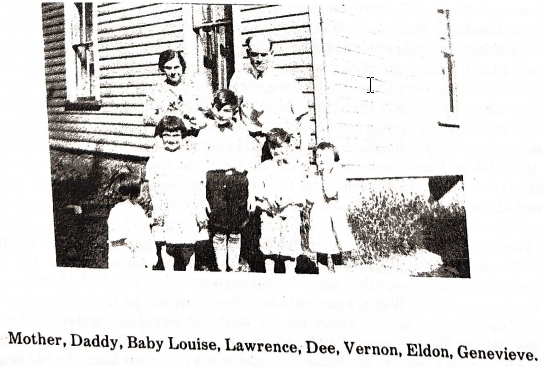 [Caption under photo: Mother, Daddy, Baby Louise, Lawrence, Dee, Vernon, Eldon, Genevieve.]
Friends and relatives came to our aid, supplying things we needed. We were at Grandma’s for awhile, but found a place much nearer Milton’s work, between Buffalo and Tonawanda. While there, we attended the Free Methodist Church in Tonawanda.
Finally, in 1929, the Depression was upon us. Milton’s work got down to three days and then to two days a week. Milton made a deal with a farmer, out near Pembroke, to work for him on the farm for a certain amount, we were to live in the tenant house, have wood to burn, milk and vegetables to eat. These would supply the greatest needs of the family; but we had just nicely gotten settled with furnishings donated by relatives and friends when Daddy took sick again, so he couldn’t satisfy the man he worked for. New houses were being built, whole streets of them in Kenmore, near Buffalo. We were allowed to move into a very nice new house there and by painting and working on other houses, we would be provided for. It was while we lived here our seventh child was born, whom we named Lester Palmer Blowers. He was born on December 3, 1931. The name Lester was my maiden name, Palmer was after his great grandfather, Noah Palmer, who was one of the earliest preachers in the Genesee Conference. He had a lot to do to live up to his name. While we lived in Kenmore, I sang in the choir at the Kenmore Baptist Church and sang some solos there. I remember singing “The Holy City.”
I enjoyed this very much for it was relaxing, after having a family of seven children to provide for. I made most of their clothes, even coats for the girls, and overcoats for the boys. Later, while we still lived there, we attended the Potomac Avenue Free Methodist Church, where I taught a very large Bible Class. After we had moved out to Marilla, around 1932 and 1934, on a small farm, we had the whole Bible Class, about thirty men and women, at our place for a Sunday School outing.
While we lived at Marilla, sometimes I attended the Methodist Church because it was close to where we lived. Several times the pastor asked me to supply the pulpit for him when he had to be away. By this time, the older children were attending school. Vernon, Dee and Eldon had all graduated from the eighth grade or grammar school while we lived there, one each year. It was a great event, held in the Methodist Church with special speakers and special finery for the boys and girls. The town band played for them to march in and there was much ado about the whole affair when the completion of the eighth grade was attained.
One day in May, while we lived there at Marilla, Daddy had to go to Buffalo. I went along and took the two youngest children, Louise and Lester. As I was expecting my eighth and last child, we thought it best that I go along, because the local doctor was to be out of town that day. When we had done everything that had to be done, we started in the direction of home, which was twenty miles east of Buffalo. We stopped outside a diner, and Daddy brought out lunch to us to eat in the car. When I finished eating, I knew I wasn’t going home, and surprised my husband by telling him to turn around and head for the hospital. This he did. I entered the hospital and urged him to take the children home because they couldn’t stay in the car so long. Finally, he reluctantly left. By the time he had driven twenty or more miles each way and returned to the hospital, he met his eighth child, a lovely little girl whom we named Lynette Eileen. She arrived May 23, 1935.
In a short time, I was back at Marilla, cooking, sewing, baking, and giving music lessons. The next year, 1936, I took a music class of eight, whose teacher left town, and I used to take Saturday, when my older children were home to look after things, to go twelve miles to South Wales, near Buffalo. There I would go to each pupil’s home and give their lessons. In late afternoon my husband would drive down after me.
One day, late in the summer of 1937, when I was at South Wales, I was met by Milton and Eldon. We were riding home. The sky was a gorgeous blue, the sun bright, but way in the distance I noticed thick clouds of black smoke ascending to the sky. I called my husband’s attention to it, because it was open country, with no railroads or factories. He said, “Oh, someone on our road has thrashers.” But as we turned onto our road, still two or three miles from home, I said, “That is on the south side of the road and there are no large farms there.” He seemed to catch on and we almost flew over the road. When we came to where we could see our house, it was ablaze all over, the fire companies were there, and many friends and other people. Within eight years we had lost our home twice by fire. It was concluded it was caused by faulty wiring in the woodshed, for that was where it started and no one was out there. My oldest girl, Dee, was alone in the house getting supper; the other children were all outside playing. We were so thankful to have them all alive and unharmed. Everything in the house was gone.
Some ladies from the Methodist Church, who were special friends of mine, came to me and were remarking that everything was gone, and offering their sympathy. I felt that was just the time to witness to these ladies in a different way than when I had ministered to them from their pulpit. I told them, “No, everything is not gone; I have another foundation to build on. I still have Christ and His love.” I felt so strongly the truth of that scripture which states, “The things that are seen are temporal; the things that are not seen are eternal.”
Again, the only thing we could do was to go to Grandma’s. It was a large house with plenty of room.
The next week, Mrs. Perkins of the Franklinville church arranged to have a kitchen shower for us. I cleaned the house and got everything ready for the guests, but in the afternoon became very ill. Milton had gone about forty miles up to where our house had been, to clean up around the place where the fire was. I was at the house alone. I went upstairs to bed and told Dee, when she came from school, she must get the supper and tell Daddy as soon as he came home to come right up to see me. It was evening when he returned and some guests had already arrived. He came upstairs to see me and then phoned for the doctor. When the doctor came, he made plans to have me taken sixty miles to a Buffalo hospital early the next morning. There I was “out” as they say, from 10:00 A.M. to 3:00 P.M., during the operation. While I was in the hospital the family had moved to Akron. When I came out of the hospital (I believe this was during the year of 1937), that was my new home.
We enjoyed living at Akron for several years. By that time some of the children had entered high school. We had a large house and had so many pleasant experiences there. We attended the Free Methodist Church, where I taught the Young People’s Class. My eldest son, Vernon, was president of the Young People’s Society. He attended the Youth Conference as delegate at North Chili. We did a lot of entertaining. Some of my family visited us there, from Troy, Milton’s brothers and sisters used to visit us often. The Sunday School Christmas tree and supper were also held at our house.
Milton taught industrial arts in night school there, at East Aurora and Indian Reservation. Believe it or not, I attended his night classes at Akron, used the various machines and had all the parts made and sanded and ready to put together for a magazine rack, which was really a table with two shelves and a magazine pocket at each side. — Quite a piece of work for an amateur, but I never got it together because we moved again and it was mislaid somewhere, so I lost it.
While at Akron, Vernon went to work at Kodak Park in Rochester, New York and lived with his Uncle Stan at North Chili. He used to come home often. Dee graduated from high school while we lived there.
Milton’s brother, Clinton, was a painter and lived at North Chili. He persuaded Milton to move to that area and they could work together. We moved to a very nice house on South Main Street in Churchville. We had lived there only a few months when we had a chance to buy an old home, which was roomy and just the thing for our large family, in Brockport, so we moved again. We had only lived there a short time when we learned that the bank in Rochester, with whom we were dealing, was planning to sell the house at auction, though we had made a substantial payment when we supposed they had sold it to us. We had moved in and were nicely settled when we heard of the deal in a roundabout way. We decided we would not stay there and have them sell the house out from under us. We talked it over with the bank and they told us of another house, a large one where we could move in and rent it. So we moved again about 1940.
We attended the Free Methodist Church in Brockport. Rev. Harry Anderson from Roberts Wesleyan College was our pastor. Often he brought young men who were studying for the ministry to assist in the services.
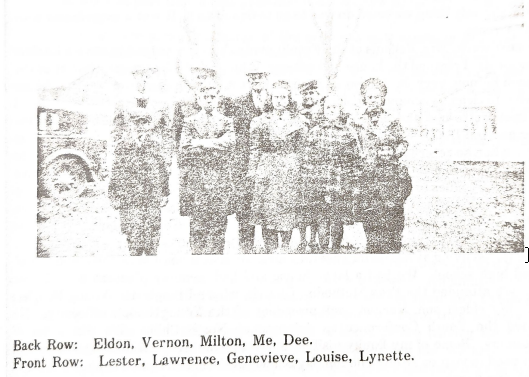 [Caption under photo: Back Row: Eldon, Vernon, Milton, Me, Dee. Front Row: Lester, Lawrence, Genevieve, Louise, Lynette.]
Our youngest girl, Lynette, started school there. By that time, Dee, Eldon, and Vernon were away from home. Vernon had joined the Air Force and afterward became a troop carrier pilot. He took paratroops into Sherburg from England, when they invaded the continent. Dee worked awhile at Kodak and worked some at a home in Rochester. Eldon worked for his cousin, Dale Lester, then of Canadaigua, New York, pasteurizing milk from his dairy farm, which was delivered in Canandaigua. When we lived there awhile, Milton decided perhaps he could go back to teaching. He signed up for a school at South Fallsburg, near Monticello, New York, not far from New York City. On the way to South Fallsburg, we visited my folks in Troy, New York, then went on to South Fallsburg, on Labor Day. From the Hudson River, it was uphill all the way to Monticello. Cars were going down the hill almost bumper to bumper, with all kinds of luggage fastened on them. We soon learned that all that country around there was a playground in the summer for the Jews from New York City. Now, many of them were heading for home. We drove up to South Fallsburg, Right away, we located a furnished house that was owned by a Jewish family who were only there during the summer. They had just left that morning. The renting of the house was in charge of the custodian of the school where Daddy was to teach. His name was Mr. Comfort. We arranged with him to move right in that night. It seemed like a dream to get supper and hang up our wraps and to go to bed in a house we had never seen before. We had left the truck with the furniture at Brockport, for our two sons, Eldon and Lawrence, to drive down. Late that night, it was raining and we had gone to bed when we heard loud knocking at the door. It was our boys with the load. I got a meal on, for they were hungry and they couldn’t understand how we happened to be there running the house. They put the load in the barn and most of it was stored there because our house was furnished. It was quite a different life. Eldon went to work in a garage. Dee came down later and worked as secretary for a lawyer, Mr. Resnik. Genevieve worked part time at the school and part time at the principal Leon Weiss’s home. The other children were in school. Later, the person in charge of the cafeteria quit suddenly and they asked me if I would take it over. The family, except for Eldon and Dee, who were at the school ate lunch there anyway so I consented to do it. This was surely a different career and it was quite an experience for me, fixing kosher and nonkosher foods. Some students worked part time in the cafeteria. I learned a lot of things that year, especially about the Jews, their way of life and way of doing things. We attended our church at Ferndale and made friends whom I still meet other places. We also attended an afternoon service in a church in Monticello on Sundays. This was the Pilgrim Holiness Church. It was here that Dee met her husband, George Reed. The lady I had lived and worked with so long before I was married, Anna Belle Collier, had transferred to the New York Conference and had pastored the church at Kingston, New York, but was now retired. She and another lady, Mrs. Pulse, lived together there at Kingston. When she heard that I was nearby, she invited the family over for church and dinner on Sunday. So in late fall, we went and had such a good time talking over former days when we were together. An amusing thing happened while we were visiting her. They learned that my youngest girl, Lynette, could sing. They bargained with her that if she would sing for them they would give her some candy. She sang: time passed; we had a lunch before leaving for home. We had stepped out the front door, when she turned back and put her head in the door and said, “We’ll forget about the candy, won’t we?” They had forgotten to keep their part of the bargain, but believe me, she got her candy. A teaching job had been offered Milton in the Caledonia High School in Caledonia, New York, so when the school year was ended, we moved back to Mumford, close by Caledonia. For awhile, we lived in a quaint old house called “the Castle,” but there was a farm outside Mumford with a twenty-room house that was worked on shares. There was a large dairy and with the aid of our boys, Lawrence and Lester, who were still at home and attending school yet, Milton thought he could continue farming with the assistance of the boys. Some time later, there was a house for sale on North Street in Caledonia which was near the school and seemed to be just the place for our family. By this time there had been some changes. Vernon was still in the Air Force and had married Eula Maddox of Atlanta, Georgia, on June 30, 1943. So he was settled in his own home in Rochester. Ethelyn and Genevieve were attending Buffalo State Teachers College. Louise was still living home and working in an office. Lester and Lynette were attending the high school in Caledonia. We still needed a large house, for some of them were always home on weekends and holidays. So with Eldon’s help, the house was purchased. Eldon was still working at the dairy at Canandaigua. Soon after, about 1945 or 1946, Lawrence went to Japan for a year. Eldon later went into the Army and was a chaplain’s assistant. Finally our youngest son, Lester, went into the service and was stationed in France for a year.
Chapter 5
It seemed so many things happened in that house on North Street in Caledonia, while we lived there over a period of fifteen years.
With some of the family away at school, others in the Army or working in other places, I didn’t have so many duties at home but what I could become involved in some extra activities. I attended typing classes for awhile, but they were closed because not enough people came. When the Christmas holidays were approaching, I decided to get a job clerking. For four weeks I worked as clerk in a 5 & 10 store in Leroy nearby. It was interesting work. A short time before this, while we lived in Mumford, I also took a course in home nursing.
At this time, I was attending the Wesleyan Church in Avon, New York and teaching the Young People’s Class. Youth for Christ meetings had become quite popular to those around Rochester. It occurred to me one night, while waiting for George and Stella Henry (who were on the Official Board at church) to pick me up for church, that it was so far for young people from the Avon area and the churches of the various denominations south of Avon to Rochester, that someone ought to promote a local Youth for Christ on Saturday nights in Avon and invite the young people from all churches in that area. I explained my idea to my friend, Stella Henry, in whispers. Next thing I knew, they presented it to the Official Board and suddenly I found myself appointed as the one to promote it.
That meant that every week I had to write invitations and notices to the pastors in several towns. It was up to me to plan the service, get special speakers, some who came quite a distance. By the time I had cleaned the house, baked pies and cakes and cookies for over Sunday and did many other things, rode to Avon, led the singing, and all that went with it, I was really tired enought to get some rest on Saturday night.
One night I remember so well. A group of young people had come with their instrument from Batavia Wesleyan Church. Of course we invited them over to Caledonia to our house for lunch afterward. I was pouring tea through the strainer with no cup under it! I really had “had it!” I really was hardly responsible for what I was doing.
While living on North Street, we nearly always had a full table every Sunday. Some of the children at first used to be home from college or from their jobs away from home. Our family liked to get together on Sundays and this continued until after they were all married and had children and then they came too. Several times we made tapes of the family singing, playing and speaking.
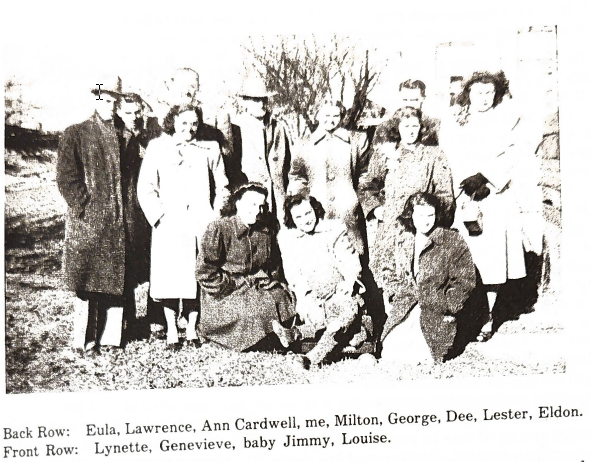 [PHOTOGRAPH — Group photo outdoors]
Back Row: Eula, Lawrence, Ann Cardwell, me, Milton, George, Dee, Lester, Eldon.
Front Row: Lynette, Genevieve, baby Jimmy, Louise.
We were a musical family. Daddy had a beautiful voice, mother had sung solos and been song leader in religious services for many years, had sung in choirs and studied vocal music at Syracuse University. Daddy had sung in the Buffalo Philharmonic while in college and teaching there.
In the family, we had a fine male quartette, also some male soloists. The same was true of the girls. We had quartettes, trios, and soloists. We are so glad to have tapes of their singing while they all lived near home, and especially of Daddy singing and reading scripture. When the grandchildren came, their voices were also recorded.
In the fifteen years we lived on North Street, many changes took place. Vernon, our eldest son, by this time had returned from service in the Air Force overseas as troop carrier pilot. He had married Eula Maddox of Atlanta, Georgia on June 30, 1943, and they were living in Rochester. Ethelyn had married George Reed, whom she met while we lived near Monticello, New York. She graduated from Buffalo State Teachers College with Genevieve on Tuesday, June 13, 1948, and was married to George Reed the next Saturday, June 19, 1948 in the Rochester Free Methodist Church. The reception was held at our North Street home, with 120 guests present.
Eldon had been in the Army as chaplain’s assistant, but after returning home he had worked in Batavia. There he met Zina Cade, whom he later married on January 19, 1952. The wedding was performed in the Wesleyan Church in Batavia, with reception following.
After finishing her work and graduating from Buffalo State Teachers College on June 13, 1943, Genevieve taught in Perry, New York for three years; then went to Asbury Seminary at Wilmore, Kentucky where she received her master’s degree in religious education. There she met Rev. Keith Graham of Pensacola, Florida. They were later married on June 25, 1955 in Pearce Memorial Church at North Chili, New
[PHOTOGRAPH — Group photo outdoors]
Back Row: Eula, Lawrence, Ann Cardwell, me, Milton, George, Dee, Lester, Eldon.
Front Row: Lynette, Genevieve, baby Jimmy, Louise.
We were a musical family. Daddy had a beautiful voice, mother had sung solos and been song leader in religious services for many years, had sung in choirs and studied vocal music at Syracuse University. Daddy had sung in the Buffalo Philharmonic while in college and teaching there.
In the family, we had a fine male quartette, also some male soloists. The same was true of the girls. We had quartettes, trios, and soloists. We are so glad to have tapes of their singing while they all lived near home, and especially of Daddy singing and reading scripture. When the grandchildren came, their voices were also recorded.
In the fifteen years we lived on North Street, many changes took place. Vernon, our eldest son, by this time had returned from service in the Air Force overseas as troop carrier pilot. He had married Eula Maddox of Atlanta, Georgia on June 30, 1943, and they were living in Rochester. Ethelyn had married George Reed, whom she met while we lived near Monticello, New York. She graduated from Buffalo State Teachers College with Genevieve on Tuesday, June 13, 1948, and was married to George Reed the next Saturday, June 19, 1948 in the Rochester Free Methodist Church. The reception was held at our North Street home, with 120 guests present.
Eldon had been in the Army as chaplain’s assistant, but after returning home he had worked in Batavia. There he met Zina Cade, whom he later married on January 19, 1952. The wedding was performed in the Wesleyan Church in Batavia, with reception following.
After finishing her work and graduating from Buffalo State Teachers College on June 13, 1943, Genevieve taught in Perry, New York for three years; then went to Asbury Seminary at Wilmore, Kentucky where she received her master’s degree in religious education. There she met Rev. Keith Graham of Pensacola, Florida. They were later married on June 25, 1955 in Pearce Memorial Church at North Chili, New
York. Soon after they were assigned to the church they were to serve at Forestville, New York. Some years later, they moved South, where they presently serve the United Methodist Church at Eufaula, Alabama.
Lawrence served as sergeant in the Army and after spending a year at Nagasaka, Japan, he returned. He met Leva Lloyd of Scottsville, New York. Their wedding was held at our home on North Street in Caledonia on December 9, 1949.
While still living on North Street, Louise met Everette Campbell from Pennsylvania. They, too, were married at the Wesleyan Church in Batavia, New York on February 17, 1951 after which a reception was held at the Batavia YMCA.
After high school, Lester served in the Army in France and soon after his return from overseas, he married Mary Jane Darling of Clifton Springs, New York. They were married in the Canandaigua Wesleyan Church on August 8, 1953. The reception was held at the Methodist Church in Canandaigua. Lester and Mary Jane live in Phoenix, Arizona now.
All our family of eight children were married except Lynette. She was the last and only one left at home. She finished high school in 1953 and worked for awhile at the First National Bank of Caledonia and later at the Lincoln-Rochester Trust Company in Rochester. Her older brother Lawrence lived much nearer Rochester than we did, so she lived with him for a time, so Daddy and I were alone.
We left our home two or three years after Lynette graduated in 1953 and went to Addison, New York where there was a teaching job for Daddy, waiting. Often we came back to Caledonia to spend our weekends and would have the children who lived nearby home, so we could be together.
While at Addison, I attended typing classes again. I wanted to help Daddy in his work. Every ten weeks he had to have exams ready in six or seven subjects; he taught mechanical drawing, auto mechanics, cabinet work and other wood work, electrical work and general metals. Getting out so many exams made much work for the office people, so we planned to take care of it ourselves. Milton was not well. He was suffering from what the doctor called “phlebitis.” After our evening meal, he would lie on the sofa and dictate questions to me, which I typed. We bought a hectograph outfit and I would use the copy I had made and using the hectograph, we made the required number of copies of each exam needed by each class.
Religious instruction classes were being conducted each week in the Addison Public School. I had a large class which was held in a classroom in the school. Several teachers were doing the same with different age groups. This included all Protestant and Catholic groups.
Like the proverbial “fly in the ointment,” a man moved into the district who was an atheist. He made a big fuss and insisted that the Bible couldn’t be taught in a public school. According to his claim, if one person protested it couldn’t be allowed.
I, with my class, went to a nice large room at the Methodist Church, while some went to the Baptist Church, some to the Presbyterian. Each of these churches had nice, convenient assembly halls with pianos and other helps, so it was not too bad for us, but the Catholics only had a church building with no extra meeting rooms, so it was impossible for them to continue.
While at Addison, sometimes I played the piano at the Christian Alliance Chapel and also spoke at one evening service. I also attended some of the Methodist services and played the piano for some special services that were held there. Sometimes, Daddy and I would drive to Wellsboro, Pennsylvania, to attend the church where his brother Everette was the pastor. He built a new church there and Daddy helped on the building sometimes on weekends.
In Addison we had a very nice apartment, having high ceilings and large rooms. It was furnished very nicely and was convenient in every way. It was one of the old homes which was a historic landmark of an earlier period.
At the end of the school year, we went back to Caledonia for summer vacation. For many years we had attended our Church Camp at Barker, New York, on Lake Ontario, even when the family were all home. Daddy always arranged housing for us. We owned a lot there but there was no building on it. Sometimes we would have a very large tent, one time it was two large trailers he had built. One time he made a frame the size and shape of a small cottage. He built the framework at home, covered each section with canvas at home and hauled it up there in a large trailer, where he put it together. It had a high peaked roof and a door on hinges. There were sleeping arrangements for each of the family inside. It really was a clever, convenient arrangement. Of course, we ate our meals at the Dining Hall.
During summer vacation from teaching in Addison, we again attended camp at Barker. For that year, he had made a large house trailer. The children by that time were married, at work or away, so we went alone. After spending the weekend there, until the Monday night of July 4th, having some work to do at Caledonia, he went home that night. Two days later, when I returned to the trailer from lunch, I saw Lawrence’s car parked there. I thought it was very unusual that he would be there at that time of day, as he worked many miles from there at Kodak in Rochester. I started looking for him and soon met Daddy’s sister, Lena Janowsky. She asked if I had seen Lawrence. I said, “No.” She said she had met him and he was looking for me. Daddy was very ill, the doctor had been to see him and Lawrence had come to take me home. I did not realize that great changes would soon come to our lives. Ethelyn (Dee) and others had helped to care for him until I could reach home.
Most of the summer he was under the doctor’s care, but when it was time for school to begin in the fall, he seemed much better, so we went back to Addison and he began the fall term at school. But after a couple months of teaching and several consultations with doctors, he was sent back to the hospital in Rochester in 1955. After diagnosis, he was informed that he had cancer of the liver in its worst stages. After having surgery, he of course had to give up his position in the school. When he could leave the hospital, we took him to our home in Caledonia. At first he was very ill and could eat but little.
Then he heard of the Hoxsey Cancer Clinic at Portageville, Pennsylvania. It was a new and different treatment than the doctors or hospitals used. Claims were made of great cures. Of course he wanted to try it. During about a year and a half, we drove down there five times. It was a long distance from Rochester, New York to the southern part of Pennsylvania.
From then on, it was a long hard struggle of hope against hope for about a year and a half. He was able after a time to do some work around home, to travel and drive the car. I had not learned to drive the car. By the next July, 1956, he drove our house trailer up to Barker Camp but could not attend the meetings much, but he did enjoy sitting out in the open where he could see the trees and the lake.
After returning to Caledonia, it wasn’t long before he began to go downhill, until in the fall of 1956 he was confined to the bed. There he suffered for the next five months, until the next April 6, 1957, when he left us to enter a glorified life, free from all suffering and pain, sorrow and death.
The last words I heard him say were, “In my Father’s house are many mansions.” The next morning, when it seemed impossible for me to accept the fact that he really had left us, an awful loneliness seemed to grip me as I stood by the kitchen window looking out over the fields. I was trying to straighten out some things that were so hard for me to accept or understand. All during his illness, I had prayed for his recovery — but the awful fact — “He has gone,” seemed to grip me. “Why didn’t God answer my prayers for him and heal him”? Then it seemed as if Christ was right by my side saying, “You prayed that he might not suffer, that he might be well again. I have answered your prayer, perhaps not in your way. I know the future. I know also that if I had answered your prayer now, at his age he would have to suffer and meet death again, soon. Now he is restored, given new life that is everlasting. Death can never torment him again. I have taken him to where he will not suffer any more.”
This message from my Lord brought peace, submission, and comfort that helped me to go on into the unknown future without him, but Jesus would walk on with me and I had nothing to fear.
The day after his death there was a very bad snow storm. The funeral was held from Jenkins Funeral Home on North Street in Caledonia and later at the Pearce Memorial Church in North Chili. The burial was at the cemetery in North Chili, where there is a stone on the grave, just beyond the top of the hill, on which is inscribed, “In my Father’s house are many mansions.”
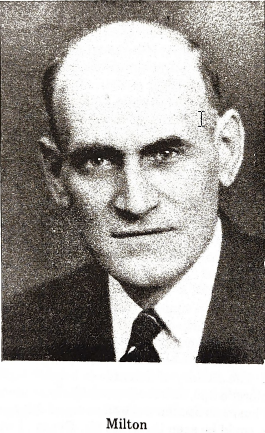 [PHOTOGRAPH — Portrait of a Milton]
Milton
It was during the long, lonely nights during Daddy’s illness when he was resting that I studied the scriptures for comfort and help. At these times it seemed that the Book of Revelation opened to me and I saw it in a different light than I had ever seen it before. The very name of the book seemed to tell the purpose for which it was written. That purpose was to reveal Christ, who was, who is, and who is to come. I felt prompted to write fourteen sermons, each one revealing Christ as He is revealed in all His fullness and glory in that book. Here are His titles as they were shown to me:
He is “The Resurrected Christ,” “The Christ of After Easter,” “The Head of the Church,” “The King on the Throne,” “The Lamb Slain from the Foundation of the World,” “The Lion of Judah,” “The Redeemer,” “The Avenger,” “The Bridegroom,” “The Warrior,” “The Light,” “The Judge,” “The Life,” “The Benefactor.”
I have explained this because there is a connection with something concerning Daddy. First I wrote the sermons as the Lord showed them to me, then later I typed them and have since taped them.
Daddy’s condition had seemed somewhat better as spring of 1956 came on. He had been able to drive the car again and to get around quite well, as mentioned earlier.
My son-in-law, Rev. Keith Graham, at that time was pastor of the Free Methodist Church at Forestville, New York. Each pastor on the district was having a ten-day meeting — every evening except Saturday and twice on Sunday during Easter season. Keith and my daughter Genevieve both felt that I was the one to hold these meetings. So, as Daddy enjoyed driving and felt well enough to go, we went. He enjoyed so much staying in the same parsonage where he had lived as a boy, when his father was the pastor there. He saw many familiar places where he had played as a boy. Then, too, on the way home we stopped at a place where they were making and selling maple syrup and sugar and when he was young he enjoyed so much doing the same thing. I was always glad he took that trip. Of course he lived about a year after that, but most of his trips were to doctors’ offices or clinics.
But in about a year he had gone. From the time of his death I must travel alone. Lynn, our youngest daughter, was married soon after on Memorial Day, May 30, 1957, in the Methodist Church in Arlington, Virginia, where her husband William Riggs of Rochester, New York was about to enter civilian life after serving with the Marines. They would both be working in Washington, D.C.
After the funeral, I spent some time in the fall at Ebenezer, New York, where Genevieve and her husband lived. He was pastor of the Free Methodist Church there.
Louise’s husband, Everette Campbell, had graduated from Roberts Wesleyan College and they had gone to Denver to live some time before. He was attending the University of Denver. In the fall of 1957, they invited me to go out and stay with them. They lived in a large trailer park. I went by train from Rochester to Chicago. I reached there about 6:00 P.M. and soon was on another train going to Denver. I had traveled on trains a lot but I think this was my first time to ride all night, except sleeping in a state room on a boat, when I went to New York City on a night boat when I was nine years old back in 1902. That time I left Troy on the Hudson at 6:00 P.M. and got into New York at 6:00 A.M.
I didn’t get a roomette but just tipped my seat back and watched the moon and the prairies for miles and miles. I reached Denver in the morning, where Everette met me at the train and took me to their trailer.
I had never been west of Chicago, so the flat plains, the rivers, lakes and mountains were wonderful to see. The scenery of Colorado is beautiful. We took many trips to Boulder, Longmont, Colorado Spa, and the great military academy there, the beautiful parks, universities and business section were all new and different. Where they lived, from our front window, could be seen the great Mt. Evans. I was alone days, as both Louise and Everette were away during the day. I could see a great, high mountain peak as I sat looking out one day. It looked, as it towered above the flat roofs of the shopping plaza on the next street, as if it might be just back of that main streeet. So I decided to walk over and take a closer look at it, as I had nothing to do right then. I walked out of the trailer court to the main street and up to the corner, then turned in the direction of that high hill. I could see it ahead of me, but it seemed it moved ahead of me. After I had walked several blocks and was no nearer to it, I approached a passer-by and naively asked how much farther I had to go to reach that mountain. “Oh,” she said, “that’s at least twenty miles away.” Then and there I decided to give up my quest.
At Denver was an immense outdoor theatre made of stone and situated on a mountainside. This was the famous Red Rock Theatre. It is here that Easter Sunrise Services are held. From this place one could see far across the level land, as far as the eyes would allow, and see the sun rise in all its glory.
Not far from Denver was the Glenwood Spa, one of the largest swimming pools in the world, fed by water from hot springs. Then there was Cheyenne Mountain, where up a winding road, through a stone arch and up to a peak, is seen the beautiful Will Rogers Shrine. At this same Mountain Cheyenne is a zoo with all kinds of animals and birds. Then too, at Colorado Spa is the Garden of the Gods, with rocks in formation resembling many things. In southern Colorado are the famous largest-known cliff-dwellings where people once made their homes in the mountainsides.
What a thrilling experience to visit the Royal Gorge and to step out on the highest bridge in the world and look almost as far as one can see down below, 1053 feet below, to the waters of the river tumbling along.
At Colorado we saw the great Air Force Academy with men marching to the dining area for the evening meal. We must not forget Pike’s Peak, America’s great mountain, or yet our trip through Denver Mint or the beautiful State Capitol. It has been my privilege to go through the state capitols of many states; just to mention a few: New York State Capitol at Albany, New York; Massachusetts Capitol at Boston; Alabama Capitol at Montgomery; and Colorado Capitol at Denver.
While at Denver, a ministerial convention was held in the spring of 1958 at our church college at McPherson, Kansas. I went by car with another lady and three preachers from the Denver area. It was about 500 miles there. On the way, there was some discussion about our modern young people. Some remarks were favorable, and some not so favorable. One of the Denver preachers, Rev. Peoples, was “all for them’” and strongly defended them. When we arrived there, my friend and I were assigned to a very nice place to stay, just across from the church. The preachers were sent to stay at the college dorm. The next morning we went to the college for breakfast. When the preachers came in we asked them if they had a nice place to stay. The one who had so strongly stood up for the young people acted sort of grumpy. He said, “No, I didn’t sleep. I couldn’t. Some of those kids got out in the hall and rolled pop bottles, making so much noise I couldn’t sleep.” He sure had changed his tune.
We did have a wonderful trip. My friend and I were invited to dinner at a home of one of the members, Mrs. Green, who was a good friend of the lady I was with. Bishop Taylor and his wife were staying there. I had known them very well when they lived at North Chili, where I now live, so we had a good visit. Our hostess was a very nice person. I just learned recently that she was the mother of Mrs. Ahern, whose husband taught here in Roberts Wesleyan College for quite awhile and they lived here. It made one feel that really the world is quite a small world after all.
[PHOTOGRAPH — Portrait of a Milton]
Milton
It was during the long, lonely nights during Daddy’s illness when he was resting that I studied the scriptures for comfort and help. At these times it seemed that the Book of Revelation opened to me and I saw it in a different light than I had ever seen it before. The very name of the book seemed to tell the purpose for which it was written. That purpose was to reveal Christ, who was, who is, and who is to come. I felt prompted to write fourteen sermons, each one revealing Christ as He is revealed in all His fullness and glory in that book. Here are His titles as they were shown to me:
He is “The Resurrected Christ,” “The Christ of After Easter,” “The Head of the Church,” “The King on the Throne,” “The Lamb Slain from the Foundation of the World,” “The Lion of Judah,” “The Redeemer,” “The Avenger,” “The Bridegroom,” “The Warrior,” “The Light,” “The Judge,” “The Life,” “The Benefactor.”
I have explained this because there is a connection with something concerning Daddy. First I wrote the sermons as the Lord showed them to me, then later I typed them and have since taped them.
Daddy’s condition had seemed somewhat better as spring of 1956 came on. He had been able to drive the car again and to get around quite well, as mentioned earlier.
My son-in-law, Rev. Keith Graham, at that time was pastor of the Free Methodist Church at Forestville, New York. Each pastor on the district was having a ten-day meeting — every evening except Saturday and twice on Sunday during Easter season. Keith and my daughter Genevieve both felt that I was the one to hold these meetings. So, as Daddy enjoyed driving and felt well enough to go, we went. He enjoyed so much staying in the same parsonage where he had lived as a boy, when his father was the pastor there. He saw many familiar places where he had played as a boy. Then, too, on the way home we stopped at a place where they were making and selling maple syrup and sugar and when he was young he enjoyed so much doing the same thing. I was always glad he took that trip. Of course he lived about a year after that, but most of his trips were to doctors’ offices or clinics.
But in about a year he had gone. From the time of his death I must travel alone. Lynn, our youngest daughter, was married soon after on Memorial Day, May 30, 1957, in the Methodist Church in Arlington, Virginia, where her husband William Riggs of Rochester, New York was about to enter civilian life after serving with the Marines. They would both be working in Washington, D.C.
After the funeral, I spent some time in the fall at Ebenezer, New York, where Genevieve and her husband lived. He was pastor of the Free Methodist Church there.
Louise’s husband, Everette Campbell, had graduated from Roberts Wesleyan College and they had gone to Denver to live some time before. He was attending the University of Denver. In the fall of 1957, they invited me to go out and stay with them. They lived in a large trailer park. I went by train from Rochester to Chicago. I reached there about 6:00 P.M. and soon was on another train going to Denver. I had traveled on trains a lot but I think this was my first time to ride all night, except sleeping in a state room on a boat, when I went to New York City on a night boat when I was nine years old back in 1902. That time I left Troy on the Hudson at 6:00 P.M. and got into New York at 6:00 A.M.
I didn’t get a roomette but just tipped my seat back and watched the moon and the prairies for miles and miles. I reached Denver in the morning, where Everette met me at the train and took me to their trailer.
I had never been west of Chicago, so the flat plains, the rivers, lakes and mountains were wonderful to see. The scenery of Colorado is beautiful. We took many trips to Boulder, Longmont, Colorado Spa, and the great military academy there, the beautiful parks, universities and business section were all new and different. Where they lived, from our front window, could be seen the great Mt. Evans. I was alone days, as both Louise and Everette were away during the day. I could see a great, high mountain peak as I sat looking out one day. It looked, as it towered above the flat roofs of the shopping plaza on the next street, as if it might be just back of that main streeet. So I decided to walk over and take a closer look at it, as I had nothing to do right then. I walked out of the trailer court to the main street and up to the corner, then turned in the direction of that high hill. I could see it ahead of me, but it seemed it moved ahead of me. After I had walked several blocks and was no nearer to it, I approached a passer-by and naively asked how much farther I had to go to reach that mountain. “Oh,” she said, “that’s at least twenty miles away.” Then and there I decided to give up my quest.
At Denver was an immense outdoor theatre made of stone and situated on a mountainside. This was the famous Red Rock Theatre. It is here that Easter Sunrise Services are held. From this place one could see far across the level land, as far as the eyes would allow, and see the sun rise in all its glory.
Not far from Denver was the Glenwood Spa, one of the largest swimming pools in the world, fed by water from hot springs. Then there was Cheyenne Mountain, where up a winding road, through a stone arch and up to a peak, is seen the beautiful Will Rogers Shrine. At this same Mountain Cheyenne is a zoo with all kinds of animals and birds. Then too, at Colorado Spa is the Garden of the Gods, with rocks in formation resembling many things. In southern Colorado are the famous largest-known cliff-dwellings where people once made their homes in the mountainsides.
What a thrilling experience to visit the Royal Gorge and to step out on the highest bridge in the world and look almost as far as one can see down below, 1053 feet below, to the waters of the river tumbling along.
At Colorado we saw the great Air Force Academy with men marching to the dining area for the evening meal. We must not forget Pike’s Peak, America’s great mountain, or yet our trip through Denver Mint or the beautiful State Capitol. It has been my privilege to go through the state capitols of many states; just to mention a few: New York State Capitol at Albany, New York; Massachusetts Capitol at Boston; Alabama Capitol at Montgomery; and Colorado Capitol at Denver.
While at Denver, a ministerial convention was held in the spring of 1958 at our church college at McPherson, Kansas. I went by car with another lady and three preachers from the Denver area. It was about 500 miles there. On the way, there was some discussion about our modern young people. Some remarks were favorable, and some not so favorable. One of the Denver preachers, Rev. Peoples, was “all for them’” and strongly defended them. When we arrived there, my friend and I were assigned to a very nice place to stay, just across from the church. The preachers were sent to stay at the college dorm. The next morning we went to the college for breakfast. When the preachers came in we asked them if they had a nice place to stay. The one who had so strongly stood up for the young people acted sort of grumpy. He said, “No, I didn’t sleep. I couldn’t. Some of those kids got out in the hall and rolled pop bottles, making so much noise I couldn’t sleep.” He sure had changed his tune.
We did have a wonderful trip. My friend and I were invited to dinner at a home of one of the members, Mrs. Green, who was a good friend of the lady I was with. Bishop Taylor and his wife were staying there. I had known them very well when they lived at North Chili, where I now live, so we had a good visit. Our hostess was a very nice person. I just learned recently that she was the mother of Mrs. Ahern, whose husband taught here in Roberts Wesleyan College for quite awhile and they lived here. It made one feel that really the world is quite a small world after all.
Chapter 6
After the convention in Kansas, we went back to Denver. We attended the Englewood Free Methodist Church while we lived there. Miss Persis Phelps, one of our well-known foreign missionaries, had returned to her home and had a large class of ladies in the Sunday School. Her sister, with whom she stayed, became quite ill so Miss Phelps had to give up her class and care for her. From then on, I taught the class until I returned East. While there, I did as I do at any church I attend, try to fill in any place where I may be needed. I played the organ, sometimes the piano, and even preached at a Sunday night service. Louise was also involved very often in the music program and in other ways, also Everette. Since I gave myself to the Lord I have always felt it was only right to make myself available and do what little I could do to spread the kingdom of God in the earth. When Everette finished his work at Denver University, he decided to take a teaching position in California. Awhile before, I had received word that Genevieve had broken her arm and as she had two babies, Bobby and Tommy, and also duties as a preacher’s wife, I decided I was needed in their home. I came back to New York State and to their home at Ebenezer, New York. After she was over her trouble, I came back to Caledonia, where Dee’s folks now lived. George was employed there. They attended church at Perry, New York. I was just in time to be asked to bring a message there on Sunday, at the Mother’s Day services. After being with Dee’s family awhile, I went to Boston to visit my eldest sister Ida and her family. This was not my first trip there, for in my early teens I had been there and spent several weeks in the summer. Then, I had seen many historical places and had been in the ocean waters at Revere Beach. I went to Boston several times over a period of years. In some of my other trips there I had attended Tremont Temple on Easter Sunday and heard the great choir sing and Rev. Cortland Myers, preach a wonderful sermon on “The Resurrection of Chirst.” At other times, I visited Harvard Museum, had gone through the State Capitol, visited Longfellow’s home, had seen the locale of the Boston Massacre, visited the Old Cemetery where so many of the founders of our country are buried, such as Benjamin Franklin’s grave and others. Nearby was the Old Park Street Church and many other historic sites. Afterward, I returned to Dee’s home at Caledonia, but it wasn’t long before I went to visit my relatives, the Lesters, still living there in Washington County, New York. One reason for going there was because this was where my father’s ancestors had lived and he had lived when a small boy. Over the years I had learned enough about my father’s ancestry to want to make it a study. Before this time I was always so busy with the family and otherwise that I never seemed to find time to do it. I had visited up there as a child and had stayed in the lovely home of the Charles Tilfords. This was the house which was first built by my great grandfather, George Lester. Ada Tilford was my father’s cousin. The house had been modernized and there were large barns and it is still a large, productive farm. It was built in the late 1700’s before there was what is now called “New York State.” Though some things were changed, the same old spring is flowing down through the farm. While there, I learned that another cousin of my father’s, Grace Wilmarth, had also become interested in this same Lester history. Her home was in Washington, D.C., but she had come up to Argyle some time before and had uncovered a lot of history. From records and other means she had found that the family had formerly lived first in
England and were of the family of the Earl of Leicester. Our ancestors had left England and had gone to live on large estates in the north of Ireland, which had been granted to them for distinguished military service. Here they had become involved in the Presbyterian Church and they were supplied with pastors from the Presbyterian Synot at Stirling, Scotland. My great grandmother had come to Ireland from Scotland. There were some practices allowed in the Church in Ireland, to which they could not adhere, so a large group, led by a Rev. Thomas Clark, broke away from the regular church. As a result they were bitterly persecuted; their pastor was jailed for a time. The babies were brought to the jail to be baptized, the young couples to be married. After awhile he was released. It was then a large group decided to move their church and its adherents to America, which was just being settled. They were granted the land around Lake George, Argyle, Ft. Edward; in fact what is now included in Washington County. There is a book called “The Salem Book” in the Washington County Courthouse which gives the history of this group. Some of the descendants are still living on some of the farms that have been in the family since 1764. This was a very interesting pastime for me. I had a great desire to learn all I could about the (Leicester, Lester, Lister, Leyster) family because I wanted to put it all in a book for future Lesters to read. When I returned to Caledonia, I did a lot more searching. In the town library I learned that one of the preachers of that early time in Washington County had come to Caledonia at the call of several families, who had come to settle in that area from Scotland. The records tell that he organized what was the old stone church – The United Presbyterian Church in Caledonia. Many very old graves were in the cemetery back of that church. The group, who came to America from around Belfast, Ireland became The United Presbyterian Church of America. Now they are all united again and are called The United Presbyterian Church. Having arranged my materials, I didn’t know what to do next to have them printed in book form. While I was in the East, Louise and Everette had moved to California after he finished at Denver, to the desert area north of Los Angeles, about six miles from Edwards Air Force Base. They had invited me to go out there and stay with them. So on the last day of the year, I took a train from Buffalo to Chicago arriving there New Year’s Eve about 6:00 P.M. Later I boarded a train for Los Angeles. It was another two nights on the train. Many soldiers and sailors rode on that train going to the West Coast. During the evening, they met together and many of them had liquor with them. They went to the dining car before midnight, where they had a celebration. I didn’t have a roomette, as I can’t sleep on trains anyway, so I sat in my seat and looked out the window. Two young men had sat across the aisle from me; one in uniform, the other, a college student from Santa Barbara, California. I had overheard some of their conversation before they attended the midnight party. One had a briefcase (the officer). In it he had some sandwiches; I also saw him show a gun to the other fellow. They were well-behaved before they went to the midnight party, but after “boozing”, I didn’t know what they might do with that gun. The lights in the car were dimmed and everyone seemed to be snoozing, but I couldn’t sleep. Long after midnight they came unsteadily down the aisle to find their seats. After they were seated, the college student stood up and said to the other one, “Oh, say, we forgot what we decided out at the party. Don’t you remember, we decided that we had a right to kiss any woman or girl on the train on New Year’s Eve”? I was
the nearest woman to them. I thought, “Mister, you just start anything like that and you’ll suffer for it.” Well, the other fellow by that time had lost interest in such things and had settled down to “sleep it off,” so he seemed to give up too and sat down and was heard from no more. I felt the Lord had protected me, because guns and booze are a very dangerous mixture and one can never tell what may happen. I arrived in Los Angeles the morning after New Year’s Day, and Louise and Everette were there to meet me. I was just a day late for the Rose Bowl Parade. They had come to Los Angeles the night before the parade and had seen it. As I remember, we drove about sixty miles, first over the Angeles Crest from where may be seen miles of cities. Then we drove down into the Mohave Desert where the sand is deep and everywhere; where the odd-looking Joshua trees were growing. They looked like crippled, bent-over old men. Other unusual flowers were seen. After the long ride, we reached Rosamond, almost close enough to Edwards Air Force Base to see it. This was the home of the famous X15 rocket, about six miles to the east of us. Here everything was new and different. There was no green carpet covering the ground. In yards fenced around, dirt was spread and grass and flowers flourished, but outside the fence was sand, sand, sand. The lights of Lancaster could be seen at night, ten miles away. In the far distance, we could see high mountains covered with snow, while the temperature where we were might be 106. Everette was teaching school at Rosamond, while Louise did some teaching and library work over at Lancaster. I was alone during the day but usually found things to do. Dr. and Mrs. Davis, who were at Roberts Wesleyan College at North Chili for a time, were now in L.A. and teaching. Often on weekends, we went down to L.A. and were entertained in their home. They had a nice piano and I enjoyed playing it. We attended the Hermon Church with them. There were some people I had known well during my days in evangelistic work, who also attended that church. I attended a surprise party given in honor of Mrs. Evangeline Thuline, whom I had known when she was Evangeline Crockett. We had held meetings in her father’s church in Binghamton, New York when she was attending Greenville College and later I had known her when she was at the Bandworkers’ Training Home at Weedsport, New York. This was when Miss Collier and I were pastors of the Free Methodist Church at North Chittenango, New York. It seems strange how old friends meet in such far away places. While at Rosamond, Mrs. Davis’s brother and wife were also living near the Air Base. He had something to do with planes and rockets. Their real home was in Whittier, California. I had become well acquainted with the brother’s wife while living on the desert, so when they returned to Whittier, they invited me to visit them, so I was at Whittier for about a week. While at Rosamond, we attended the Nazarene Church at Lancaster about twelve miles away. I taught a large adult Bible Class part of the time, sang with the choir, played the piano sometimes or the organ when needed and preached one Sunday night. Louise also conducted the choir there. Around 1960, we went to see many interesting places while there, such as Marine Land of the Pacific, Knotts Berry Farm, Disneyland, Hollywood, Whittier, Bakersfield, Lancaster and others. My nephew, Louis Lester, lived near Los Angeles. One night he came up to Louise’s house to supper. When he saw my manuscript of the Lester family history, he was quite excited and offered to have it printed by their own machines in his plant. I was very glad to find a way to preserve what I had found, so I gladly accepted his offer. One week later, when we returned, after being away, I found one hundred copies of
the book with the Lester Coat-of-Arms in color on the cover of the book. One trip we made while in the West was one we took from where Louise lived in the desert in California to Phoenix, Arizona. It was a long distance to go over the desert sands, through the little towns. We received a warm welcome in more ways than one. We were entertained in the home of Bob and Melva Hendricks for several days. While there we saw many interesting things and places. But it was hot! Oh, so hot! Wherever you were, whether at home or church, there was air conditioning. It was around the 30th of May, with temperatures around 106. A wind from an air conditioner was blowing on you, whether awake or asleep. By the time we went home, I had a cold or sore throat or something. I had to lie on the back seat of the car, I was so miserable. We drove from around 4:00 in the afternoon, until the next morning to reach home. We attended the Free Methodist Church in Phoenix while there on Sunday and enjoyed meeting friends. At the close of the school year, we headed back for New York State, where Everette would be teaching at Roberts Wesleyan College and Louise would be Dorm Mother. Their goods came by truck from California to the college here in New York State. Our journey back from the West was very enjoyable. We drove north from Rosamond to Needles, California, the hottest place in the United States. It was late evening when we stopped at a restaurant there for a little rest and refreshment. When ready to leave, as we opened the door to leave, it seemed as if the heat was so solid, you felt something that seemed like a slap in the face. We drove all night and reached Grand Canyon about the time the visitors and tourists were getting out for breakfast. We stopped there for our morning meal, visited all the interesting views of the Canyon, then drove on. Most of the places we passed through were hardly more than hitching posts. In the evening, we stopped at a motel in Utah for the night. As we often find copies of the Holy Bible in the motel rooms when traveling, here we found copies of the Book of Mormon instead. I had bought a copy of that book while in California, read it and discussed it with some people there. I was interested in it because the whole system had started not far from where I lived, in Ontario County, New York. The next day we continued on our journey. When we came to the Rocky Mountain country, I was so glad and excited to see the beautiful tall trees with their luxuriant foliage, I felt I would like to get out of that car and embrace those majestic trees. On the desert, the trees were such dwarfs, they gave no shade. But these trees! They were like the trees I had been brought up with “way down East” in the Hudson Valley and Adirondack region. I thought of my childhood days, when the sap began to run in the maple trees, how we kids would get most any kind of a bottle and pound a nail into the tree to make the sap run. There we would stand from after school till dark and time to go for supper with the bottle in one hand and a straw poked into the hole in the tree and the other end in the bottle and wait for the sap to drip, drip drip into the bottle. It was still cold weather, our hands and feet would be nearly frozen. We endured with patience, just to have our mothers explain, when we insisted on her boiling it down to syrup and sugar, that there was just not enough to do this. All our work was in vain, but we did love those old trees. That was why I had these wonderful feelings as we headed through the Rockies to Denver, which would be our next stop. We reached Denver late in the afternoon. The Olsons were expecting us and entertained us royally for two or three days. Our next stop was at Jeffersonville, Missouri, where we stayed overnight in a very nice large hotel. In my postcard collection, I have one, a picture of the old house where Jesse James was killed and one of the old brick buildings which were the stables where they kept the ponies of the “Pony Express” of early western days. This was
where they began and finished their trips. The hotel where we stayed was called “The Pony Express Hotel.” By noon the next day we were at Hannibal, Missouri, which was where Mark Twain had lived. We ate at a very nice restaurant. From there I made a long distance call to Winona Lake, Indiana. The 1960 General Conference of the Free Methodist Church was in session there. I wanted to arrange for a place to stay when we would reach there as I was planning on stopping there for a few days. That afternoon we reached Springfield, Illinois, the home town of Abraham Lincoln. We visited the place which was once his home and what impressed me most was the way everything was arranged so it seemed as if he might have been sitting at that desk writing only yesterday. There were the old style eyeglasses lying on his desk as if he had just laid them down when he was called to dinner. In the front hall, on a rack hung his tall silk hat. Upstairs was the bedroom with a little rocking chair beside the mother’s chair. Perhaps she had told bed-time stories from that chair. It seemed as if our yesterdays and todays were all of one piece. We saw several other places about town where our President had lived and worked. We still had quite a stretch of road to cover between there and Winona Lake. It was 1:00 A.M. when we reached the Administration Building. On the phone, we had been told to come to that building when we arrived and we would learn where I was to stay. But! The place was all dark and no other place seemed to be open either. Everette went up the walk to the door and there was a note telling me to go to the Bauer home. We found it and were received graciously, even if it was almost the middle of the night. Then Louise and Everette left me, as they had planned to continue driving all night. While at breakfast the next morning I discovered they had stayed at the Inn the rest of the night. Later that day they left for Rochester. I was there until Conference closed, July, 1960. Then a preacher from Genesee Conference who had a large station wagon allowed several of us to ride back to New York State with him. It was late in the evening on a Monday early in July when I reached the home of my son, Eldon, who lived just west of Batavia. I stopped there for a few days, then went on to Dee’s in Caledonia where I stayed for awhile. They attended the Free Methodist Church in Perry, New York at that time. Their Sunday School picnic was held in a beautiful park there. I was asked to bring the scriptural meditation after the supper. About that time, after traveling and going here and there, I decided I would like to settle somewhere in an apartment at North Chili, New York where I could have my books, music and other treasured things where I could use them. At first, from spring until fall of 1961, I shared an apartment with Celeste Smith, upstairs on the corner of Buffalo Road and Union Street in North Chili. We shared the housework and cooking and cost of meals. Finally she decided to give up the place in September. I was fortunate to find another of my own. It was owned by the O’Brien sisters, Mildred and Lois. There were four rooms partly furnished with bed, dresser, dining furniture, folding couch-bed in the living room, electric range to cook on and a refrigerator. I had to wait awhile before I could go there. However, I had become a member of the Womans’ Christian Temperance Union and was chosen as delegate to represent Monroe County at the State Convention at Jamestown, New York. I went and when I returned, the apartment was ready for me to move in. This was about October 15, 1961. How happy I was! The situation was perfect for me. The church I would attend was on the corner from my home, the Post Office was on the same block, the shopping plaza was nearby. I bought a desk, bookcase, had an electric sewing machine. I have an electric organ, bought by my children. After living here about twelve years, I have all I could wish for.
Before I come to the end of this conglomerate history, I want to add two other important trips I haven’t mentioned and I don’t think they should be left out. I spent two winters in Alabama with Genevieve and her family. The first time I went down, I went from Rochester, New York to Cincinnati, Ohio, then took another train to Birmingham and Mobile. There Genevieve’s husband, Keith Graham, met us and we drove to their home north of Mobile, at Leroy. He was pastor of the Methodist Church there. They had a very pleasant parsonage and served two churches. While there I went to Montgomery, went through the State Capitol and saw many other interesting things. We also visited the Bellingrath Gardens. It seemed they must be almost as beautiful as Eden. I was there at the time azalias were in full bloom. Words fail me to describe their beauty. They were everywhere abloom in the city of Mobile also at that time. One day we took a trip north from Leroy, then west into Mississippi to Jackson, and from there south to the Gulf of Mexico and the towns of Gulfport and Biloxi. Then we turned east to Mobile and north from there back to Leroy. A regional convention of the Gideons’ organization was held in Mobile at a beautiful motel. I had the privilege of attending it with some friends and my daughter and husband. I also attended a great gathering of Methodist youth groups from all over the Southland which was also at Mobile. Genevieve was teaching school at Jackson, Alabama. Keith was pastor of the Methodist Church at Leroy. When spring came, like the birds, I headed back North. The next year I went down there again, but by a different route. I took a bus from Rochester to Philadelphia, stayed overnight with friends at Gloucester, then rode all day and night by auto from Gloucester, arriving at Pensacola, Florida, early Sunday morning. I stayed with Keith’s folks over Sunday and Keith came on Monday and took me back to their home in Leroy. That time, when I returned North, I took a different route again. Keith drove from Leroy to Birmingham, where I took the train in late afternoon to Washington, D.C., arriving the next morning. Lynette lived there. Bill met me at the train and I was with them for a few days. I returned by train to Buffalo, where my son Eldon met me and took me to his home in West Batavia. Later, he brought me back to my home in North Chili. Both these trips were taken after I had moved to North Chili. My children have been wonderfully kind and thoughtful of my needs and even my wants. I have all I could ask for. They have given me many gifts — I have a nice Zenith TV, an electric toaster, which I use daily; I have a radio, an electric organ, a GE casette. A camera was another gift, and an electric hair dryer. I have a Royal typewriter on which I typed my story herein related. I have several lovely lamps, some handcrafted that my children have given me. What more could I ask? I am quite content with my lot. “Godliness with contentment is great gain.” It seems each one has contributed to make my life happy, contented and eventful. I am a very busy person. Each week I have so much scheduled, I have to list my activities and appointments so I don’t forget them. At the time of this writing, I will be having my 81st birthday on July 10, 1974, about three months hence. When people, in my presence, talk about me as one of the “old folks,” I keep thinking they must be talking about someone else, not me. I am interested and involved in so many things, I just don’t have time to be “old.” At present, I am a member of the Pearce Memorial Church at North Chili and attend both morning and evening services on Sunday, also Sunday School. On Wednesday night I play the piano for the mid-week prayer service. Once a month I attend the Official Board Meeting on Tuesday night. Being a member of the Senior Citizen’s group, I have attended their luncheons, have sung with a quartette and played piano duets on their programs. I
have also gone on one of the trips offered, to Southern New York, also Gerry Home, New York. Then there is my large family, with eight children married, and eight in-laws (no out-laws), and twenty grandchildren. Vernon and Eula have two children: James, who is married to Anne Seiler; and Daniel. Dee and George have three children: Margaret, who is married to Robert Merkle; Glen, and Janet. Eldon and Zina have two children: Laura and Nathan. Genevieve and Keith have three children: Robert, Thomas, and James. Lawrence and Leva have four children: David, Stephen, Diane, and Richard. Louise and Everette have one daughter, Bonnie. Lester and Mary Jane have four children: Stephen, Douglas, Kevin, and Cheryl. Lynette and Bill have one daughter, Susan. This all adds up to enough to keep me occupied most of the time. Since moving to North Chili, I have been active in the W.C.T.U. For a number of years I have been president of our local union, second vice president of Monroe County, also public relations director for the County. With meetings to plan for each month such as programs, committees and other duties, it takes much time and effort. I have attended New York State Conventions each year for a number of years. They have taken me to places such as Jamestown, Massena, Rochester National Convention, Syracuse twice, Utica, Cobleskill, Canandaigua, Poughkeepsie, Salamanca and some other places. Usually tours are promoted at these places, like the Seaway at Massena, Franklin Roosevelt Mansion and many other places. This year is the 100th Anniversary of the W.C.T.U. The National Convention is to be held at Cleveland, Ohio, and New York State at Jamestown, New York where it was first organized in 1864. A book of songs is to be used, with songs chosen from the contestants in New York State. A song which I wrote is to be included in the book. I also have a seven-page instrumental number which I wrote and had copyrighted but never had it published. The Lord has been good to me. He has shown His love and care over me and mine. I can do nothing else but give Him the praise for all His benefits and mercies.