The Little Preacher from Troy: Chapter 5
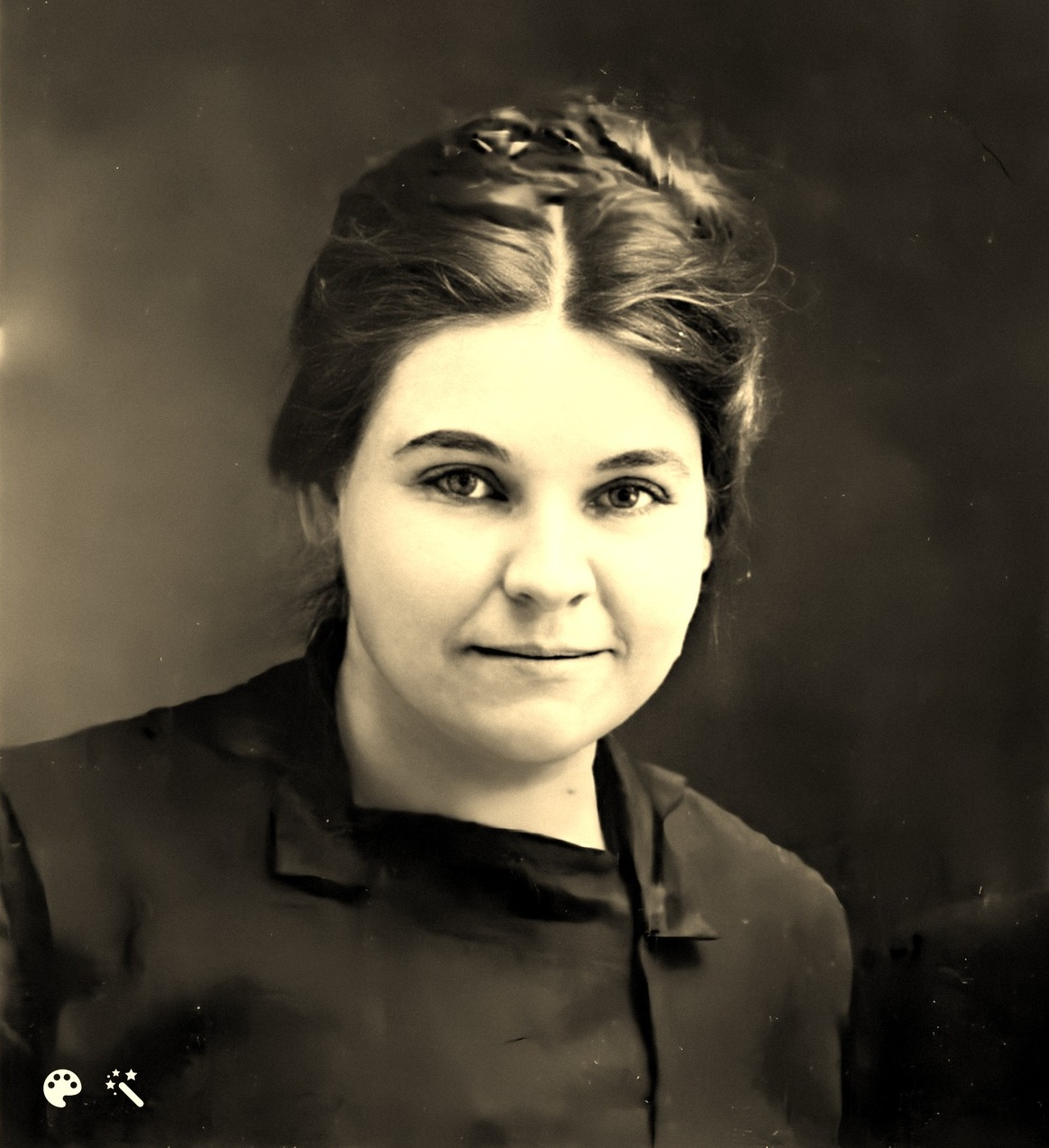
It seemed so many things happened in that house on North Street in Caledonia, while we lived there over a period of fifteen years.
With some of the family away at school, others in the Army or working in other places, I didn’t have so many duties at home but what I could become involved in some extra activities. I attended typing classes for awhile, but they were closed because not enough people came. When the Christmas holidays were approaching, I decided to get a job clerking. For four weeks I worked as clerk in a 5 & 10 store in Leroy nearby. It was interesting work. A short time before this, while we lived in Mumford, I also took a course in home nursing.
At this time, I was attending the Wesleyan Church in Avon, New York and teaching the Young People’s Class. Youth for Christ meetings had become quite popular to those around Rochester. It occurred to me one night, while waiting for George and Stella Henry (who were on the Official Board at church) to pick me up for church, that it was so far for young people from the Avon area and the churches of the various denominations south of Avon to Rochester, that someone ought to promote a local Youth for Christ on Saturday nights in Avon and invite the young people from all churches in that area. I explained my idea to my friend, Stella Henry, in whispers. Next thing I knew, they presented it to the Official Board and suddenly I found myself appointed as the one to promote it.
That meant that every week I had to write invitations and notices to the pastors in several towns. It was up to me to plan the service, get special speakers, some who came quite a distance. By the time I had cleaned the house, baked pies and cakes and cookies for over Sunday and did many other things, rode to Avon, led the singing, and all that went with it, I was really tired enought to get some rest on Saturday night.
One night I remember so well. A group of young people had come with their instrument from Batavia Wesleyan Church. Of course we invited them over to Caledonia to our house for lunch afterward. I was pouring tea through the strainer with no cup under it! I really had “had it!” I really was hardly responsible for what I was doing.
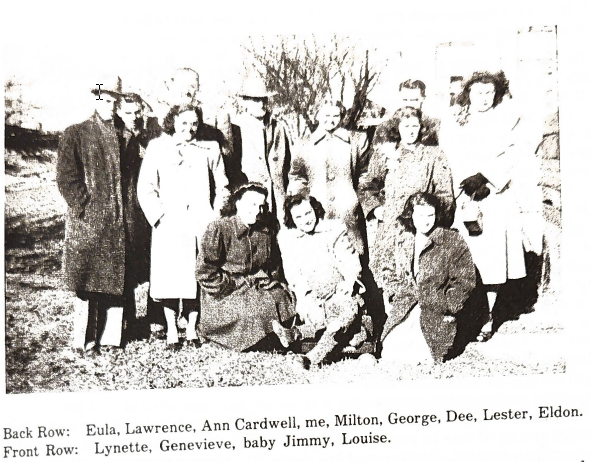
While living on North Street, we nearly always had a full table every Sunday. Some of the children at first used to be home from college or from their jobs away from home. Our family liked to get together on Sundays and this continued until after they were all married and had children and then they came too. Several times we made tapes of the family singing, playing and speaking.
 [PHOTOGRAPH — Group photo outdoors]
Back Row: Eula, Lawrence, Ann Cardwell, me, Milton, George, Dee, Lester, Eldon.
Front Row: Lynette, Genevieve, baby Jimmy, Louise.
We were a musical family. Daddy had a beautiful voice, mother had sung solos and been song leader in religious services for many years, had sung in choirs and studied vocal music at Syracuse University. Daddy had sung in the Buffalo Philharmonic while in college and teaching there.
In the family, we had a fine male quartette, also some male soloists. The same was true of the girls. We had quartettes, trios, and soloists. We are so glad to have tapes of their singing while they all lived near home, and especially of Daddy singing and reading scripture. When the grandchildren came, their voices were also recorded.
In the fifteen years we lived on North Street, many changes took place. Vernon, our eldest son, by this time had returned from service in the Air Force overseas as troop carrier pilot. He had married Eula Maddox of Atlanta, Georgia on June 30, 1943, and they were living in Rochester. Ethelyn had married George Reed, whom she met while we lived near Monticello, New York. She graduated from Buffalo State Teachers College with Genevieve on Tuesday, June 13, 1948, and was married to George Reed the next Saturday, June 19, 1948 in the Rochester Free Methodist Church. The reception was held at our North Street home, with 120 guests present.
Eldon had been in the Army as chaplain’s assistant, but after returning home he had worked in Batavia. There he met Zina Cade, whom he later married on January 19, 1952. The wedding was performed in the Wesleyan Church in Batavia, with reception following.
After finishing her work and graduating from Buffalo State Teachers College on June 13, 1943, Genevieve taught in Perry, New York for three years; then went to Asbury Seminary at Wilmore, Kentucky where she received her master’s degree in religious education. There she met Rev. Keith Graham of Pensacola, Florida. They were later married on June 25, 1955 in Pearce Memorial Church at North Chili, New
[PHOTOGRAPH — Group photo outdoors]
Back Row: Eula, Lawrence, Ann Cardwell, me, Milton, George, Dee, Lester, Eldon.
Front Row: Lynette, Genevieve, baby Jimmy, Louise.
We were a musical family. Daddy had a beautiful voice, mother had sung solos and been song leader in religious services for many years, had sung in choirs and studied vocal music at Syracuse University. Daddy had sung in the Buffalo Philharmonic while in college and teaching there.
In the family, we had a fine male quartette, also some male soloists. The same was true of the girls. We had quartettes, trios, and soloists. We are so glad to have tapes of their singing while they all lived near home, and especially of Daddy singing and reading scripture. When the grandchildren came, their voices were also recorded.
In the fifteen years we lived on North Street, many changes took place. Vernon, our eldest son, by this time had returned from service in the Air Force overseas as troop carrier pilot. He had married Eula Maddox of Atlanta, Georgia on June 30, 1943, and they were living in Rochester. Ethelyn had married George Reed, whom she met while we lived near Monticello, New York. She graduated from Buffalo State Teachers College with Genevieve on Tuesday, June 13, 1948, and was married to George Reed the next Saturday, June 19, 1948 in the Rochester Free Methodist Church. The reception was held at our North Street home, with 120 guests present.
Eldon had been in the Army as chaplain’s assistant, but after returning home he had worked in Batavia. There he met Zina Cade, whom he later married on January 19, 1952. The wedding was performed in the Wesleyan Church in Batavia, with reception following.
After finishing her work and graduating from Buffalo State Teachers College on June 13, 1943, Genevieve taught in Perry, New York for three years; then went to Asbury Seminary at Wilmore, Kentucky where she received her master’s degree in religious education. There she met Rev. Keith Graham of Pensacola, Florida. They were later married on June 25, 1955 in Pearce Memorial Church at North Chili, New
York. Soon after they were assigned to the church they were to serve at Forestville, New York. Some years later, they moved South, where they presently serve the United Methodist Church at Eufaula, Alabama.
Lawrence served as sergeant in the Army and after spending a year at Nagasaka, Japan, he returned. He met Leva Lloyd of Scottsville, New York. Their wedding was held at our home on North Street in Caledonia on December 9, 1949.
While still living on North Street, Louise met Everette Campbell from Pennsylvania. They, too, were married at the Wesleyan Church in Batavia, New York on February 17, 1951 after which a reception was held at the Batavia YMCA.
After high school, Lester served in the Army in France and soon after his return from overseas, he married Mary Jane Darling of Clifton Springs, New York. They were married in the Canandaigua Wesleyan Church on August 8, 1953. The reception was held at the Methodist Church in Canandaigua. Lester and Mary Jane live in Phoenix, Arizona now.
All our family of eight children were married except Lynette. She was the last and only one left at home. She finished high school in 1953 and worked for awhile at the First National Bank of Caledonia and later at the Lincoln-Rochester Trust Company in Rochester. Her older brother Lawrence lived much nearer Rochester than we did, so she lived with him for a time, so Daddy and I were alone.
We left our home two or three years after Lynette graduated in 1953 and went to Addison, New York where there was a teaching job for Daddy, waiting. Often we came back to Caledonia to spend our weekends and would have the children who lived nearby home, so we could be together.
While at Addison, I attended typing classes again. I wanted to help Daddy in his work. Every ten weeks he had to have exams ready in six or seven subjects; he taught mechanical drawing, auto mechanics, cabinet work and other wood work, electrical work and general metals. Getting out so many exams made much work for the office people, so we planned to take care of it ourselves. Milton was not well. He was suffering from what the doctor called “phlebitis.” After our evening meal, he would lie on the sofa and dictate questions to me, which I typed. We bought a hectograph outfit and I would use the copy I had made and using the hectograph, we made the required number of copies of each exam needed by each class.
Religious instruction classes were being conducted each week in the Addison Public School. I had a large class which was held in a classroom in the school. Several teachers were doing the same with different age groups. This included all Protestant and Catholic groups.
Like the proverbial “fly in the ointment,” a man moved into the district who was an atheist. He made a big fuss and insisted that the Bible couldn’t be taught in a public school. According to his claim, if one person protested it couldn’t be allowed.
I, with my class, went to a nice large room at the Methodist Church, while some went to the Baptist Church, some to the Presbyterian. Each of these churches had nice, convenient assembly halls with pianos and other helps, so it was not too bad for us, but the Catholics only had a church building with no extra meeting rooms, so it was impossible for them to continue.
While at Addison, sometimes I played the piano at the Christian Alliance Chapel and also spoke at one evening service. I also attended some of the Methodist services and played the piano for some special services that were held there. Sometimes, Daddy and I would drive to Wellsboro, Pennsylvania, to attend the church where his brother Everette was the pastor. He built a new church there and Daddy helped on the building sometimes on weekends.
In Addison we had a very nice apartment, having high ceilings and large rooms. It was furnished very nicely and was convenient in every way. It was one of the old homes which was a historic landmark of an earlier period.
At the end of the school year, we went back to Caledonia for summer vacation. For many years we had attended our Church Camp at Barker, New York, on Lake Ontario, even when the family were all home. Daddy always arranged housing for us. We owned a lot there but there was no building on it. Sometimes we would have a very large tent, one time it was two large trailers he had built. One time he made a frame the size and shape of a small cottage. He built the framework at home, covered each section with canvas at home and hauled it up there in a large trailer, where he put it together. It had a high peaked roof and a door on hinges. There were sleeping arrangements for each of the family inside. It really was a clever, convenient arrangement. Of course, we ate our meals at the Dining Hall.
During summer vacation from teaching in Addison, we again attended camp at Barker. For that year, he had made a large house trailer. The children by that time were married, at work or away, so we went alone. After spending the weekend there, until the Monday night of July 4th, having some work to do at Caledonia, he went home that night. Two days later, when I returned to the trailer from lunch, I saw Lawrence’s car parked there. I thought it was very unusual that he would be there at that time of day, as he worked many miles from there at Kodak in Rochester. I started looking for him and soon met Daddy’s sister, Lena Janowsky. She asked if I had seen Lawrence. I said, “No.” She said she had met him and he was looking for me. Daddy was very ill, the doctor had been to see him and Lawrence had come to take me home. I did not realize that great changes would soon come to our lives. Ethelyn (Dee) and others had helped to care for him until I could reach home.
Most of the summer he was under the doctor’s care, but when it was time for school to begin in the fall, he seemed much better, so we went back to Addison and he began the fall term at school. But after a couple months of teaching and several consultations with doctors, he was sent back to the hospital in Rochester in 1955. After diagnosis, he was informed that he had cancer of the liver in its worst stages. After having surgery, he of course had to give up his position in the school. When he could leave the hospital, we took him to our home in Caledonia. At first he was very ill and could eat but little.
Then he heard of the Hoxsey Cancer Clinic at Portageville, Pennsylvania. It was a new and different treatment than the doctors or hospitals used. Claims were made of great cures. Of course he wanted to try it. During about a year and a half, we drove down there five times. It was a long distance from Rochester, New York to the southern part of Pennsylvania.
From then on, it was a long hard struggle of hope against hope for about a year and a half. He was able after a time to do some work around home, to travel and drive the car. I had not learned to drive the car. By the next July, 1956, he drove our house trailer up to Barker Camp but could not attend the meetings much, but he did enjoy sitting out in the open where he could see the trees and the lake.
After returning to Caledonia, it wasn’t long before he began to go downhill, until in the fall of 1956 he was confined to the bed. There he suffered for the next five months, until the next April 6, 1957, when he left us to enter a glorified life, free from all suffering and pain, sorrow and death.
The last words I heard him say were, “In my Father’s house are many mansions.” The next morning, when it seemed impossible for me to accept the fact that he really had left us, an awful loneliness seemed to grip me as I stood by the kitchen window looking out over the fields. I was trying to straighten out some things that were so hard for me to accept or understand. All during his illness, I had prayed for his recovery — but the awful fact — “He has gone,” seemed to grip me. “Why didn’t God answer my prayers for him and heal him”? Then it seemed as if Christ was right by my side saying, “You prayed that he might not suffer, that he might be well again. I have answered your prayer, perhaps not in your way. I know the future. I know also that if I had answered your prayer now, at his age he would have to suffer and meet death again, soon. Now he is restored, given new life that is everlasting. Death can never torment him again. I have taken him to where he will not suffer any more.”
This message from my Lord brought peace, submission, and comfort that helped me to go on into the unknown future without him, but Jesus would walk on with me and I had nothing to fear.
The day after his death there was a very bad snow storm. The funeral was held from Jenkins Funeral Home on North Street in Caledonia and later at the Pearce Memorial Church in North Chili. The burial was at the cemetery in North Chili, where there is a stone on the grave, just beyond the top of the hill, on which is inscribed, “In my Father’s house are many mansions.”
 [PHOTOGRAPH — Portrait of a Milton]
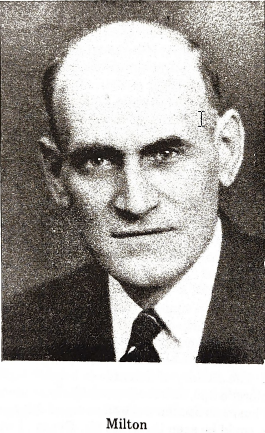
Milton
It was during the long, lonely nights during Daddy’s illness when he was resting that I studied the scriptures for comfort and help. At these times it seemed that the Book of Revelation opened to me and I saw it in a different light than I had ever seen it before. The very name of the book seemed to tell the purpose for which it was written. That purpose was to reveal Christ, who was, who is, and who is to come. I felt prompted to write fourteen sermons, each one revealing Christ as He is revealed in all His fullness and glory in that book. Here are His titles as they were shown to me:
He is “The Resurrected Christ,” “The Christ of After Easter,” “The Head of the Church,” “The King on the Throne,” “The Lamb Slain from the Foundation of the World,” “The Lion of Judah,” “The Redeemer,” “The Avenger,” “The Bridegroom,” “The Warrior,” “The Light,” “The Judge,” “The Life,” “The Benefactor.”
I have explained this because there is a connection with something concerning Daddy. First I wrote the sermons as the Lord showed them to me, then later I typed them and have since taped them.
Daddy’s condition had seemed somewhat better as spring of 1956 came on. He had been able to drive the car again and to get around quite well, as mentioned earlier.
My son-in-law, Rev. Keith Graham, at that time was pastor of the Free Methodist Church at Forestville, New York. Each pastor on the district was having a ten-day meeting — every evening except Saturday and twice on Sunday during Easter season. Keith and my daughter Genevieve both felt that I was the one to hold these meetings. So, as Daddy enjoyed driving and felt well enough to go, we went. He enjoyed so much staying in the same parsonage where he had lived as a boy, when his father was the pastor there. He saw many familiar places where he had played as a boy. Then, too, on the way home we stopped at a place where they were making and selling maple syrup and sugar and when he was young he enjoyed so much doing the same thing. I was always glad he took that trip. Of course he lived about a year after that, but most of his trips were to doctors’ offices or clinics.
But in about a year he had gone. From the time of his death I must travel alone. Lynn, our youngest daughter, was married soon after on Memorial Day, May 30, 1957, in the Methodist Church in Arlington, Virginia, where her husband William Riggs of Rochester, New York was about to enter civilian life after serving with the Marines. They would both be working in Washington, D.C.
After the funeral, I spent some time in the fall at Ebenezer, New York, where Genevieve and her husband lived. He was pastor of the Free Methodist Church there.
Louise’s husband, Everette Campbell, had graduated from Roberts Wesleyan College and they had gone to Denver to live some time before. He was attending the University of Denver. In the fall of 1957, they invited me to go out and stay with them. They lived in a large trailer park. I went by train from Rochester to Chicago. I reached there about 6:00 P.M. and soon was on another train going to Denver. I had traveled on trains a lot but I think this was my first time to ride all night, except sleeping in a state room on a boat, when I went to New York City on a night boat when I was nine years old back in 1902. That time I left Troy on the Hudson at 6:00 P.M. and got into New York at 6:00 A.M.
I didn’t get a roomette but just tipped my seat back and watched the moon and the prairies for miles and miles. I reached Denver in the morning, where Everette met me at the train and took me to their trailer.
I had never been west of Chicago, so the flat plains, the rivers, lakes and mountains were wonderful to see. The scenery of Colorado is beautiful. We took many trips to Boulder, Longmont, Colorado Spa, and the great military academy there, the beautiful parks, universities and business section were all new and different. Where they lived, from our front window, could be seen the great Mt. Evans. I was alone days, as both Louise and Everette were away during the day. I could see a great, high mountain peak as I sat looking out one day. It looked, as it towered above the flat roofs of the shopping plaza on the next street, as if it might be just back of that main streeet. So I decided to walk over and take a closer look at it, as I had nothing to do right then. I walked out of the trailer court to the main street and up to the corner, then turned in the direction of that high hill. I could see it ahead of me, but it seemed it moved ahead of me. After I had walked several blocks and was no nearer to it, I approached a passer-by and naively asked how much farther I had to go to reach that mountain. “Oh,” she said, “that’s at least twenty miles away.” Then and there I decided to give up my quest.
At Denver was an immense outdoor theatre made of stone and situated on a mountainside. This was the famous Red Rock Theatre. It is here that Easter Sunrise Services are held. From this place one could see far across the level land, as far as the eyes would allow, and see the sun rise in all its glory.
Not far from Denver was the Glenwood Spa, one of the largest swimming pools in the world, fed by water from hot springs. Then there was Cheyenne Mountain, where up a winding road, through a stone arch and up to a peak, is seen the beautiful Will Rogers Shrine. At this same Mountain Cheyenne is a zoo with all kinds of animals and birds. Then too, at Colorado Spa is the Garden of the Gods, with rocks in formation resembling many things. In southern Colorado are the famous largest-known cliff-dwellings where people once made their homes in the mountainsides.
What a thrilling experience to visit the Royal Gorge and to step out on the highest bridge in the world and look almost as far as one can see down below, 1053 feet below, to the waters of the river tumbling along.
At Colorado we saw the great Air Force Academy with men marching to the dining area for the evening meal. We must not forget Pike’s Peak, America’s great mountain, or yet our trip through Denver Mint or the beautiful State Capitol. It has been my privilege to go through the state capitols of many states; just to mention a few: New York State Capitol at Albany, New York; Massachusetts Capitol at Boston; Alabama Capitol at Montgomery; and Colorado Capitol at Denver.
While at Denver, a ministerial convention was held in the spring of 1958 at our church college at McPherson, Kansas. I went by car with another lady and three preachers from the Denver area. It was about 500 miles there. On the way, there was some discussion about our modern young people. Some remarks were favorable, and some not so favorable. One of the Denver preachers, Rev. Peoples, was “all for them’” and strongly defended them. When we arrived there, my friend and I were assigned to a very nice place to stay, just across from the church. The preachers were sent to stay at the college dorm. The next morning we went to the college for breakfast. When the preachers came in we asked them if they had a nice place to stay. The one who had so strongly stood up for the young people acted sort of grumpy. He said, “No, I didn’t sleep. I couldn’t. Some of those kids got out in the hall and rolled pop bottles, making so much noise I couldn’t sleep.” He sure had changed his tune.
We did have a wonderful trip. My friend and I were invited to dinner at a home of one of the members, Mrs. Green, who was a good friend of the lady I was with. Bishop Taylor and his wife were staying there. I had known them very well when they lived at North Chili, where I now live, so we had a good visit. Our hostess was a very nice person. I just learned recently that she was the mother of Mrs. Ahern, whose husband taught here in Roberts Wesleyan College for quite awhile and they lived here. It made one feel that really the world is quite a small world after all.
[PHOTOGRAPH — Portrait of a Milton]
Milton
It was during the long, lonely nights during Daddy’s illness when he was resting that I studied the scriptures for comfort and help. At these times it seemed that the Book of Revelation opened to me and I saw it in a different light than I had ever seen it before. The very name of the book seemed to tell the purpose for which it was written. That purpose was to reveal Christ, who was, who is, and who is to come. I felt prompted to write fourteen sermons, each one revealing Christ as He is revealed in all His fullness and glory in that book. Here are His titles as they were shown to me:
He is “The Resurrected Christ,” “The Christ of After Easter,” “The Head of the Church,” “The King on the Throne,” “The Lamb Slain from the Foundation of the World,” “The Lion of Judah,” “The Redeemer,” “The Avenger,” “The Bridegroom,” “The Warrior,” “The Light,” “The Judge,” “The Life,” “The Benefactor.”
I have explained this because there is a connection with something concerning Daddy. First I wrote the sermons as the Lord showed them to me, then later I typed them and have since taped them.
Daddy’s condition had seemed somewhat better as spring of 1956 came on. He had been able to drive the car again and to get around quite well, as mentioned earlier.
My son-in-law, Rev. Keith Graham, at that time was pastor of the Free Methodist Church at Forestville, New York. Each pastor on the district was having a ten-day meeting — every evening except Saturday and twice on Sunday during Easter season. Keith and my daughter Genevieve both felt that I was the one to hold these meetings. So, as Daddy enjoyed driving and felt well enough to go, we went. He enjoyed so much staying in the same parsonage where he had lived as a boy, when his father was the pastor there. He saw many familiar places where he had played as a boy. Then, too, on the way home we stopped at a place where they were making and selling maple syrup and sugar and when he was young he enjoyed so much doing the same thing. I was always glad he took that trip. Of course he lived about a year after that, but most of his trips were to doctors’ offices or clinics.
But in about a year he had gone. From the time of his death I must travel alone. Lynn, our youngest daughter, was married soon after on Memorial Day, May 30, 1957, in the Methodist Church in Arlington, Virginia, where her husband William Riggs of Rochester, New York was about to enter civilian life after serving with the Marines. They would both be working in Washington, D.C.
After the funeral, I spent some time in the fall at Ebenezer, New York, where Genevieve and her husband lived. He was pastor of the Free Methodist Church there.
Louise’s husband, Everette Campbell, had graduated from Roberts Wesleyan College and they had gone to Denver to live some time before. He was attending the University of Denver. In the fall of 1957, they invited me to go out and stay with them. They lived in a large trailer park. I went by train from Rochester to Chicago. I reached there about 6:00 P.M. and soon was on another train going to Denver. I had traveled on trains a lot but I think this was my first time to ride all night, except sleeping in a state room on a boat, when I went to New York City on a night boat when I was nine years old back in 1902. That time I left Troy on the Hudson at 6:00 P.M. and got into New York at 6:00 A.M.
I didn’t get a roomette but just tipped my seat back and watched the moon and the prairies for miles and miles. I reached Denver in the morning, where Everette met me at the train and took me to their trailer.
I had never been west of Chicago, so the flat plains, the rivers, lakes and mountains were wonderful to see. The scenery of Colorado is beautiful. We took many trips to Boulder, Longmont, Colorado Spa, and the great military academy there, the beautiful parks, universities and business section were all new and different. Where they lived, from our front window, could be seen the great Mt. Evans. I was alone days, as both Louise and Everette were away during the day. I could see a great, high mountain peak as I sat looking out one day. It looked, as it towered above the flat roofs of the shopping plaza on the next street, as if it might be just back of that main streeet. So I decided to walk over and take a closer look at it, as I had nothing to do right then. I walked out of the trailer court to the main street and up to the corner, then turned in the direction of that high hill. I could see it ahead of me, but it seemed it moved ahead of me. After I had walked several blocks and was no nearer to it, I approached a passer-by and naively asked how much farther I had to go to reach that mountain. “Oh,” she said, “that’s at least twenty miles away.” Then and there I decided to give up my quest.
At Denver was an immense outdoor theatre made of stone and situated on a mountainside. This was the famous Red Rock Theatre. It is here that Easter Sunrise Services are held. From this place one could see far across the level land, as far as the eyes would allow, and see the sun rise in all its glory.
Not far from Denver was the Glenwood Spa, one of the largest swimming pools in the world, fed by water from hot springs. Then there was Cheyenne Mountain, where up a winding road, through a stone arch and up to a peak, is seen the beautiful Will Rogers Shrine. At this same Mountain Cheyenne is a zoo with all kinds of animals and birds. Then too, at Colorado Spa is the Garden of the Gods, with rocks in formation resembling many things. In southern Colorado are the famous largest-known cliff-dwellings where people once made their homes in the mountainsides.
What a thrilling experience to visit the Royal Gorge and to step out on the highest bridge in the world and look almost as far as one can see down below, 1053 feet below, to the waters of the river tumbling along.
At Colorado we saw the great Air Force Academy with men marching to the dining area for the evening meal. We must not forget Pike’s Peak, America’s great mountain, or yet our trip through Denver Mint or the beautiful State Capitol. It has been my privilege to go through the state capitols of many states; just to mention a few: New York State Capitol at Albany, New York; Massachusetts Capitol at Boston; Alabama Capitol at Montgomery; and Colorado Capitol at Denver.
While at Denver, a ministerial convention was held in the spring of 1958 at our church college at McPherson, Kansas. I went by car with another lady and three preachers from the Denver area. It was about 500 miles there. On the way, there was some discussion about our modern young people. Some remarks were favorable, and some not so favorable. One of the Denver preachers, Rev. Peoples, was “all for them’” and strongly defended them. When we arrived there, my friend and I were assigned to a very nice place to stay, just across from the church. The preachers were sent to stay at the college dorm. The next morning we went to the college for breakfast. When the preachers came in we asked them if they had a nice place to stay. The one who had so strongly stood up for the young people acted sort of grumpy. He said, “No, I didn’t sleep. I couldn’t. Some of those kids got out in the hall and rolled pop bottles, making so much noise I couldn’t sleep.” He sure had changed his tune.
We did have a wonderful trip. My friend and I were invited to dinner at a home of one of the members, Mrs. Green, who was a good friend of the lady I was with. Bishop Taylor and his wife were staying there. I had known them very well when they lived at North Chili, where I now live, so we had a good visit. Our hostess was a very nice person. I just learned recently that she was the mother of Mrs. Ahern, whose husband taught here in Roberts Wesleyan College for quite awhile and they lived here. It made one feel that really the world is quite a small world after all.