The Little Preacher from Troy: Chapter 4
The next spring in 1924, we again started for Grandma’s house at Franklinville. All seemed normal at Olean but the farther we drove north, the more snow was on the roads, till within a few miles of Franklinville we couldn’t make it up a steep hill because of the deep snow. I begged Daddy to turn back to the nearest house to see if we could stay overnight. The people there were very kind and did all they could to make it pleasant and comfortable overnight. Next day was Sunday. We thought perhaps we could get through with the car but while at breakfast, we saw a car get stuck in front of the house where we were. It was decided that the man of the house would take us in a sleigh with horses to Franklinville. So we sat in the bottom of the sleigh bundled in blankets and with umbrellas to ward off the snow, as it was snowing hard. The car was left at their house and we reached Franklinville finally. We had to return to Olean by train Sunday night because Milton had to teach on Monday. Later in the week, when the weather was better, he went up and brought the car home to Olean. Later in the spring, we started up there again to Franklinville. Milton’s youngest sister, Lillian, had just graduated and was teaching in a district school. After a very short illness of flu which developed into encephalitis, she died in March of 1924. We were going up there this time to attend her funeral which would be the next day.
When we reached Franklinville, two creeks had flooded the streets. We drove into deep water just as we entered the town, and were stuck. A truck finally hitched to the back of the car, hauled us out of the water, across a bridge and to higher ground. We went to the nearest house and soon their son who had been into town, came and said the only way into town was to walk down the railroad tracks. So we walked the tracks to the railroad station carrying the children and our luggage. Milton left me there to go to his home and have someone come down after us. Finally someone came with a car and took us to Grandma’s.
The funeral was held the next day and one of the men of the church, Mr. Gonsolus, drove a team and wagon with those who could go, over almost impassible roads to Rushford, New York, where the burial took place. I couldn’t go because of caring for the babies and, as I remember, Grandma and Lena Janowsky, Milton’s sister, were not able to go either. It was a sad time. There was an epidemic of flu on at the time and many suffered from it.
After Eldon Pearce, my third child, was born on July 2, 1923, at Grandma’s, we stayed there most of the summer. By September, Milton had accepted a new teaching job with higher salary in Buffalo at the Elm Vocational School. We sold our home in Olean and rented a large upstairs apartment in Buffalo. Milton taught there in Buffalo a week before we could move. On the next Saturday, he had his brother Stanley and a good friend, Ben Austin, help load the truck to drive to Buffalo. Daddy took his sister Myrtle, the babies and I in the car. The boys drove the truck. Our full car arrived in Buffalo about suppertime so Milton bought some food and we ate in an empty apartment while Stan and Ben were somewhere on the road headed for Buffalo.
Milton had taught there the first week of school and had taken our folding couch into the apartment to sleep on it. When we arrived with the three babies, Myrtle and I, we laid the babies, one by one, as they went to sleep, across the couch. Myrtle and I took turns sitting in the broken-down kitchen chair, for that was all that was there till the truck came at 11:00 o’clock P.M. on Saturday.
Thinking that Stan and Ben might be lost, Milton left us to look for them. It was 11:00 o’clock when they all got there with the load. There was an upstairs porch with a door opening into the living room, so they backed the truck so they could unload there. The next day was Sunday, so the boys went back to Franklinville on the train and I heard after, they were there in time for Sunday School. We couldn’t go to church because things were in such a mix-up we couldn’t find clothes, etc. So we got in the car and drove around to some of the parks where we could relax awhile.
It was while living at this house in Buffalo that Daddy arranged a “contraption” called a “radio.” We sure were excited when we could hear downtown Buffalo and then from much farther away. Later Milton’s sister Myrtle had married Roland Hamilton, whom she met while attending Free Methodist College at Spring Arbor, Michigan. Both of them attended there. He went to work in a plant in Buffalo and they lived with us. Many evenings, during that year of 1924, we would listen to radio programs of that earlier time, with two sets of ear phones. It was quite a marvel then.
While we lived there I wrote a seven-page piece of music for piano and had it copyrighted. The title was “Sunset Meditations.” I have never had it printed. I also wrote four hymns which I had Thoro Harris, noted hymn writer, correct. I have never had them published.
On November 18, 1924, our fourth child, a girl arrived. We had a boy first, a girl second, a boy third and now another girl. (So it was with the next four.) This girl was named Genevieve Louise. Vernon, Eldon, and Genevieve were all light complexioned but Dee had dark hair with blue eyes and fair skin.
I have termed this period “the mischief era,” for it seemed the older ones kept me very busy. One morning I sat them at the table in the kitchen to eat breakfast. I went into the front of the house to do up the work while they busied themselves with their food. Soon I heard giggling and scurrying around and went to see what they were up to.
Before they got up, I had cooked up a kettle of grapes and strained them into another kettle and left it on the back of the stove, thinking I would put it in the bottles after they had eaten. They had beaten me to it. They had a wash basin on one chair, bottles on other chairs and anything that would hold liquid; they had poured it on the chairs, their clothes, the floor, and some was in the containers. I didn’t know where to begin to clean up the mess. Some of their clothes were so stained that I had to throw them away.
Another time they were playing in the front part of the house while I was in the kitchen, when the doorbell rang. When I went into the parlor to go downstairs to answer the door, the living room was a sight. Daddy had hidden some nice apples behind something on a landing halfway down the stairs. Of course they had found them. The doors were painted white. The floors around the rug were highly polished. They were — but not now. They had found some apples that had passed their prime and had thrown them at the door and woodwork and floor, so it was a sight to see. When I discovered the mess, I still had to answer the bell. Who would it be but our pastor from Olean, Rev. Reber, Sr., who was in the city and had come to call on us. They saw us, all right — at our lowest ebb.
Another time they were playing and I thought they were having too good a time. The drapes between the parlor and back parlor were quite new and had been a gift. We had a jumper in which I had put the baby, Eldon, in the doorway. The two older children, Vernon and Dee, had cut off from the drapes the tassels which were the edging on the drapes. Vernon had a stick or paddle and was hitting the balls and the baby was kicking them as he jumped up and down, while Dee was laughing and clapping her hands. Vernon was the instigator of all this! What could I do with him? I put him in the bedroom, up on the bed, and told him to stay there till I told him he could come out. He didn’t cry or make a fuss, which I thought was unusual, so I peeped in the door to see if he could have gone to sleep. I could hardly see across the room. He sat there on the bed with the talcum powder, sifting it into the air. These are just samples. We lived on a busy street. I couldn’t let them out to play, so they had to keep busy and keep me busy, too. While living there, we attended Potomac Avenue Church. About a year later, we moved to a house at the east end of the city where we had much more room. We lived in a house by ourselves and had a large yard where the children could play outside. They also had a playroom upstairs. We bought a new piano while we lived there. Earlier in life, as has been mentioned before, I had studied piano, organ and vocal music. I took some further vocal music with Professor Drew at Syracuse University. This was while I was at Chittenango, about 1918, before I was married. Now, by learning a certain quick method of teaching, I was persuaded to take a course at a music school in Buffalo and would be given a position teaching classes in piano.
At that same time, Milton began having digestive and liver problems and was advised to get out of the city, where he could work outdoors. During the next school year, he found a place at Griffin’s Mills, near West Falls, southwest of Buffalo.
That was a real switch; from a house where we had a laundry in the basement, electric washer, refrigeration, electric lights, and the house heated by gas — then change to a house with the only heat from wood-burning stoves, do the washing on the washboard, hand wringer, kerosene lamps for lighting and no water of any kind in the house. When I washed, I had to carry eighteen pails of water, pumped by hand, across the road, keep some cold for rinse water, a tub for bluing water and heat some in a boiler over a wood-burning kitchen stove for washing. It was the same for baths. Baths had to be taken in washtubs. Milton was doing some farming, such as putting in a large crop of potatoes, some buckwheat and the yield from a large apple orchard. But finances were low mostly. We lived there about three years.
My fifth baby arrived while there, a nice healthy, brown-eyed boy born on October 23, 1927, whom we named Lawrence Spencer. When he was about a year old things began to happen to us. I wondered just what God was trying to say to us. Our potato crop was almost a failure. They were nice potatoes but the mud was so deep in the fall it became almost impossible to harvest them. A windstorm in one night blew most of the beautiful apples to the ground. Our car was giving us trouble too. At this time I was expecting my sixth baby. (All my children were born at home except the last one, Lynette.) A dear friend came and promised to stay till after the baby was born. Meanwhile, with all the rest of our financial failures in trying to make a living on the farm, Milton had taken a job to help us through the winter. On the 30th of January, 1929, the baby was born. Another lovely little girl, we named her Louise Marie. When a week had passed, one day she didn’t wake up. She slept so long the doctor was called. He tried different things but nothing worked. She was just lying there breathing and sleeping. He even put her into a bowl of warm water thinking it might wake her up but still she slept on. I couldn’t sleep all that week, just watching and waiting for her to awaken. Milk was dropped from a tube into her throat. She slept most of that week, but suddenly in the night, after the doctor had given her a small dose of nitre, she awoke and was starved.
Milton had been laid off from his work earlier in the week because of lack of work to do, but he didn’t want to leave to look for other work. After Louise awoke, he went to Buffalo and there found a very profitable job at the Pierce-Arrow plant. That night we sat around the stove talking about the best way for Milton to get to his work, for it was a long drive from home.
We went to bed — little did we think that would be our last night in that house. The next morning, around the 14th of February, we arose, and got breakfast ready. Mable, Milton’s sister, was with us. The children were given their breakfast. I sat at the end of the table and went to the stove to get some oatmeal. There I smelled smoke and looking up through the open ring around the stovepipe, which went into the attic and the brick chimney, I saw flames.
I turned and told my husband I saw a fire upstairs. He grabbed a pail of water from the shelf on the sink and dashed upstairs. I got the children away from the table, pushed them ahead of me, grabbed the baby in her basket, going through the dining room, and got them all out the front door. None of us had coats or outside wraps on. It was a very cold February morning, with snow all around. The neighbor lived quite a distance back on the other side of the road. I knocked, but it was quite long before anyone came to the door. While we stood there, Milton came where we were. The fire company had been called. Suddenly, as we stood there waiting for someone to come to the door, I realized that Lawrence, our fifteen-month-old baby wasn’t there. Milton, coming through the parlors, about to leave the house, remembered that all our best and outside coats and hats and other apparel were in the clothes closet off the parlor. He had gone in there and gathered those things over his arm and it was still there as it had fallen over his arm. When I suddenly said, “Where’s Lawrence?” I saw all those things move on Milton’s arm and Lawrence poked his head through.
The fire company came, but there wasn’t anything that could be done to save the house. In a very short time everything was gone and the ashes lay upon the ground. We lost things that could never be replaced such as valuable books; I had stacks of music that I had accumulated over the years, all our precious wedding gifts, our furniture, clothes — all was gone. There was no insurance. When we had lived in the towns and cities we had insurance — but nothing now. It is in times like these that we are shown what God can do. Also, we learn that “the things that are seen are temporal, but things that are not seen are eternal.” It seems contradictory, but it is the truth.
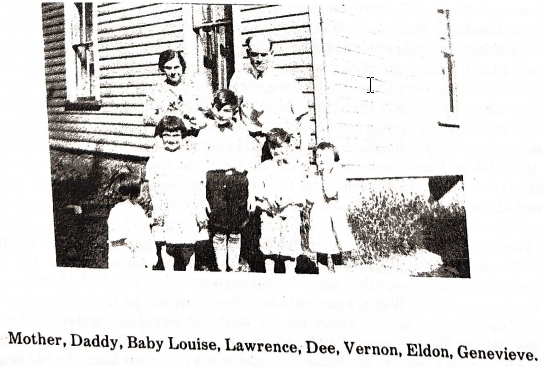 [Caption under photo: Mother, Daddy, Baby Louise, Lawrence, Dee, Vernon, Eldon, Genevieve.]
Friends and relatives came to our aid, supplying things we needed. We were at Grandma’s for awhile, but found a place much nearer Milton’s work, between Buffalo and Tonawanda. While there, we attended the Free Methodist Church in Tonawanda.
Finally, in 1929, the Depression was upon us. Milton’s work got down to three days and then to two days a week. Milton made a deal with a farmer, out near Pembroke, to work for him on the farm for a certain amount, we were to live in the tenant house, have wood to burn, milk and vegetables to eat. These would supply the greatest needs of the family; but we had just nicely gotten settled with furnishings donated by relatives and friends when Daddy took sick again, so he couldn’t satisfy the man he worked for. New houses were being built, whole streets of them in Kenmore, near Buffalo. We were allowed to move into a very nice new house there and by painting and working on other houses, we would be provided for. It was while we lived here our seventh child was born, whom we named Lester Palmer Blowers. He was born on December 3, 1931. The name Lester was my maiden name, Palmer was after his great grandfather, Noah Palmer, who was one of the earliest preachers in the Genesee Conference. He had a lot to do to live up to his name. While we lived in Kenmore, I sang in the choir at the Kenmore Baptist Church and sang some solos there. I remember singing “The Holy City.”
I enjoyed this very much for it was relaxing, after having a family of seven children to provide for. I made most of their clothes, even coats for the girls, and overcoats for the boys. Later, while we still lived there, we attended the Potomac Avenue Free Methodist Church, where I taught a very large Bible Class. After we had moved out to Marilla, around 1932 and 1934, on a small farm, we had the whole Bible Class, about thirty men and women, at our place for a Sunday School outing.
While we lived at Marilla, sometimes I attended the Methodist Church because it was close to where we lived. Several times the pastor asked me to supply the pulpit for him when he had to be away. By this time, the older children were attending school. Vernon, Dee and Eldon had all graduated from the eighth grade or grammar school while we lived there, one each year. It was a great event, held in the Methodist Church with special speakers and special finery for the boys and girls. The town band played for them to march in and there was much ado about the whole affair when the completion of the eighth grade was attained.
One day in May, while we lived there at Marilla, Daddy had to go to Buffalo. I went along and took the two youngest children, Louise and Lester. As I was expecting my eighth and last child, we thought it best that I go along, because the local doctor was to be out of town that day. When we had done everything that had to be done, we started in the direction of home, which was twenty miles east of Buffalo. We stopped outside a diner, and Daddy brought out lunch to us to eat in the car. When I finished eating, I knew I wasn’t going home, and surprised my husband by telling him to turn around and head for the hospital. This he did. I entered the hospital and urged him to take the children home because they couldn’t stay in the car so long. Finally, he reluctantly left. By the time he had driven twenty or more miles each way and returned to the hospital, he met his eighth child, a lovely little girl whom we named Lynette Eileen. She arrived May 23, 1935.
In a short time, I was back at Marilla, cooking, sewing, baking, and giving music lessons. The next year, 1936, I took a music class of eight, whose teacher left town, and I used to take Saturday, when my older children were home to look after things, to go twelve miles to South Wales, near Buffalo. There I would go to each pupil’s home and give their lessons. In late afternoon my husband would drive down after me.
One day, late in the summer of 1937, when I was at South Wales, I was met by Milton and Eldon. We were riding home. The sky was a gorgeous blue, the sun bright, but way in the distance I noticed thick clouds of black smoke ascending to the sky. I called my husband’s attention to it, because it was open country, with no railroads or factories. He said, “Oh, someone on our road has thrashers.” But as we turned onto our road, still two or three miles from home, I said, “That is on the south side of the road and there are no large farms there.” He seemed to catch on and we almost flew over the road. When we came to where we could see our house, it was ablaze all over, the fire companies were there, and many friends and other people. Within eight years we had lost our home twice by fire. It was concluded it was caused by faulty wiring in the woodshed, for that was where it started and no one was out there. My oldest girl, Dee, was alone in the house getting supper; the other children were all outside playing. We were so thankful to have them all alive and unharmed. Everything in the house was gone.
Some ladies from the Methodist Church, who were special friends of mine, came to me and were remarking that everything was gone, and offering their sympathy. I felt that was just the time to witness to these ladies in a different way than when I had ministered to them from their pulpit. I told them, “No, everything is not gone; I have another foundation to build on. I still have Christ and His love.” I felt so strongly the truth of that scripture which states, “The things that are seen are temporal; the things that are not seen are eternal.”
Again, the only thing we could do was to go to Grandma’s. It was a large house with plenty of room.
The next week, Mrs. Perkins of the Franklinville church arranged to have a kitchen shower for us. I cleaned the house and got everything ready for the guests, but in the afternoon became very ill. Milton had gone about forty miles up to where our house had been, to clean up around the place where the fire was. I was at the house alone. I went upstairs to bed and told Dee, when she came from school, she must get the supper and tell Daddy as soon as he came home to come right up to see me. It was evening when he returned and some guests had already arrived. He came upstairs to see me and then phoned for the doctor. When the doctor came, he made plans to have me taken sixty miles to a Buffalo hospital early the next morning. There I was “out” as they say, from 10:00 A.M. to 3:00 P.M., during the operation. While I was in the hospital the family had moved to Akron. When I came out of the hospital (I believe this was during the year of 1937), that was my new home.
We enjoyed living at Akron for several years. By that time some of the children had entered high school. We had a large house and had so many pleasant experiences there. We attended the Free Methodist Church, where I taught the Young People’s Class. My eldest son, Vernon, was president of the Young People’s Society. He attended the Youth Conference as delegate at North Chili. We did a lot of entertaining. Some of my family visited us there, from Troy, Milton’s brothers and sisters used to visit us often. The Sunday School Christmas tree and supper were also held at our house.
Milton taught industrial arts in night school there, at East Aurora and Indian Reservation. Believe it or not, I attended his night classes at Akron, used the various machines and had all the parts made and sanded and ready to put together for a magazine rack, which was really a table with two shelves and a magazine pocket at each side. — Quite a piece of work for an amateur, but I never got it together because we moved again and it was mislaid somewhere, so I lost it.
While at Akron, Vernon went to work at Kodak Park in Rochester, New York and lived with his Uncle Stan at North Chili. He used to come home often. Dee graduated from high school while we lived there.
Milton’s brother, Clinton, was a painter and lived at North Chili. He persuaded Milton to move to that area and they could work together. We moved to a very nice house on South Main Street in Churchville. We had lived there only a few months when we had a chance to buy an old home, which was roomy and just the thing for our large family, in Brockport, so we moved again. We had only lived there a short time when we learned that the bank in Rochester, with whom we were dealing, was planning to sell the house at auction, though we had made a substantial payment when we supposed they had sold it to us. We had moved in and were nicely settled when we heard of the deal in a roundabout way. We decided we would not stay there and have them sell the house out from under us. We talked it over with the bank and they told us of another house, a large one where we could move in and rent it. So we moved again about 1940.
We attended the Free Methodist Church in Brockport. Rev. Harry Anderson from Roberts Wesleyan College was our pastor. Often he brought young men who were studying for the ministry to assist in the services.
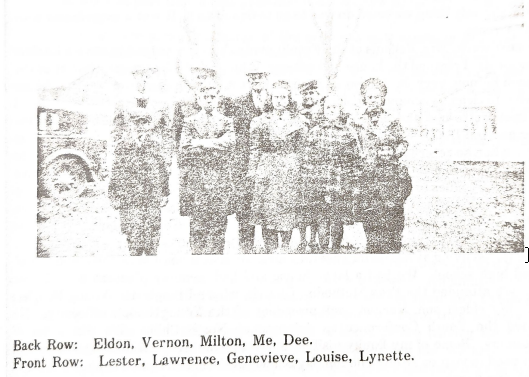 [Caption under photo: Back Row: Eldon, Vernon, Milton, Me, Dee. Front Row: Lester, Lawrence, Genevieve, Louise, Lynette.]
Our youngest girl, Lynette, started school there. By that time, Dee, Eldon, and Vernon were away from home. Vernon had joined the Air Force and afterward became a troop carrier pilot. He took paratroops into Sherburg from England, when they invaded the continent. Dee worked awhile at Kodak and worked some at a home in Rochester. Eldon worked for his cousin, Dale Lester, then of Canadaigua, New York, pasteurizing milk from his dairy farm, which was delivered in Canandaigua. When we lived there awhile, Milton decided perhaps he could go back to teaching. He signed up for a school at South Fallsburg, near Monticello, New York, not far from New York City. On the way to South Fallsburg, we visited my folks in Troy, New York, then went on to South Fallsburg, on Labor Day. From the Hudson River, it was uphill all the way to Monticello. Cars were going down the hill almost bumper to bumper, with all kinds of luggage fastened on them. We soon learned that all that country around there was a playground in the summer for the Jews from New York City. Now, many of them were heading for home. We drove up to South Fallsburg, Right away, we located a furnished house that was owned by a Jewish family who were only there during the summer. They had just left that morning. The renting of the house was in charge of the custodian of the school where Daddy was to teach. His name was Mr. Comfort. We arranged with him to move right in that night. It seemed like a dream to get supper and hang up our wraps and to go to bed in a house we had never seen before. We had left the truck with the furniture at Brockport, for our two sons, Eldon and Lawrence, to drive down. Late that night, it was raining and we had gone to bed when we heard loud knocking at the door. It was our boys with the load. I got a meal on, for they were hungry and they couldn’t understand how we happened to be there running the house. They put the load in the barn and most of it was stored there because our house was furnished. It was quite a different life. Eldon went to work in a garage. Dee came down later and worked as secretary for a lawyer, Mr. Resnik. Genevieve worked part time at the school and part time at the principal Leon Weiss’s home. The other children were in school. Later, the person in charge of the cafeteria quit suddenly and they asked me if I would take it over. The family, except for Eldon and Dee, who were at the school ate lunch there anyway so I consented to do it. This was surely a different career and it was quite an experience for me, fixing kosher and nonkosher foods. Some students worked part time in the cafeteria. I learned a lot of things that year, especially about the Jews, their way of life and way of doing things. We attended our church at Ferndale and made friends whom I still meet other places. We also attended an afternoon service in a church in Monticello on Sundays. This was the Pilgrim Holiness Church. It was here that Dee met her husband, George Reed. The lady I had lived and worked with so long before I was married, Anna Belle Collier, had transferred to the New York Conference and had pastored the church at Kingston, New York, but was now retired. She and another lady, Mrs. Pulse, lived together there at Kingston. When she heard that I was nearby, she invited the family over for church and dinner on Sunday. So in late fall, we went and had such a good time talking over former days when we were together. An amusing thing happened while we were visiting her. They learned that my youngest girl, Lynette, could sing. They bargained with her that if she would sing for them they would give her some candy. She sang: time passed; we had a lunch before leaving for home. We had stepped out the front door, when she turned back and put her head in the door and said, “We’ll forget about the candy, won’t we?” They had forgotten to keep their part of the bargain, but believe me, she got her candy. A teaching job had been offered Milton in the Caledonia High School in Caledonia, New York, so when the school year was ended, we moved back to Mumford, close by Caledonia. For awhile, we lived in a quaint old house called “the Castle,” but there was a farm outside Mumford with a twenty-room house that was worked on shares. There was a large dairy and with the aid of our boys, Lawrence and Lester, who were still at home and attending school yet, Milton thought he could continue farming with the assistance of the boys. Some time later, there was a house for sale on North Street in Caledonia which was near the school and seemed to be just the place for our family. By this time there had been some changes. Vernon was still in the Air Force and had married Eula Maddox of Atlanta, Georgia, on June 30, 1943. So he was settled in his own home in Rochester. Ethelyn and Genevieve were attending Buffalo State Teachers College. Louise was still living home and working in an office. Lester and Lynette were attending the high school in Caledonia. We still needed a large house, for some of them were always home on weekends and holidays. So with Eldon’s help, the house was purchased. Eldon was still working at the dairy at Canandaigua. Soon after, about 1945 or 1946, Lawrence went to Japan for a year. Eldon later went into the Army and was a chaplain’s assistant. Finally our youngest son, Lester, went into the service and was stationed in France for a year.