Families of Knapdale: Their History and Their Place-Names
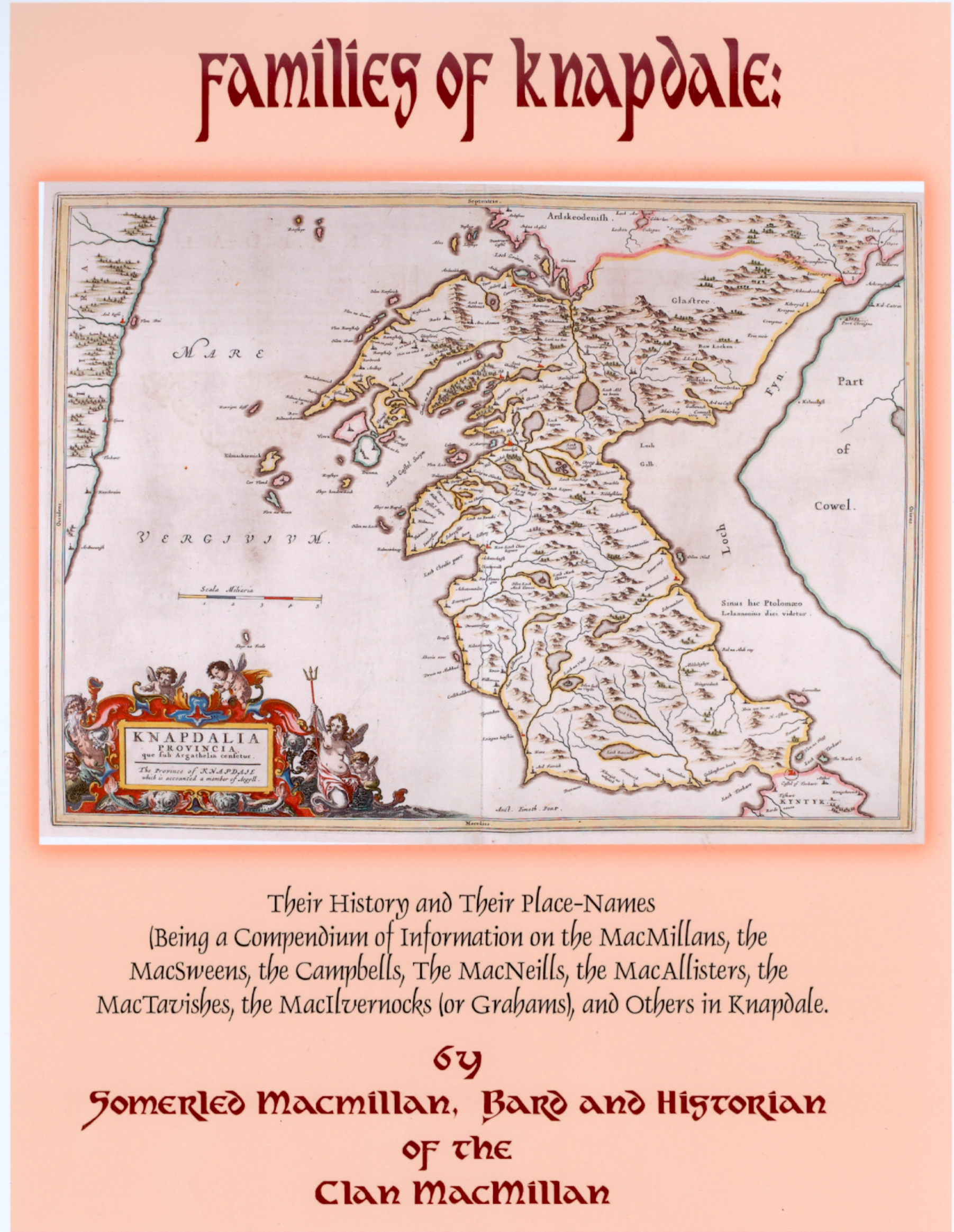
Families of Knapdale by Somerled MacMillan, Bard and Historian of the Clan MacMillan, 1960.
Being a Compendium of Information on the MacMillans, the MacSweens, the Campbells, the MacNeills, the MacAllisters, the MacTavishes, the MacIlvernocks (or Grahams), and Others in Knapdale.
By Somerled MacMillan, Bard and Historian of the Clan MacMillan
Copyright 1960 by the Rev. Somerled MacMillan, 7 High Calside, Paisley, Renfrewshire, Scotland. Privately printed by Edward B. McMillan, Brownville Avenue, Ipswich, Massachusetts, U.S.A. Cover motifs and lettering from The Book of Durrow. Cover design and maps by Hugh J. Collins.
Table of Contents
- Preface
- Maps
- Families of Knapdale
- The MaSween Lords of Knapdale
- Knapdale Under the Stewarts of Menteith
- Knapdale Under the Lords of the Isles
- The MacMillans of Knap
- The MacMillans in Clachbreck and the New Dunmore Line
- The MacMillans in Ballyourgan
- The MacNeills of Taynish and Castle Sween
- The MacMillans of Gallochoille, Arichoran, and Cravar
- The MacAlisters of Loup
- The MacAlisters of Tarbert
- The MacAllisters of Kenlochkilliport
- Knapdale Under the Campbells of Argyll
- The Campbells of Skipness
- The Campbells of Castle Sween
- The Campbells of Kilmory
- The Campbells of Danna
- The Campbells of Kilberry
- The Campbells of Knap
- The MacTavishes of Dunardry
- The MacIlvernocks of Oib and Ardnackaig
- The Ecclesiastical Parishes of Knapdale
- Statistics of the Parishes
- Bibliography
Preface
This brochure has been specially written for MacMillans attending the Clan Rally at Asheville, North Carolina this summer, and it goes out with the sincere good wishes of the author. It should have a special appeal to Robert Leroy McMillan, our esteemed President, and to his family and kinsfolk belonging to the Knapdale group in North and South Carolina. However, there is much in it to commend the interest of others outwith our clan, particularly to MacDonalds, MacNeills and Campbells, for, after all, they, too, had a share in making the history of Knapdale.
Unfortunately, the past history of Knapdale has been sadly neglected and almost forgotten, and it was with great difficulty, not to mention time and patient research, that the writer was able to rescue a few fragments from oblivion. However, even in this brief sketch one is conscious that Knapdale was once more important than it is now, for it was the very hub of early civilisation and culture in Scotland in the bygone ages. Indeed, the soil of this small district is sacred, for the writer knows of no other place in Scotland or outside of it so rich in hagiography. One only needs to look at the place-names to see the names of the saints enshrined in them. The very name Knapdale is practically synonymous with MacMillan, and although centuries have passed since our chiefs held this proud possession, nevertheless, they will always be associated with it as long as the MacMillan Cross, the tiny chapel of Kilmory, and MacMillan’s Tower at Castle Sween defy the ravages of time.
The writer desires to thank Edward B. McMillan and members of his staff for time and labour freely given, and were it not for his keen interest and kindness this booklet would still be in manuscript form, or, in all probability, it might never have been written. In conclusion, the author craves your generous indulgence to adopt a blind eye to any blemish and look for those things which will ensure profit and delight.
7 High Calside, Paisley, Renfrewshire, Scotland 28th April, 1960
— Somerled MacMillan
Maps
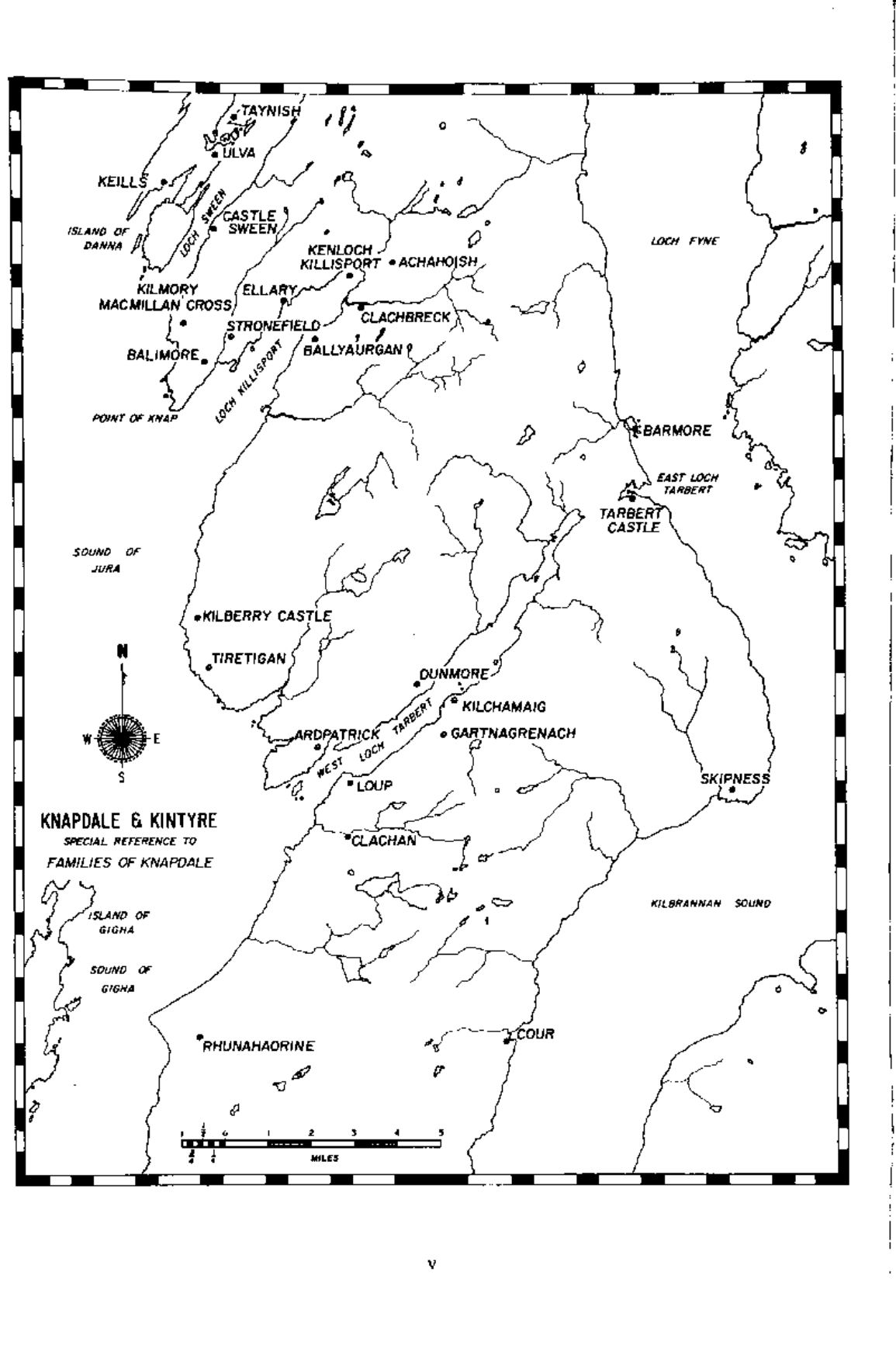
Knapdale & Kintyre — illustrating locations mentioned in this work.
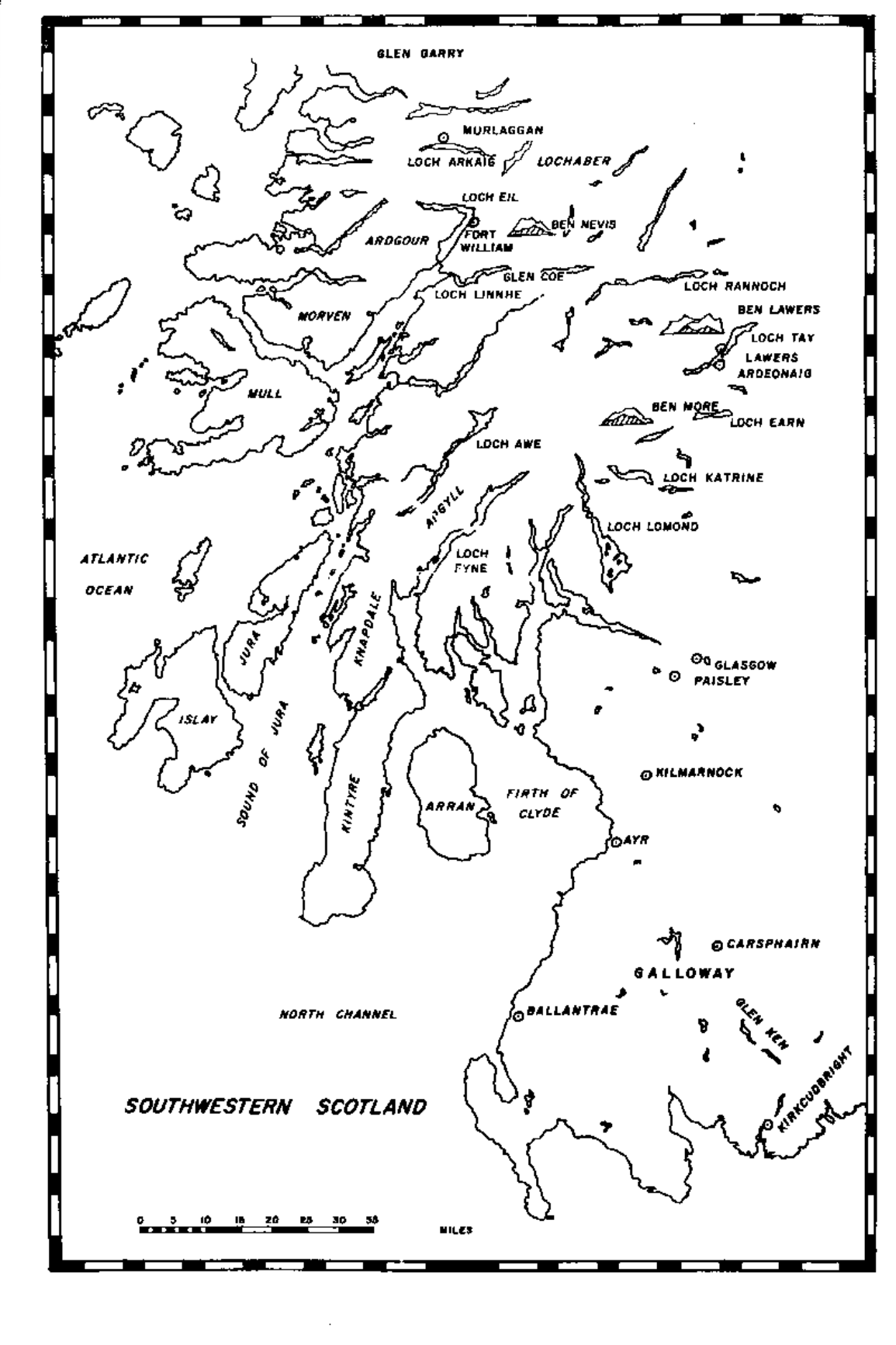
Southwestern Scotland — showing Knapdale and environs.
Families of Knapdale
Knapdale is the name of a district in Mid Argyll. Its ancient bounds originally extended from Crinan, in the north-west, to Lochgilphead, in the north-east, and followed the coastline down to Cour on the east side of Kintyre, across to Rhunabaorine on the west side of the peninsula. To-day, its southern extremity extends to the northern shore of East and West Loch Tarbert.
The name of the district in Gaelic is Cnapadal, which is obviously borrowed from the Norse Knappa-dalr, and means ‘knob-dale.’ This name is most descriptive of the whole district owing to the peculiar shape of the hills, especially when seen at a distance, either by land or sea. The dale follows the course of Abhainn Mhòr or Big River.
It was here that the Dalriadic Scots had an early settlement on the west shore of Loch Sween prior to making Dunadd their capital. In 560 A.D., Conall, King of Dalriada and nephew of Gabhran, dwelt in a fortress on the site where the present Castle Sween stands. It is believed that St. Columba actually resided with this king for a time and later received Iona as a gift from him, which was probably confirmed by Brude, King of the Picts. Close to the castle there is a well, which was known to an older generation as ‘St. Columba’s Well.’ They firmly believed that it had the best drinking water in the whole of Argyll. Not far from Kenlochkilliport, at a place called Owa, there is a cave chapel which has an altar and font cut in the rock with a cross carved above. Tradition affirms that this primitive place of worship was used by St. Columba during the time of his sojourn in Knapdale. At that time the part of Argyll stretching from the River Add to the Mull of Kintyre was known as Kintyre, for it was only with the coming of the Norsemen that the district under our consideration came to be known as Knapdale.
However, long before the coming of the Dalriadic Scots from Ireland there lived a people throughout the entire area who were known to the Romans as the Epidii, or ‘horse-lords.’ We have good reason to believe that their descendants are the MacEachrans, or ‘race of the horse-lords,’ once numerous in Craignish and the Mull of Kintyre.
The soil of Knapdale is pretty poor for growing crops but appears to be ideally suited for grazing. At one time it was famous throughout the Highlands for breeding horses, and this is borne out by an old saying: “Foumich du chaidh do Cnapadail.” The natives of South Uist did not think there was much wealth in Knapdale when they said — “Tha fo lìn ann an Cuirceal-gibhte na fichead ris-a Cnapadal” (‘There is under a tombstone in Knapdale a better gift than Knapdale’).
The colonisation of the Dalriadic Scots was followed by a zealous band of missionaries from different parts of Ireland who had a profound influence over the whole countryside, so much so that even after a thousand years have gone their names are still enshrined in the topography of those places where they had laboured. One is astounded at the number of missionaries who visited Knapdale. There, we find the name of St. Cormac in Kilmaclomane; St. Mo-Laug in Kilmoluaig (now Kilmore); St. Bride in Kilbride; St. Barry in Kilberry; St. Angus in Killanish; St. Cammoc in Kilchamanaig; St. Colman in Kilmory; St. Martin in Eilean Martainn; in Suidhe Bhaecirc; and St. Guttmoc in Kilmochumaig. Others not so easily recognised are St. Beocan in Ufaich Chille-Bheagain, St. Nechtan in Ardnackaig, and St. Blaacn in Lochan a’ Chille-Bhlaidhain. Two other saints are also commemorated in the surnames of two families once numerous in Knapdale: MacMillan, from the Gaelic ‘MacGhillemhearnaig’ (‘Son of the Servant of St. Mernoc’); and MacGurman, from the Gaelic ‘MacGhilleGuirmein’ (‘Son of the Servant of St. Gorman’).
The Norse settlement of Knapdale took place during the second half of the ninth century. The evidence of their activities is to be found in a number of place-names, such as Skipness, Ormsary, Ulva, Fascadale and Danna. It is obvious from the last name that those Scandinavian settlers were Danish stock. Indeed, tradition has it that Sween, King of Denmark, who died in 1004, built Castle Sween on the site of an earlier fortress, but evidence shows that the castle is more likely to have derived its name from MacSween, its builder. The MacSweens were of royal Dalriadic stock, who owned it at the end of the twelfth century.
It was during the twelfth century that the Norsemen were driven out of Kintyre and Knapdale by Somerled Mòr Mac Ghille-Brighde (Great Somerled), son of Gilbride. We have good reason to believe that he received considerable support from his kinsman Sween, son of Dusslebie, who held extensive lands in Glasseary, Knapdale, Cowal and Kintyre.
The MaSween Lords of Knapdale
The history of the ancient Lords of Knapdale has either been overlooked or misunderstood by modern historiographers. The MacSweens claim descent from Caibre Rigach, son of Malcolm, son of Conn I, King of Ireland, and his wife Sadhb (daughter of Conn of the Hundred Battles). From the well-known Niall Glunn-dubh (Black-Knees), High King of Ireland, who was slain by the Danes in 917 A.D., the descent ran — Donald of Armagh, King of Ireland; Muirceartach, an Ulster chief; Flaitheartaigh; Aedh Albhannach, Chief of Tribe; Araoltan; Aedh Alain (Hugh Splendid), who died in 1047. Aedh Alain had a son called Dun-sleibe; from Dun-sleibe sprang MacSween; and from the latter’s son Subhne or Sween, sprang the MacSweens.
Sween’s lands were well fortified. Castle Sween dominating the western sea-board and aptly called ‘the Key of Knapdale,’ also Skipness Castle, built by him, which dominated the eastern approaches to his lands in the Tarbert and Cowal areas. One of Sween’s daughters married Sir Colin Campbell of Loch Awe, by whom she became the ancestress of the MacMillans of Knapdale; and Ellice, daughter of Colin Campbell of Loch Awe, who was the progenitor of the MacTavishes of North Knapdale. This naturally led to a feud between the Campbells and the MacSweens. The lady, deserted by her husband, was remarried to MacLachlan and received as a dowry from her father all his lands in Glasseary, Knapdale, Cowal and Kintyre. Those lands subsequently became the property of the MacLachlans, namely ‘Dunaad, Dunamutick, Auchenschalloch, Shervain and Brenchylies.’
Sween, 1st Lord of Knapdale, had two sons — Dugall, his heir; and Murchard. We cannot tell when Sween’s demise took place, but he was certainly dead sometime before 1247. He was succeeded by his elder son —
Dugall, 2nd Lord of Knapdale. Like other nobles he was devoted to the service of the Church and was certainly not unmindful of the monks of Paisley. Indeed, all the information we have of Dugall is culled from the Register of Paisley.
In the year 1247, Pope Innocent IV confirmed to the rector of the Church of Saint Colmanell a certain portion of land, commonly called a penny land, which had been granted to that church by John Dugall (Dugall), late patron of the same (Reg. Pass., p. 123).
In the year 1261, Dufgal, the son of Syfin (Subhne), with the consent of John, his heir, granted to the monks of Paisley the right of patronage of the Church of Saint Colmanell, which was situated near the Castle of Schyphinche (Skipness), after the death of Clement, rector of said church, bequeathing at the same time his body to be buried in the Monastery of Paisley (Ibid., pp. 120–121).
In the year 1262, Walter Steward, Earl of Menteith, confirmed to the monks of Paisley the grants of Dufgal, the son of Syfin, made to them before he gave him (Walter Steward) his lands of Schyphinche, regarding the Church of Saint Colmanell, situated within the said land, with one penny land belonging to that church and the chapel near the Castle of Schyphinche (Ibid., pp. 121–123).
Dufgal granted Walter Steward of Menchet (Menteith) his lands of Schyphinche in free barony to the king, for two-thirds of one soldier and other service (Ibid., pp. 120–121).
In 1292, the Earl of Menteith’s lands in Knapdale are named in an ordinance of King John Balliol (Act. Parl. Scot. Vol. I, p. 81).
John, 3rd Lord of Knapdale, supported King Edward I of England and his son, and this only heightened the enmity already existing between him and the Campbells. Such a move also incurred enmity between him and Robert Bruce, who later stripped him of his lands in Knapdale.
In 1320 John MacSween sailed with a fleet in the service of King Edward I, calling at Bute and Kintyre in company of Sir Hugh Bissett and Angus MacDonald of Islay. A little later he wrote to King Edward I from Antrim, complaining that he had visited his own lands in Knapdale, which King Edward had given him by letters patent, and had found them occupied by John (MacDougall) of Argyll and Sir John Menteith, with a very large number of men. Before 1310 John MacSween was deprived of his lands on account of his opposition to Bruce, who granted them to Menteith, the betrayer of Sir William Wallace.
In 1310, King Edward II of England, in order that John MacSween and his brothers might render themselves more hateful to John of Menteith, the king’s enemy, and to his other enemies in Scotland, granted to them the whole of the lands in Knapdale which belonged to their ancestors, ‘if they are able to recover them from their enemies.’ A grandson of John bearing the same Christian name, whose father was called Sween, changed his name to MacSween and, on retiring to Ottir in Cowal, became the progenitor of the MacSweens of Ottir.
Knapdale Under the Stewarts of Menteith
Walter Stewart, called Balloch, or Speckled, third son of Walter, third high steward of Scotland, having married Mary, the younger sister of Margaret, Countess of Menteith, laid claim to the Earldom of Menteith in right of his wife, and by favour of the Estates of the Realm, obtained it, in 1258, and kept it.
In 1262 he received from Dugall MacSween the gift of lands in Skipness and other lands in Knapdale. These lands in Knapdale were named in an ordinance of King John Balliol, in 1292.
He had two sons who assumed the name of Menteith, although they retained the Stewart Coat of Arms: Alexander, who succeeded his father to the earldom, and John de Menteith of Ruske, whose name appears in history as the betrayer of Sir William Wallace. He altered the Stewart fesse into a band, and the colours to sable and argent.
On 9th August 1297, Sir John Menteith was released from an English prison on condition of serving with the British against the French. In 1305 he was appointed keeper of Dumbarton Castle by King Edward I, and the same year, according to tradition, he treacherously handed over to the English the person of Sir William Wallace. He held the Castle of Dumbarton for the English till 1309, and then took sides with Bruce, who granted him the lands of Knapdale. He died in 1323 and was succeeded by his son, Sir John Menteith, Lord of Arran and Knapdale.
In 1323, Sir John Menteith made Archibald Campbell of Loch Awe hereditary keeper of Castle Sween, with a considerable grant of lands in Knapdale. Five years later he deposed the greater part of South Knapdale to the Earl of Argyll, and on his death, in 1360, the rest of Knapdale fell to the Crown.
Knapdale Under the Lords of the Isles
The first person to bear the renowned title of ‘Lord of the Isles’ was John, son of Angus Og MacDonald of Islay, a friend and staunch supporter of King Robert Bruce, who was awarded some of the former possessions belonging to the MacDougalls before 1308. Unlike his father, he fell foul of the Scottish Crown, as did his son, grandson, and great-grandson after him. The first signs of such antagonism began to appear when Bruce’s nephew, Randolph, Earl of Moray, acted as Regent during the minority of King David II. Rather than come to some understanding over a mutual adjustment of his lands, he only aggravated the situation by his refusal and matters became worse when he took sides with Edward Balliol.
On Thursday, 12th September 1335, John received an indenture from Edward Balliol, and at Tarbert he received, among other possessions, the lands of Knapdale, which had to be confirmed by King Edward III of England.
John of the Isles was married twice. By Amy MacRury, his first wife, he obtained extensive possessions in the north-west of Scotland. By the second wife, Margaret, he assumed, in fact, the title of King Robert II in 1350. Four years later he assumed the title of Dominus Insularum or Lord of the Isles.
After the death of Sir John Menteith, in 1360, John, 1st Lord of the Isles, took steps to possess Knapdale. He obtained it from the Campbells, and he employed the MacMillans for this purpose.
In 1376, King Robert II granted to John, 1st Lord of the Isles, and to Margaret, his wife, a charter of his lands in Knapdale (Reg. Sig., p. 130; Robertson’s Index, p. 118, No. 14). John died about the year 1385 and was succeeded by Donald, the eldest son by his second wife.
Donald, 2nd Lord of the Isles, married Mary, daughter of Sir William Laslie and Euphemia, Countess of Ross, and sought to claim the said earldom in his wife’s name who was heiress of Ross before the death of the 3rd Lord of the Isles. He resigned the earldom for his own son. This led to a show of strength which brought the Clan MacDonald to battle under his leadership. Many lives were lost on both sides and among the slain from Knapdale was the Chief of the MacMillans. The following year, the settlement was concluded at Lochgilphead when Donald made submission and withdrew his claims to the Earldom of Ross. He died in 1423 and was succeeded by his eldest son —
Alexander, 3rd Lord of the Isles and Earl of Ross, who, like his father, was continually coming to blows with the Crown. Between 1425 and 1428 he was arrested by the king and released from prison after a short period of detention. After his release he raised an army, advanced on Inverness, burning the town, but was unable to take Inverness Castle. He was forced to withdraw to Lochaber with his depleted forces. He was most foolhardy of him to challenge the authority of King James I. He sent a message to the king offering the rents of Knapdale and other possessions taken from him. James told him in no uncertain manner that he must come and submit himself to his mercy. Shortly afterwards he appeared in a more secular and undignified way, for, while the king and his nobles were attending worship in Holyrood Church, Edinburgh, he drew near only attired in his shirt and drawers. In a cringing manner he fell on his knees before the king in supplication, and held out his sword with the point in his own hand. Instead, the king took pity on him and sent him as a prisoner to Tantallon Castle for a short period. During his confinement Alexander’s cousin, Donald Balloch, rose up in rebellion against the king. James took the necessary precautions, seized Alexander’s lands in Knapdale in 1430, and allowed his cousin, Donald Balloch and Sir Robert Cunningham of Kilmaurs to act as joint-wardens of the district for seven years. Alexander died in 1448 and was succeeded by his eldest son —
John, 4th Lord of the Isles, who had the misfortune of being of a character which led him to be perpetually rebellious, and this not only proved his undoing but led to the forfeiture of the Earldom of Ross and the Lordship of the Isles. In April 1452 Douglas was appointed to act as one of the King’s Commissioners in negotiating a truce with England, but before going there he paid the Lord of the Isles a secret visit the month following, either at Castle Sween or at Tarbert. It is recorded that Douglas brought him ‘high right gifts’ of clothes, wine, silk, English cloth and silver, and received in return presents of ‘mantles.’ No doubt, this sop was given with a view to obtaining support from the Lord of the Isles in his treasonable designs against the Scottish Crown.
In 1462, a treaty was signed by which the Lord of the Isles and Donald Balloch of Dunnyveg and the Glens of Antrim agreed to become vassals of King Edward IV, and to support the Yorkist cause in Scotland. The whole of the North was to be divided equally between the Earl of Douglas, the Lord of the Isles, and Donald Balloch, while Douglas’ former possessions in the South of Scotland were to be restored to him.
This treaty, however, could not be carried out without waging war against the King of Scots, and so the Lord of the Isles began operations by assuming sovereign power in the Sheriffdoms of Inverness and Nairn, laying them waste in his name, and Angus Og, his son, acted as his Lieutenant.
In 1474, negotiations for a marriage between King James III’s infant son and the daughter of King Edward IV seems to have brought the treaty to light with dire consequences. Forthwith, the Lord of the Isles was summoned before Parliament in Edinburgh and charged with treason. On his failure to appear, sentence of forfeiture was passed against him in 1475.
The Lord of the Isles now realised that he was not in a position to withstand the concentrated might of Scotland, but the King was equally conscious of the fact that the execution of the forfeiture would be a heavy task. John, therefore, accepted a surrender on terms in 1476. He surrendered to the King the Sheriffdoms of Inverness and Nauro, and the districts of Knapdale and Kintyre. The rest of his former possessions were granted to him and he was created a Peer of the realm with the title of Lord of the Isles.
In default of legitimate issue, Angus, his natural son, was nominated as heir. The various branches of Clan Donald did not take kindly to the submission of the Lord of the Isles, especially the MacDonald southern branch. Troubles in Kintyre resulted in a summons of the Lord of the Isles before Parliament in 1478, when John MacDonald was fully representative of his clan. The following lands in Knapdale were restored to him for life — ‘the lands of Barmore, Garielane, Achnaley, Strondow, Glenmalane, Glensuie (Glennarloch?), Largbehane, Barnellane, Kowldinrich, Glannateoch, Ardpatrick, Ardmornys, Largnahowwyn, Ferleygloch, Creuyr, and Drewmnamonylow, amounting to 31 marks; Kilsepart, 4 marks; Drumdribok, 2 marks; Schengart, 4 marks; Barcroregane, 4 marks; Clachbreck, 2 marks; and Barkoryt, 4 marks — all claimed in the Lordship of Knapdale’ (Reg. Sec. Sig. Vol. I, fol. 101).
A quarrel with Kenneth MacKenzie, the Master of Kintail, was used as a pretext by Angus for attempting to recover Ross. Alexander MacDonald of Lochaish, a first cousin of Angus, took over the leadership of the insurgents. He succeeded in taking Inverness, but was defeated by the MacKenzies and the MacRaes at the famous battle of Bealach nam Brog.
The Lord of the Isles was by this time an old man and obviously unfit to control the situation. Seventeen years of continual disorder had been the outcome of the settlement of 1476. King James IV, who had come to the throne in 1488, was resolved to put an end to the trouble and disturbance of the peace in the West. In 1493, the affairs of the Isles were brought to a head and the Lordship of the Isles once more declared forfeit. The Lordship of the Isles virtually passed away and with it much of the Celtic culture fostered within its domain during the one hundred and thirty-nine years of its existence.
Now, although the Lords of the Isles were the Superiors of Knapdale, their estates there were held by the MacMillans and the MacNeills in lieu of sword-service. It is only fitting that some mention be made of the MacAlisters in Knapdale, as they held some land in South Knapdale near the close of the Lordship of the Isles.
The MacMillans of Knap
The MacMillans had earlier lost their lands on Loch Tayside when David II granted them to a court favourite called Chalmers. For a time they stoutly resisted expulsion, but when the Sheriff of Argyll threatened them with fire and sword they very reluctantly gave up the Barony of Lawers which they had held for two hundred years. Their arrival in Knapdale was in 1360 when John, 1st Lord of the Isles, employed them in sword-service against the Campbells. It was probably about this time that the Clan Ilean used a witch called Mor (Sarah) to assist them against the MacMillans and when occult powers and diablerie failed they attributed their defeat to the fact that it was because they had not time to put Sarah on her horse. This fight is said to have taken place at Largnahuntion.
Glann ‘ic ‘illemhaol ibho Cnapadal, — Gheibh iad smachd na mothachain.
‘The Clan MacMillan of Knapdale — (Either) they’ll find authority or resentment.’
Malcolm, son of John, son of Maolmaire, was the first MacMillan Chief of Knap. In Gaelic his name is ‘MacMhaolain a’ Ghnàp’ (Great MacMillan of Knap). His possessions included Dunmore, Kilchamnaig on the opposite side of West Loch Tarbert, also Tiretigan and Kilberry. It was on the slopes of a rock near the shore and down from Tiretigan that the ‘Coir,’ or ‘Right’ of the MacMillans was claimed. Malcolm had several sons: John, the eldest son, lived at Kilchamnaig. Life there does not appear to have been too happy for him owing to a troublesome neighbour called Morrlaich Mor, who proved a great menace to the community. Under great provocation, young MacMillan slew him and was compelled to flee to Inveraray to answer the charge in front of Campbell of Dunstaffnage. They do not appear entirely faultless, for tradition has it that they, too, were troublesome neighbours, hence the origin of the old Gaelic saying:
Clann ‘ic ‘illemhaol ibho Cnapadal, — Gheibh iad smachd na mothachain.
‘The Clan MacMillan of Knapdale — (Either) they’ll find authority or resentment.’
Malcolm Mor’s death took place about the year 1376.
Malcolm Og, 2nd of Knap, of whom nothing is known beyond the fact that he succeeded his father and left a son and heir —
Lachlan, 3rd of Knap. In the Red Book of Clan Ranald mention is made that he was killed in action before the actual battle of Harlaw (1411). The Clan tradition has it that a Campbell of Colintraive came out of the army before any part of the main force went with them, viz. Tormoid (Norman) MacLeoid and Torculich his brother, MacGorrie. Lachlan was succeeded by his son and heir —
Lachlan Og, 4th of Knap. The writer has good reason to believe that this Chief, when young, was sent to be fostered by MacCallum of Craignish. Archibald Ban attended a fair at Inveraray one day when, in a melee, he was slightly wounded and he was hurly pursued by the clansmen and friends of the dead man. As he drew near to old Inveraray Castle (built by Wonderful Colin in 1420) he decided there and then to seek shelter in a different capacity, that of a baker and in this new guise he deceived his assailants. Thereafter, he was nicknamed ‘Am Bacasdair’ (‘The Baker’), and in this way his descendants came to be known as MacBaxter and latterly Baxter.
Alexander, 5th of Knap, who married Erca, daughter of Hector Mac Torquil MacNeill, 1st of Gallochoille. A little chapel at Kilmory is said to have been built by him and in all probability he was buried near the spot where the famous Cross was erected to his memory. However, he and his clan did not enjoy those new possessions for long, because it was towards the close of his life that Argyll was given the Constabulary of Castle Sween with certain lands there in 1481. It is interesting to note that when certain lands listed were restored to John, 4th Lord of the Isles, in 1481, the MacMillans were granted charters for their lands from King James IV, but in 1499 those charters were suddenly withdrawn with no definite reason given. Alexander was succeeded by his eldest son —
Hector, 6th of Knap, who was chief of the clan when Argyll took over the whole of Knapdale. He is only mentioned indirectly in the patronymic of his grandson, Neil Glas. He was succeeded by his son —
Duncan, 7th of Knap, who is known to have had, at least, two sons — Neil Glas, his heir; and John Roy, progenitor of the Clachbreck, Ballyourgan and New Dunmore branches. He was succeeded by his elder son —
Neil Glas, 8th of Knap, who was called upon to act as a witness after a series of disturbances caused by Alexander McAlester of Loup and his followers in 1539. In those disturbances, certain families which had come under the displeasure of the MacDonalds were sought for and the Campbells came in for brutal treatment, and they also sought to take Argyll’s life when he paid a visit to Craignish in North Knapdale. Two MacMillan names are included in that of the disturbers of the peace: their names are given as Donald eur (five) mc melane and Duncan, son of Neil Glas. Neil was succeeded by his son —
Duncan, 9th of Knap. It was probably during Duncan’s lifetime that Colin MacMillan was settled as the first Campbell laird of Kilberry. There is a tradition in the Baxter family that their progenitor came riding on a white horse. MacMillan is believed to have challenged his right to Kilberry by inviting him to go down to the rock known as ‘the Steing’ where he would see his ancient Knap charter engraved on the rock. Campbell told him that he was not interested in the rock-charter and could not care less since he had been granted the possession of Kilberry from Argyll himself. Duncan was succeeded by his son —
Donald, 10th of Knap. Little is known about him beyond the fact that he appeared as a witness to an Argyll charter at Targy Loch on 2nd June, 1576. His patronymic is given thus — ‘Donald McDonche vre mylen.’ He had, at least, two sons — Angus and Malcolm Gair. The writer’s opinion is that Malcolm Gair and his family lived near Castle Sween. He had a son, John Gair, who for his part in an abortive rising, was hanged with others at the Grassmarket, Edinburgh, on 8th July, 1615. In September of that year, the father and other members of the family came to blows with Campbell of Calder and his men at Castle Sween; all, if we are to take the rest of the story as entirely authentic, all were slain with the exception of the youngest son. Thereafter, we know more about Angus and his family, and the writer has, after much careful study and research, come to the conclusion that Angus was the elder brother who succeeded his father as heir.
Angus, 11th of Knap, had four sons: Donald Og, his heir; Robert; Malcolm in Lagg; and Neil in Kenlochkilliport.
7 and 12 May, 1606. Charter of Confirmation by Archl. Mak Connyil o’ Giga, heritable proprietor to his beloved son, etc. Witnesses: Angus McSmelyn, Donald og McSmelyn, etc. Angus was succeeded by his eldest son —
Donald Og, 12th of Knap. He appears as witness to a sasine on 25th May, 1632, and his patronymic is given thus — ‘Donald McAngus VcMillan in Kyllaillat.’ It is the writer’s opinion that Donald Og and his family had fallen on evil days and the estate was apparently taken from them and given to a collateral family in Clachbreck. He had, at least, three sons — Neil, representative of the family; Malcolm; and Duncan. The last mention of Archibald Og was when he appears as witness to a sasine granted to James, seventh son of Colin Campbell of Kilberry, in 1649. On his death, he was succeeded, as representative of the family, by his eldest son —
Neil in Dunmore. He and his son appear as witnesses to a sasine in 1659, and their address is given as ‘in Dunmore.’ He was succeeded, as representative of the family, by his son —
Neil Mor in Dunmore. Apart from a stray reference about him acting as a witness to a sasine in 1659, we know nothing else about him except that he was succeeded, as representative of the family, by his son —
Donald of Clachbreck and Baillie. We learn quite a lot about Donald from existing records. The following was recorded at Dumbarton on 18th May, 1714: ‘Sasine in favour of Donald MacMillan of Clochbreck for the 4 mark lands of Clochbreck, lying in the Parish of Killasert, Parish of Road of Tirstigan (Tiretigan), Parish of Keali, warrandice granted by Dugall Campbell of Kilberry with consent of Archibald Campbell, his spouse, to the Master of Campbell of Kilberry for the lands of Baillie and poundings thereof lying in the parish of Kilberry.’ On 24th February, 1718, the following notice was given: ‘Rental, Johne McMillan, tenant in Ardroe: gives Donald MacMillan heir and of any rights of revision to him upon the lands of Baillie.’ Donald had two sons and one daughter — Donald, Neil. By the month of August, 1734, the lands of Clachbreck were taken over in favour of Duncan MacMillan of Dunmore. Donald sold the lands of Clachbreck and during last century some of their descendants emigrated to the United States of America.
Nothing is known of Robert, second son of Angus, 11th of Knap, unless that he may have removed to Camnethan on his lands in the 17th century. Malcolm, his brother, was living at Lagg in Glasseary on 6th June, 1659, when he appears in the Records of Campbeltown. His patronymic is given thus — ‘Gillecalium McAngus VcMoycilln.’ He had, at least, one son — Duncan, who was tenant in Fernoch, Knap, in 1641. In a charter of the same date his name is given in patronymic form as follows — ‘Duncan McGillecalium Vcmillen.‘
The MacMillans in Clachbreck and the New Dunmore Line
The progenitor of the MacMillans in Clachbreck was John Roy, youngest son of Neil Glas, 8th of Knap. John Roy was probably the first of the Knapdale MacMillans to curry favour with the Campbells of Argyll, as all his descendants did after him. This new allegiance infuriated others of the old MacDonald persuasion and in one of those outbreaks against the Earl of Argyll by McAlester of Loup and his associates in 1539, John Roy was cruelly murdered. He was succeeded by his son —
Archibald, 1st of Clachbreck. November, 1552, witnesses an instrument of sasine at Dunastaffnage Castle, following a precept of sasine of King James V, dated 16th October, to Neil MacMillan of Knap. Archibald, 4th Earl of Argyll, of the borderland and Castle of Dunoon, and of the erection of the Lordship of Lorn. Archibald was succeeded by his son —
Dunnar Mor, who acted as a witness to the reversion of a wadset at Dunstaffnage in 1593. He was succeeded by his son —
Alexander, who had three sons — Archibald, Duncan, and Iain Dubh. Archibald succeeded his father in the tenancy of Clachbreck and became the first Campbell in the patronage at Kilmichael. Iain Dubh lived in the township of Ballyourgan. Alexander was succeeded by his eldest son —
Archibald, 1st of the New Dunmore line. In the Argyll Charter Chest we find a charter for the 4 mark land of Dunmore, 2 mark Barzawthragen (Ballyourgan) and ½ mark Clachnaig, all lying in Keilsaire, for yearly payment of 10 merks with a rene wadder. Archibald died in 1676 and was succeeded by his son —
Alexander, 2nd of Dunmore, who married Gellis, daughter of John MacFarlane of Arrochar, with issue — Duncan, his heir; and John, progenitor of the Laggelgarve branch. Grizel, the mother of Gellis, was a daughter of Sir John Lermont, and her grandmother, Beatrice, was a daughter of Lord Sempel. Jean, a sister of Gellis, was the wife of Sir John Buchanan of Leny. Gellis seems to have had money and, no doubt, it was largely due to her that the estate of Dunmore was redeemed for the payment of 5,000 merks. Alexander took an active part in the Argyll rising in 1685, and died shortly after being taken prisoner. On 19th March, 1688, the Dunmore estate was forfeited to the widow, who held it until 1690, when it was restored to Alexander’s heir —
Duncan, 3rd of Dunmore, who married (1) Katherine Buchanan of Leny, his cousin, with issue — Alexander, his heir, John, and Gellis; and (2) Isobell Campbell. He died at Dunmore on 5th March, 1707, and was succeeded by his son —
Alexander, 4th of Dunmore. In June, 1767, Donald MacMillan, Junior, promised to pay Alexander MacMillan of Dunmore as ante-nuptial sum one hundred and twenty pounds from the lands of Dunmore, and by January, 1774, Alice Flemming of Fleming was granted a sasine for half of the said lands of Dunmore. In 1779, a sasine was granted to Duncan MacMillan, Writer in Edinburgh, and by March, 1781, Archibald Bell was granted a disposition in his favour by Donald MacMillan of the lands of Kilberry, lying in the Barony of Kilberry. Archibald Bell was granted a disposition in his favour by Donald MacMillan of the lands of Clachbreck and during last century some of their descendants emigrated to the United States of America.
Iain Dubh, youngest brother of Archibald, 1st of Dunmore, had a son, Donald, who was land-officer in Torturk. Members of the Ballyourgan branch must have been occupied with fuller’s work and in this way some of them came to be known as ‘Mac an Fhucadair’ (‘Son of the Fuller’), anglicised to ‘Mac-Naxter,’ and changed latterly to ‘Walker.’ The last of those Walkers are buried in Kilanissi Cemetery, near Dunmore.
Dated Kilmichael, Glasseary, 31st October 1697. There were two sons by this union — John and Duncan. About a hundred years later we find in the Baptismal Register of South Knapdale that Archibald, son to Neil McMillan and Peggy McMillan in Barirwagan (Ballyourgan), was baptised on 2nd October, 1786.
The MacMillans in Ballyourgan
Neil, the fourth son of Angus, 11th of Knap, settled in Kenlochkilliport. His name appears as a witness to different sasines. He had three sons — Neil Glas, the elder; Neil, and Donald in Kenlochkilliport.
It is difficult to trace in unbroken succession the descendants of Neil from 1685 until 1791, but from then until 1791 it is straightforward. Angus MacMillan, a descendant, was at Ardroe from 1791 to 1810, when he was succeeded by his son Alexander, who in turn was succeeded by Neil, who married Katherine Brown, with issue — Dugald, Angus, Archibald, Duncan, Alexander, Margaret, Katherine, and Mary. Margaret married a Mr. Campbell; a number of the family went to Australia; Katherine married a Mr. MacLachlan and lived with her family in Glasseary. Alexander attended college in Glasgow with the intention of becoming a Doctor of Medicine, but he had a breakdown in health, and on returning home, was accepted by his father in the family farm of Ardroe. He did no manual work, but, being well-educated, he transacted all the business and directed the affairs of the family. Unfortunately, Alexander died when still a comparatively young man, and Angus then took over responsibility. Five of those children were born in Knapdale and the other three in North America. John and his wife and young family emigrated to Robeson County, North Carolina. Today, their numerous descendants have formed a group which is known as the Knapdale MacMillans.
Duncan, who survived the other members of the family, died at Tayvallich in 1933. The following tribute appeared in the ‘Glasgow Record’ at the time of his death: of Duncan MacMillan, retired farmer, the last of the MacMillans, who were tenants of Ardroe farm for centuries. There was a Gaelic inscription on a rock on the MacMillan tomb, well-known to older residents, to the effect that as long as waves lapped the rock the MacMillans would remain at Ardroe. The inscription is now obliterated.
The MacNeills of Taynish and Castle Sween
A great deal of controversy has arisen over the true descent of the MacNeills belonging to Argyllshire. They are not descended from the MacSweens of Knapdale, nor are they related to the MacNeills of Barra, but spring from the same stock as the MacLeans of Duart.
Gillise, youngest son of Gillean of the Battle-Axe, settled in Kintyre, and his son, Malcolm, appears there as a landlord in 1296. He married Erca, grand-daughter of the MacNeil in Garviach, and their second son, Neil, became the progenitor of the Argyllshire MacNeills. He became known as Malcolm MacNeill, the first MacNeill in Kintyre. Malcolm had a son called Neil, who, in turn, had a son called Torquil.
Early in the 15th century Torquil received from the Lord of the Isles a charter of the lands of Gigha and Taynish, and was Constable of Castle Sween. In this charter he is designated ‘Illus Nigelli’ (‘Son of Neil’). He had two sons — Neil, his heir, and Hector, progenitor of the Taynish family. The elder son died without leaving male issue and was succeeded by the brother —
Hector, 1st of Taynish and Constable of Castle Sween. A document dated 1455 survives which proves that John, 4th Lord of the Isles and Earl of Ross, confirmed Hector MacTorquil MacNeill as hereditary keeper of Castle Sween and in certain lands that Hector’s father had held; among those were lands at Kilberry. He had a son, Neil, who succeeded him, and Brce, who married Alexander MacMillan of Knap. The last mention we have of Hector was in 1472. He was succeeded by his son —
Neil, 2nd of Taynish, who with members of his clan is brought to our notice in 1478. In April of that year the Lord of the Isles was summoned to appear before Parliament in Edinburgh to answer charges of holding Castle Sween treasonably, or making war upon the King’s lieges, and for giving support to Donald Gorm and Neil and their accomplices who ‘daily invade the King’s lieges and destroy his lands’ (APS II, 115; History of Argyll, p. 147). Three years later Neil and the chief of the MacMillans put a counter claim for certain lands in Knapdale which King James III had restored to the last Lord of the Isles. Neil was succeeded by his son —
Neil, 3rd of Taynish. This chief and other members of his clan saw that it would be to their disadvantage if they continued to support the MacDonalds and so they found it profitable to become Campbells. Some of their former possessions were restored to them, but this incurred great displeasure among the supporters of the Islay and Kintyre branches of the MacDonalds. Neil had two brothers: Neil; and John Oig, ancestor of the MacNeills of Gallochoille, Arichonain, Cravar, and Colonsay. He was succeeded by his elder son —
Neil, 4th of Taynish. On the extinction of the direct male line of the Gigha MacNeills, the Taynish family assumed the Chiefship. Neil had issue — Hector, his heir; Malcolm; and others.
Hector, 5th of Taynish. In 1590, he purchased the island of Gigha from John Campbell of Calder, who had acquired it from MacDonald of Islay. He was succeeded by his son —
Hector, 6th of Taynish. We gather from the Pollalloch Writs that he acted as a witness to a few charters by Lord Lorne to Niall Campbell of Oib in 1633. He was an elder of the Presbytery of Argyll in 1640 and attended the Provincial Assembly of Argyll that year at Inveraray, 17th May. He had, at least, two sons — John, his heir; and Donald. He was succeeded by his heir —
John, 7th of Taynish. Very little appears on record about this chief and only when he is indirectly mentioned in connection with others in the General Register of Sasines do we discover the following entries: 15 Feb., 1672: Wadset in favour of Duncan MacMillan on the lands of Antalachain in Gigha (with consent of his superior, John MacNeill of Taynish) to Niall Oig MacNeill. John was succeeded by his son —
Neil, 8th of Taynish. He was called upon to act as a witness after a series of disturbances in 1659. Neil was succeeded by his son —
Iain Dubh, youngest brother of Archibald, 1st of Dunmore; Roger, who during the reign of King George III sold the estates of Gigha and Taynish. The latter married Elizabeth Price, eventual heiress of Dumyat; and Angus was succeeded by his elder son —
Hector, 9th of Taynish. He was succeeded by his heir — Roger, who during the reign of King George III sold the estates of Gigha and Taynish to the Hamiltons of Raploch. Their descendants have assumed the name of Hamilton.
The MacMillans of Gallochoille, Arichoran, and Cravar
Little is known of the Gallochoille MacNeills. Donald, either a son or grandson of Donald, 6th of Gallochoille, is mentioned several times in the General Register of Sasines; also in Knapdale in the lands of Gallochoille in similar fashion, lands were given by Argyll to Donald MacNeill of Gallochoille — alias Campbell. In 1673, he came across a wadset to Niall Oig MacNeill in Creaigantagach. On 25th August, 1673, he witnesses the resignation of the lands and barony of Gallochoille, in Glasseary, to Argyll. In 1700, Donald came to an agreement with the Duke of Argyll and exchanged the lands of Cravar and Druimdarroch for the islands of Colonsay and Oronsay.
Malcolm Beg, progenitor of the MacMillans and Cravar MacNeills, was, according to Highland tradition, celebrated for his extraordinary prowess and great strength. He was succeeded by his only son —
Neil Og of Gallochoille, who had three sons — Malcolm, John, and Donald. In the Register of the Privy Council we find (1659): Sasine of an annual rent of 31 bolls oatmeal from the lands of Cnoc Laighne (Gallochoille) in Knapdale given by Duncan Duncanson, notary in Inveraray, as baillie, to John McGloran in Inveraray, as attorney of Donald MacNeill. In 1671, he witnessed a marriage contract. In 1720, Donald came to an agreement with the Duke of Argyll and exchanged the lands of Cravar and Druimdarroch for the islands of Colonsay and Oronsay.
The MacAlisters of Loup
This family traces its descent from Alasdair Mòr (Great Alexander), second son of Donald of Islay, progenitor of Clan Donald. After the forfeiture of the Lordship of the Isles, in 1493, the McAlisters became so numerous as to form a separate and independent clan. It is said that their residence was at Ardpatrick in Kilberry parish. His son, Charles, was appointed Steward of Kintyre in 1481. The latter had a son —
Angus, 1st of Loup. In the Register of the Privy Seal for 1515 his patronymic is given as ‘Angus vic Ean Dubh’ (‘Angus, (son) of a son of John Dubh’). He had three sons — Alexander, his heir; Donald, Constable of the Castle of Tarbert, Loch Fyne, an office which became hereditary in the family; and Roderick, said to have been bishop of the Isles. In 1545, although the name is not given in Keith’s Catalogue. Angus was succeeded by his eldest son —
Alexander, 2nd of Loup. He was forfeited for treasonably abiding from the army at Solway, but in 1540 he obtained a remission for himself and fifteen of his clan. A year earlier he was one of those who organized a rising in Knapdale which was directed against Argyll and some of his subjects. He was succeeded by his son —
Hector, 3rd of Loup, who did not survive his father long. He was succeeded by his elder son —
Alexander, 4th of Loup, who in 1573 obtained a charter from Archibald, 5th Earl of Argyll. He was one of those Highland chiefs who were held responsible, by the Act of Parliament called ‘the Black Band,’ passed in 1587, for the peaceable behaviour of their clansmen and the ‘broken men’ who lived on their lands. He was succeeded by his brother —
Godfrey, 5th of Loup, who was yet under age at the time of his brother’s death. In 1591, he obtained a charter from Archibald, 7th Earl of Argyll, and in it he is designated thus — ‘Gorrie Mc-Govrid Mc-Alaister-Vic-Ean Dubh.’ He was succeeded by his son —
Hector, 5th of Loup, who had charters from the Earl of Argyll for the lands of Loup and others, wherein he is designated ‘Hector McGorry-Vic-Eachne-Vic-Alistter-Vic Ean Dubh.’ On 3rd July, 1615, two of his kinsmen, Alester and Angus McAlester, with Angus Oig, were among those named in connection with a disturbance in Knapdale.
‘Zachine Vic-Alester-Vic Ean Dubh.’ This youthful chief became the hero of a tragedy which forms one of the most remarkable cases in Pitcairn’s Criminal Trials (vol. III, p. 7). A mutual love existed between him and a young lady of great property not far from his own possessions, but this was first prevented by his guardian, who contrived to get her married to one of his own sons. Apprehensive of the resentment of his ward, who had now attained his majority, he removed for a time to a distant part of the country. On the tutor’s return, in 1598, he was attacked and slain by the young chief. As the latter’s vengeance was equally directed against the sons, the tutor’s sons were taken to the house of Askomall in Kintyre, belonging to Angus MacDonald of Dunnyveg, chief of the Scots branch of Clan Donald. The chief of the McAlisters procured the assistance of Sir James MacDonald, the son of Angus. Then at variance with his father, who became aware of the danger, they surrounded the house of Askomall at midnight, and on the refusal of the inmates to open, the house was immediately set on fire. Although Sir James knew that his father and mother were at the time in the house, he savagely refused to let the fire be extinguished. At length the mother managed to escape through a hole in the thatch, after being burnt and receiving many indignities from the servants of his most unnatural son. The other inmates of the house also fell into his hands, and others were treated with various degrees of severity, but he does not appear to have caused any of them to be put to death. For his share in this transaction McAlester was banished from himself for a time. He afterwards returned and joined Sir James MacDonald in the deadly conflict which took place on 5th August, 1598, on Loch Gruinart in Islay, between the MacDonalds and the MacLeans, in which the latter were defeated and their chief slain. In 1605, Sir David Murray, Lord Scone, was directed to repair to Kintyre to receive the obedience of the principal men of the clans in the South Isles. MacDonald and his relatives and vassals in Kintyre were the only persons who appeared before him. Dying soon after, he was interred at Saddell.
Hector, 6th of Loup, who had charters from the Earl of Argyll for the lands of Loup and others, was succeeded by later chiefs of Loup down to —
Charles, who held the rank of Lieutenant Colonel of a Rifle Regiment. Charles was succeeded by his elder son —
Angus, 10th of Loup, who married his cousin Jane, then a widow, daughter of John MacDonald of Ardnabroknish, a younger brother of Colin Og, 2nd of Kilberry, on 30th January, 1678. He had a son Charles and three daughters. In 1791 the lands of Ardmore, etc., were Kintarbert. Charles, only son of Angus, married and their descendants filled the Lordship of Loup and Kenmore.
Page 28 of the original copy of this book was not included in the scan and its contents are missing here. The text continued within the MacAlisters of Loup section. The MacAlisters of Tarbert section, which begins on page 29, continues below.
The MacAlisters of Tarbert
The progenitor of this family was Donald, second son of Angus, 1st of Loup. He was appointed Constable of Tarbert Castle, Loch Fyne, an office which became hereditary in the family. The next notice we find of this family is in 1558, when Charles, probably a son or grandson of Donald, took action against a Campbell. In the Argyll Charter Chest we find a charter by Archibald Campbell; and in the Renfrewshire Writs we find a Bond in which Charles Campbell, 1st of Skipnaick, for registration of a Contract between the Campbells, 29th December 1593, for the marriage of the said Margaret and Colin wherein she is to be infeft in the 3 Merkland of Cregga and the lands of Skipnaick and others. In the Argyll Charter Chest: ‘A Bond by which Charles Campbell of Skipnaick, also Archibald McAlister, apparent of Tarbert, Hector McAlister of Dunarnell and others’ (Register of Deeds, Vol. 470).
Donald, probably a grandson of Charles, was head of the Tarbert family in 1640 when he was an elder of the Presbytery of Argyll. In the Argyll Charter Chest we find: Donald MacAlister, burgess of Tarbert, gave a bond in respect of Ardcroise, and on the same day Iain MacAlister, who was probably his brother or sister, and was wife of Donald Campbell of Kilmichael-Glasseary, had saisine on a bond, ‘with the said Donald.’ In the General Register of Sasines: ‘after 1678, the late Duncan MacAlister of Tarbert died intestate, his heir Margaret consenting.’ On 6th October, Ann Campbell, widow of Thomas MacAlister of Tarbert, had the burial right at Kilberry Church and the Mausoleum House of Sannoy. One of the most illustrious members of this branch of Tarbert was Sir Donald of MacAlister, Principal of Glasgow University.
The MacAllisters of Kenlochkilliport
The progenitor of this family was Duncan MacAllister, probably a Duncan MacAllister who appears to be the first of this family to become hereditary in the family. He had a son, Ronald, and was before the Presbytery of Argyll in 1679.
Hector, who in 1693 entered into an Ante-nuptial Marriage Contract with Christina, daughter of the Rev. William MacLachlan, parson of Kilmartin and Lagg; the couple, as man and wife, had a sasine of Kenlochkilliport as security for £1000. Nothing further is known of this family.
Knapdale Under the Campbells of Argyll
Sometime before 1480, Sir Colin Campbell, first laird of Glenurquay, acquired the 4 marklands of Inversnell in Knapdale, which he afterwards exchanged for lands in Perthshire (Black Book of Taymouth); this was but a prelude to the Campbells possessing other lands in Knapdale.
In 1480, Argyll profited greatly as the result of the King’s action against the Lord of the Isles, for that same year there was conferred upon him much of North Knapdale along with the keeping of Castle Sween.
Hitherto, King James IV had been fairly lenient with the vassals of the Lord of the Isles in 1475, but in 1493 he suddenly revoked all the charters granted by him during the last five years. Gregory, commenting on this sudden change of policy, writes: ‘We find him at Tarbert in the month of April 1493, now giving commission to Archibald (II), Earl of Argyll, and others for letting on lease, from year to year, the lands in the South Isles as possessed by the last Lord, both in the Isles and on the mainland, excepting only the island of Lismore.’ Argyll received also a commission of Lieutenantcy, with the fullest powers over the Lordship of the Isles; and some months later, was appointed keeper of the Castle of Tarbert, and Bailie and Governor of the King’s lands in Knapdale.
In 1504–5, a Charter was given by King James IV, under the Great Seal, in favour of Archibald (II), Earl of Argyll, of the offices of Justiciarship, Sheriffship, Crownery and Chamberlainship, of Knapdale and Kintyre, and also Captain of the House and Fortailice of Tarbert, with the lands of the South Half of Knapdale, and the advocation of the Church of Kilberry in the Sheriffdom of Tarbert, all united into a free barony called the Barony of Tarbert, also seasoning heretably to the Earl and his heirs, with the half eschates and amerciaments of the said courts, and half of the fees and casualties of the offices of Coronary and Chamberlainery, all to be held in Ward (Argyll Charters No. 239).
In 1511, a Charter was given by King James IV, under the Great Seal, in favour of Archibald (III), Earl of Argyll, of the offices of Justiciarship and Sheriffship, Crownery and Chamberlainship, of the lands and Lordship of his lands in Knapdale, Captain of the House and Fortailice of Tarbert when it shall be built, also seasoning heretably to the Earl of Argyll, the lands of Kilbernie and the South Half of Knapdale with the patronage of the Kirk of Kilbernie, and uniting the same into a barony called the Barony of Tarbert, to be held in Ward (Argyll Charters No. 239).
The same year, Archibald Campbell, Earl of Argyll, confirmed to the Earl’s son and heir the following lands: 1 merkland of Glenki, 4 merks Torturk, 1 merk of Glencloch, 4 merks Cragintagach, 2 merks of Achingiaschain and Clachaig, 4 merks Dounmour (Dunmore), 1 merk Fewrwinilochan, 6 merks Creus (Carse), 1 merk of Ardmenis, 4 merks of Langchon, 6 merks Terrodyn (Tiretigan), 4 merks Coull of Glassenale (Glasseary), 4 merks of Kilsiopn, 4 merks of Kelmalowie, 2 merks of Drumdarroch, 4 merks of Drumdrybake, 4 merks Schengart, 4 merks Barcroregane, 2 merks Clachbreck, and 4 merks Barkoryt — all claimed in the Lordship of Knapdale (Reg. Mag. Sig. lib. XVII, No. 33).
In 1526, King James V granted to Archibald, Earl Colin and heir of Earl Colin, the lands of South Knapdale with the keeping of the castle of Tarbert when built (Reg. Mag. Sig. lib. xxiii, No. 44). Three years later the same King granted to the same Archibald, on resignation by Earl Colin, these lands of South Knapdale as well as the keeping of the castle of Tarbert (Argyll Inventory).
Argyll met with much opposition from the former vassals of the Lords of the Isles after he had virtually become owner of their estates, as witness to the following account:
‘1539. Letters from King James V to his Sheriff of Tarbert and his deputes and to his lovitt William Champsey, messengers and sheriffs in that part, following on a complaint by the King’s brash cousing and counselor Archibald Ile of Craignish alias Campbell of Argyll that his complices to the number of 30 persons “bide in feir of weir upoun auld feild and fourth felony” and on the 18 of May last cruelly slew and murdered Gillecalium Mcane Makeill. And on 12 May, 1541, also issued summons to the Lord McAllester of Loupe, rannold McAllester his brother, Archibald Makharliche, Alestir his son, Rannold bowy mcronvid vc allester vc rannald Wayne, John mcconiall vc conail and their complices to the number of 300 persons “bide in feir of weir with horsemen, bows, dirks and felony” and murdered. Ordered that the messenger pass to the Market cross of the places they dwell at and to the Proclaiming that they be put to our horn. Given at Edinburgh under the Signet Seal in the 26th year of our reign’ (Argyll Charter Chest).
‘1559. Proclamation by the said William Champney, messenger of the Lord of the Isles, concerning the indenture that he had the Lord of Loup personally and had proclaimed the above persons to appear before him and find sureties within 6 days. Witnesses: William McWilliamson; Niall glas Mcmilane modenvich mellwechanie; Duncan Mell Mcyichan. Duncan MacMillan was in Kilberry in 1658. The same day he proclaimed and summoned at Tarbert Market Cross:’
The precept of Sasine following the above charter (Ibid) was directed to Gilbert MacNactan, Niall and Alexander Campbells, Charles Makarbur and Duncan Mak as his sheriffs and baillies ordering the Sasine thereof. The witnesses to the above Charter are William, Bishop of Aberdeen; Keeper of the Privy Seal, Patrick, Earl of Bothwell; Lord Hailes; Mathew, Earl of Lennox; Lord Derniis; Alexander, Lord Hume, our Sheriff of Berwick; George Elphinstone, his Master Secretary and Vicar General of the Metropolitan Church of St. Andrews; James, Abbot of Dunfermling (Argyll Charter Chest).
Precept of Sasine directed to Gilbert MacNactan, Niall and Alexander Campbells, Charles Makarbur and Duncan Mak — as his sheriffs and baillies ordering the Sasine thereof.
Persons summoned at Tarbert Market Cross — from the 1559 proclamation:
Rannald dov mc rynald vc conill dow, Alexander bell mc rynald his brother, Gothra mc rynald Kynt, Donald mc Iersoun mc Kyne, Johne Mcallister vc Sorie vc conill, Rynald roy vc Sorie vc Conill, Rynald mc vc Sorie moy, Alexander Mc vc Sorie moy, Dungcan de mc rynald vc Sorie moy, Gilcrest mc ilkoane vc murche, Duncan mc ilkoane vc Wuriche mc inish mc Murche, John bane Mc illiaspe mc Murche, Niall murroche vc ewin, Johne mc illiaspe vc wuiriche vc inish makmurche, Johne mc conche vc marriche, Gilcrest roy vc Keynane, Johne mc coull vc Kennane, Duncane mc aitinr vc ilcair, John roy mc gowikane, Duncan mc conche, Donald mc ilchallum vc Reynoane, Alexander mc ane vc rynald bane, Donald eur mc melane, Niall mc Keyn, Wilzem mc casry, Neyne mc gillys Iywk, Alexander Mc gilliaspe vc gorre, Donald Mc nikoll mc ilbreid, Suene McKennane, Gilpatrik McKennane, Angus mc Conche bane vc Angus, Duncan mc angus conill, Gilcrest mc nikoll mc ilbreid, Achyne mc ane swyr, Gillcalium mc conche mc Killup, Johne mc Ronald vc rynald bane, Aliane reoch mc conaid vc rynald bane, Alexander buy mc coneil vc Alester, Glinell McKeich, Johne Dow McKeich, John Dow mc vc coul moy, Johne Dow mc fariane, Duncan mc neil glass mc melane, Ycop McIlkure, Mollicalum mc darziddich.
Note: Pages 32–33 of the original book contained a photocopy of the 1654 Knapdale map by J. Blaeu — the same map reproduced in colour on the cover of this work, shown above.
In 1644, Alasdar, son of Coli Gloatch, was paying off old scores in Knapdale against his inveterate foes — the Campbells. Everywhere he went with his raiding parties none could stop him. It was that same year he besieged and burned Castle Sween.
The next tragic episode in the history of Knapdale was when Argyll rashly supported Monmouth’s rebellion in 1685. The principal men in Knapdale were taken prisoner, including Alexander MacMillan of Dunmore, who died shortly after the incident.
Much of the history of Knapdale under the Argyll family deals with cadets and other vassals who received estates there, and so the remaining part of this section will be devoted briefly to them.
The Campbells of Skipness
The progenitor of this family was Archibald Campbell, second son of Archibald, 2nd Earl of Argyll. He had a charter of Skipness from his father on 30th July, 1511, and was still alive on 22nd June, 1536. By his first wife he had an only daughter who married Campbell of Ardentinny. He married, secondly, Janet, sister of Archibald Douglas, 6th Earl of Angus, and widow of John Lyon, 6th Lord Glamis. She was burned on Castlehill, Edinburgh, on 17th July, 1537, after being wrongly condemned for the death of King James V through the means of witchcraft. Her husband was subsequently declared to have been a judicial error, as she had been convicted ‘without any substantial ground or proof of matter against her.’ He was succeeded by his son —
John, 2nd of Skipness, whose name appears in records between 19th August, 1553, and 6th June, 1563. He married Marion Montgomery, widow of Thomas Crasfurd of Auchenames, by whom he had a daughter. He married, secondly, Agnes. Patrick bell, of the Ardkinglas family, was installed as Captain of Skipness Castle during the life of his father-in-law. For the rest of this family, see Burke’s Landed Gentry.
The Campbells of Castle Sween
The progenitor of this family was Duncan, second son of Archibald Campbell, 3rd of Auchinbreck. He married Mary, daughter and heiress of William Maccalister. She took a maid of honour to Mary, Queen of Scots, ‘being, no doubt, one of the Queen’s celebrated Maries.’ In a charter dated 16th June, 1570, she is stated to be ‘a maid of honour to the Queen.’ His wife was a daughter of Duncan Campbell of Castle Sweyne. The marriage took place about the year 1423. He was succeeded by this union —
Donald, who was created Knight Baronet of Nova Scotia during Charles I’s reign. His testament was dated 3rd November, 1628, but he appears to have been knighted at an earlier date.
Sir Duncan, 5th of Auchinbreck and Captain of Castle Sween, was first married to Lady Mary Brakine, sister of Thomas, Viscount of Fentoun, by whom he had two sons — Archibald and Duncan, and two daughters — Anne, who became the bride of the laird of Barnell, and Fingo, who married the laird of Coll. He was thereafter married to the Isobell Boyd, widow of John Blair, younger of that Ilk, by whom he had two other sons — Neill and Alexander.
Sir Duncan, 7th of Auchinbreck and Captain of Castle Sween, was married three times. His first wife, Margaret, daughter of the Lord of Blair, died without issue. His second wife, a daughter of Sir John Mcnab of Macnab, was also to have been a governess. He married, thirdly, Dame Jean Colquhoun. He was succeeded by his eldest son —
Sir Dugald, 8th of Auchinbreck, who died unmarried.
The Campbells of Kilmory
The progenitor of this family was Donald, third son of Archibald Campbell, 1st of Auchinbreck. He married a daughter of Stewart of Kildonan, with issue — Dugald, his heir; Duncan, Vicar of Kilmarow (Kilberry); and Marion. He was succeeded by his eldest son —
Dugald, 2nd of Kilmory, who married Elizabeth Lamont, with issue — Dugald, unmarried; Duncan; Patrick; and John. He was succeeded by his third son —
Patrick, 3rd of Kilmory, who married (1) a daughter of MacLachlan of Lerga, without issue; (2) Iona MacLachlan, daughter of Donald Campbell of Kilmichael in Bute. He was succeeded by his only son —
Donald, 4th of Kilmory, who, dying without male issue, made over the estate to Dugald Campbell of Stuk. For his descent we must go back to Patrick Dubh of Stuk, fifth son of Donald, 1st of Kilmory.
Patrick Dubh of Stuk married Elizabeth, daughter of Cameron of Callart, with issue — Dugald, person of North Knapdale; Duncan of Argadean, Baillie of Kintyre; John of Femiald; Archibald; and Elizabeth, who married Duncan Mcillvernock of Ardnackaig.
Dugald, eldest son of Patrick Dubh, married Margaret, daughter of George Maxwell, and niece of Sir Patrick Maxwell Campbell of Ardentinny. He was succeeded by his son —
Patrick Campbell of Torblaren, who married Jean, daughter of Campbell of Pennymor, with issue — Dugald of Torblaren (thereafter 5th of Kilmory); Duncan, Merchant in Glasgow; Colin of Knockboy; Colonel John of Black River, Jamaica; Elizabeth Bessie; and Jean.
The Campbells of Danna
There were two distinct families styled ‘of Danna.’ The first family belonged to the House of Craignish, whereas the second family sprang from the Campbells of Auchinbreck.
On 27th May, 1523, Colin, Earl of Argyll, gave a charter of the 4 mark land of Danna and other lands in Knapdale to his beloved cousin and servitor, Dugall Campbeill Craiginish, of Corwantein, in fee (Craignish MS., Appendix E.I). The liferenter was Head of the House of Craignish, and the author of the Craignish MS. says, ‘Whereupon is this Dannach, is the lands of the first owners of Dannach and did not possess it above two generations. So it fell again soon after to Argyll. Archibald, son and heir of Auchinbreck, purchased these lands about the year 1560 or 70.’
The progenitor of the second family of Danna Campbells was Archibald, fourth son of Archibald Campbell, 3rd of Auchinbreck. (He was better known in the Argyllshire area as ‘Gillies’ (Archibald of the coat of mail).) He died about the year 1582, leaving a widow, Anna, and family — Duncan, his heir; and Colin Mor of Kilberry.
Duncan, 2nd of Danna, whom we encounter at various dates between 1589 and 1615. ‘At Toyintaynis, 15th April, 1589, a charter of sale by Duncan McDougall VcEan alias Campbell of Sorobay to Duncan Campbell of Dannay, of the above lands and islands, with precept of sasine, addressed to John Campbell of Rudill. Witnesses: Duncan gair McDougald Dannay, Malcolm gair McMolen, Hew McMillan.’ Iain McKaouris (MacTavish) of Dunnardarye, Duncan McConnell in Coltouchelochleum vom’ there. Registrate at Glasgow 12 April, 1641. Iain was succeeded by his son —
In 1591, Duncan Campbell of Danna acted as witness to a bond of friendship between John Campbell of Galder and Angus MacDonald of Dunnyveg. His daughter, Katherine, was married to Angus Oig MacDonald, who was executed in 1615. He was succeeded by his son —
Donald, 3rd of Danna, who became laird in succession to his father sometime before 6th March, 1618 (P. R., Argyll, vol. xi, fol. 83). He was succeeded by his son —
Archibald, 4th of Danna. We discover from the Synod Minutes of Argyll that he was an elder in the Presbytery of Inveraray and that he attended the Provincial Assembly there on 16th October, 1650. He was succeeded by his son —
Archibald, 5th of Danna, who took an active part in the Argyll rising in 1685 when he was taken prisoner. He was succeeded by his son —
Dugald, 6th of Danna, who was an army captain. He sold the estate to Colonel of Auchinbreck. It was later sold to Colonel Archibald Campbell of Inversnell in 1774.
The Campbells of Kilberry
was infefted in the fee of Carredale on 9th February, 1614, and from him sprang the Campbells of Kilberry. Duncan was of Drumamuickloch on 11th August, 1619; Dugaid (who appears subsequently as ‘Mr. Dugaid,’ which implies that he had a University degree) was the son of Archibald; Niall, his brother; Walter Campbell, had a charter of Inverber, etc., on 20th February, 1609, with the remainder to his brother James; James Mor, who acquired Ormsary on 1st October, 1635, and died in 1700; Donald was of Cullighailtro and died before May, 1652; and Alexander, who was of Glennan. Colin Mor, who died before 8th March, 1619, was succeeded by his eldest son —
Colin Og, 2nd of Kilberry, who on 23rd June, 1615, married Elspeth, sister of Archibald Campbell of Ottir, with issue — Colin, who left no issue; Isabell; and Alexander Campbell, who married Matthew Campbell, 4th of Skipness; and Mary, who married Patrick Campbell, 3rd of Knap. Colin Og was succeeded by his second son —
Dugald, 3rd of Kilberry, who married first a daughter of MacDonald of Largie, Kintyre, with issue — Angus, his heir; and Colin, who left no issue. Married, secondly, Mary, third daughter of Sir John Kayvet, of Ashwellthorpe, Norfolk, and by her had issue — Duncan who married Alicia, niece of Campbell of Glendarulchy, with issue — Dugald, Lieut. Col. of the 40th Regiment; Patrick Archibald, who later became 6th Laird of Kilberry; and Angus. Dugald, 3rd of Kilberry, was succeeded by his eldest son —
Angus, 4th of Kilberry, who succeeded his father by 24th September, 1675, and died in 1693. He was Commissioner of Argyll in 1690, a Lieutenant-Colonel of the Argyllshire Regiment, and acted as A.D.C. to James, Duke of Monmouth. His first wife was a sister of Archibald Campbell of Inveraray, and two children were born of this union — Dugald, his heir; and Margaret, who on 24th December, 1696, married Robert Burnet of Leys, then Counsellor at State. He married, secondly, Elizabeth, daughter of John MacFarlane of Arroquhar. He was succeeded by his son —
Dugald, 5th of Kilberry, who is described as a youth in the fee of Carredale. He died in December, 1715, leaving only four daughters — Elisabeth; Florence, who married Archibald Campbell, 2nd of Knockbuy; Jane; and Mary.
The Campbells of Knap
The progenitor of this family was Campbell of Duntroon. In the Knap Inventory we find the first deed mentioned is an Instrument of Sasine in favour of Patrick Campbell of Knap of the lands of Kilmore, Tarmore, Ballimeanach, lying in the Lordship of Knapdale, and dated 1567. On 10th June, 1568, Archibald, Earl of Argyll, granted a charter of confirmation in favour of the said Patrick. He was succeeded by his son —
Archibald Roy, 2nd of Knap. All that we know of him is that his death took place shortly before 21st July, 1631, when he was succeeded by his son —
Iain, 3rd of Knap. On 21st July, 1631, a Charter of Confirmation was granted in favour of Iain Campbell of Knap. On 29th May, 1632, a Sasine (George Campbell, Clerk of Dunkeld Diocese as Notary), following on the Charter of Confirmation by Archibald, Lord Lorn, fiar of the Earldom of Argyll, dated 21st July, 1631, was given in favour of Iain Campbell of Knap of the 2 merkland of Kilmor, 2 merk Farnoch (Fornoch), 4 merk Ballemor, 4 merk Strons (now Stronefield), lying in the Lordship of Knapdale. A later entry in the Argyll Charter Chest is made of Iain when his son Patrick entered into a marriage contract with Mary, daughter of Colin Og, 2nd of Kilberry, on 2nd July, 1641. Iain was succeeded by his son —
Patrick, 4th of Knap. He had, at least, three sons — John, his heir; Archibald; and Neill. He was succeeded by his eldest son —
John, 5th of Knap, who was heritor of the estate in 1685 when he and his son took an active part in the Argyll rising. He was succeeded by his son —
Duncan, 6th of Knap, whose name appears with other Argyllshire lairds in a document dated 1715, wherein a resolution was made to defend King George from the Hanoverian government. He married Elizabeth, daughter of Captain Archibald Campbell of Achindaeroch, with issue — Patrick, his heir; Colin; Dugaid; Isobel; and others. He was succeeded by his eldest son —
Patrick, 7th of Knap. Little further is known of this family beyond the fact that the estate of Knap was bought by Colonel Archibald Campbell of Inversnell in 1775.
The MacTavishes of Dunardry
This old family held their lands in North Knapdale for centuries, and take their descent from Tavish, second son of Sir Colin Campbell of Loch Awe by a daughter of Subhne, lord of Knapdale. The name appears in various forms such as McCaus, McCawis, McKavis, and MacTavish, and is from the Gaelic MacTamhais, meaning ‘son of Tammas’, the Lowland Scots form of Thomas.
John MacTavish, 1st of Dunardry, received a feu charter for his lands from the Earl of Argyll in 1533: “At Kilmartin, 10 Dec., 1533, Feu charter by the Earl of Argyll to his beloved John McTavise VcEwin VcCaus and his son, Dugald of Tonarche (Dunardry), 2 merk lands of Dunnavis, 1 merk land of Bardarroch and 2 merk land of Berisdale, and other lands. Witnesses: Colin Campbell of Ardkinglass, Lachlan MacEachlain of that Ilk, Mr. Niall Campbell, Vicar of Kilmartin and Dean of Loch Awe, Mr. Robert McCawis, Vicar of Inchkeld, and Ewer McDewr of Rennymore.” At the same place and date a Precept of Sasine was given, and on 18th December of the same year a Sasine was given on the above charter. John MacTavish died sometime before 18th June, 1547, and was succeeded by his son —
Dugald, 2nd of Dunardry. This fact is borne out by the following: “At Glenaskirra, 18 June, 1547, Precept of Clare Constat by the Master and Earl of Argyll, addressed to their beloved Mr. Archibald Campbell of Arinead and Donald McKay of Kilmachumaig, for the infeftment of John McKavise VcAlexander VcEwin as son and heir of deceased John McAlexander VcEwin, in the above 7½ merk lands in Knapdale. Witnesses: John Lamont of Knockdow, Dugald Campbell of Ardquillam, Alexander Campbell of Kilmorie, Mr. Archibald McVicar, provost of Kilmun, and Mr. Alexander McCavis, rector of Kilmoir.” Dugald did not enjoy his estates long, for his death took place before 20th October of the same year. He was succeeded by his elder son —
Patrick, 3rd of Dunardry. On 20th October, 1547, a Precept of Clare Constat was given to Patrick and his heir for his infeftment in succession to his father, and on 2nd November of the same year he was granted a Sasine for the said lands. On 28th July, 1569, he received a charter for his lands from the Earl of Argyll. The last we learn of him was in 1580, when he received a discharge of payment for part of the feu-duties of his estate. He was succeeded by his elder son —
Dugald, 4th of Dunardry, who succeeded his father shortly after 8th June, 1580, and was dead before 6th November, 1623. He was succeeded by his son —
Archibald, 5th of Dunardry, who, on the same day as he was lawfully recognised as his father’s heir, resigned the lands in favour of John, his eldest son. In 1541, the advowson of Kilberry was included in a grant of the barony of Lochow by King James V to Archibald Campbell of Lochow. He was succeeded by his son —
John, 6th of Dunardry, who was married to a MacNeill, with issue — Donald, his heir; Dugald; Archibald; and Hew. He was succeeded by his son —
Donald, 7th of Dunardry. On 24th July, 1658, Donald McTavish, son to John McAyish of Dunardrie, was served heir of John McNeill, his mother’s brother. He received a charter from Argyll for the lands of Dunardry shortly after his father’s death on 15th May, 1669. His lands were forfeited in 1685 for his part in the Monmouth Rebellion the previous year, but they were later restored to him. He married Bessie, daughter of Rev. Dugald Campbell, parson of North Knapdale, with issue — Archibald. He died in June, 1694, and at the time of his death the debts due to him amounted to £60, 13, 4d., and debts due by him to £308, 10/-. His funeral cost £120. We also learn that “on 24th October, 1694, the inventory of the goods and gear pertaining to umquhill Donald McTavish of Dunardry at the time of his decease in the month of June, 1694, was given up by ‘Archibald McTavish, the deceased’s brother’, and Patrick Campbell of Kilduskland, executors-creditors deceased to the dead.” He was succeeded by his son —
Archibald, 8th of Dunardry. On 18th September, 1700, a Precept of Clare Constat was given him by the Earl of Argyll, and on 20th May, 1701, he received a sasine for his lands. His death took place shortly before 18th November, 1752, when he was succeeded by his son —
Dugald, 9th of Dunardry. He married Isabell, daughter of Lachlan MacLachlan of Strathlachlan, with issue — Lachlan, his eldest son, who entered into a Marriage Contract with Mary, only daughter of William Loch of Braemore, on 6th August, 1778. Dugald’s death took place some time before 24th January, 1782, when he was succeeded by his eldest son —
Lachlan, 10th of Dunardry. He seems to have been in financial difficulties after his father’s death. On 31st October, 1782, we find a “Trust Disposition by Lachlan McTavish of Dunardry in favour of James Ferrier, W.S., as Trustee on behalf of said Lachlan and his creditors, registered in the Books of the Lords of Session, 10 December, 1782.” On 31st December, 1785, we have the conditions attached to the above Trust, and on the same date the sale of the property went through. By his wife, Mary Loch, he had Dugald, his heir; John; Margaret; and Flora. In August, 1786, Lachlan appointed Mary, his wife, as sole executor and legatee, and nominated her, along with John Loch, Esq., of Rachan, Liban McTavish, Esq., and Donald McNeal of Ugadale as curators to the children, Dugald, John, and Flora, which indicates that Margaret must have been of age. Dugald was apprentice to James and John Ferrier, and became a Writer to the Signet in 1813. On 30th April, 1810, he married Letitia, only daughter of the Rev. William Lockhart, D.D., of Glasgow. He was Sheriff-Substitute at Campbeltown from 1823 to 1848, and died in 1855. He was succeeded by his son, William, of the Hudson’s Bay Company, Canada. The family became well-known in Canada.
The MacIlvernocks of Oib and Ardnackaig
This very old family is of ecclesiastical origin, their name in the Gaelic language being MacGilleMhearnaig, ‘son of the servant of Gillie Mhearnaig.’ It is also imagined that it was derived from Gillie-Bhearnaig, ‘servant of the bite’, or ‘greim’, hence the change of their surname to Graham. Their lands were known as Oib-MacIlvernock, and latterly as Oib-Greim.
The first to be found in records belonging to Knapdale is John McIlvernock of Oib, who, in 1664, was granted a bond of caution. We have good reason to believe that Archibald McIlvernock, minister of Rothesay in 1667 and last bishop of the Isles from 1680 to 1688, was a brother of John. The latter was succeeded by his son Archibald, who was heritor of Oib in 1649. Archibald was succeeded by his son, Duncan, who married Margaret, sister of the Rev. Patrick McNeill, Minister of North Knapdale, with issue. In Clan Campbell records we glean the following: “1758. Aug. 9th — Discharge and Renunciation by John Campbell, sheriff-clerk of Argyll, to Duncan McIlvernock (then younger) and John McIlvernock of Ardnackaig as cautioner for him, dated 18th May, 1733, to the deceased Duncan McIntyre, merchant, Inveraray, for the sum of £3000 Scots, which they resigned to the now deceased Archibald Campbell of Craignish by a discharge dated 20th December, 1737, and the said Duncan McIlvernock having paid the same the discharge is now granted at Inveraray, 25th May, 1758.” “1761. July 18th — Bond by Duncan McIlvernock of Oib (elder), Archibald McIlvernock and Donald Graham, younger of Ardnackaig, dated at Kilmichel-Glassary, 2nd June, 1759. James Campbell of Rudill being a witness.”
Duncan McIlvernock was heritor of Ardnackaig in 1649, when his son Donald was being considered as a student to be educated by the Synod of Argyll. Duncan married Elisabeth, daughter of Patrick Dubb Campbell of Stuk, fifth son of Donald Campbell, 1st of Kilmory. Donald McIlvernock was heritor of Ardnackaig at the time of the Argyll rising. He was succeeded by his son John, who appears as a cautioner for Duncan McIlvernock of Oib. In 1732, John’s son and heir was Donald, referred to as “Donald Graham, younger of Ardnackaig” in connection with a bond dated 2nd June, 1759.
During the first half of last century there were several Grahams living in Kilberry parish of MacIlvernock stock. Some of them emigrated to Canada in 1832. These were the family of: Alexander Graham, Kilberry; Duncan Graham, who married Katie McLachlan from Barbreckish, Southend, Kintyre, and went to Canada at an earlier date; they had a son, Duncan, who became a captain and drowned in 1872. He married Ann Graham, daughter of Donald Graham and the Captain. Graham’s descendants of Shielhill, who emigrated in 1832, included Captain Graham’s son, the Rev. Dr. Angus Graham, of Moose Jaw College, Moose Jaw, Saskatchewan, Canada. There was also a John Graham from Kilberry, who married Catherine MacCormick, from Knapdale, and emigrated to Canada in 1832. On 22nd June, 1948, the following notice appeared in a well-known Scottish Newspaper: “The United Church of Canada Farm, Tayvallich: Mr. Archibald Graham is said to be ending a tenancy held by his family since 1692.”
The Ecclesiastical Parishes of Knapdale
About the year 1200, a new bishopric was set up in Argyll with its headquarters in the Isle of Lismore. The new bishop exercised authority over the mainland of Argyll, Morvern and Lochaber, and these were at times divided into four “rural deaneries” known as Morvern, Lorn, Glassary, and Kintyre. Knapdale was included within the latter and formed one parish until it was divided, in 1734, into two parishes — North and South Knapdale.
(1) North Knapdale or Cill Mo Chearnaig
The Church of this parish was dedicated to St. Cormac, who is believed to be buried in Eilean Mòr, B.W. of Danna, where two churches were dedicated to his memory, and on Blaeu’s map a church is indicated to have been built to his memory at Keills. It was a prebend of Lismore and belonged to the Abbey of Kilwinning, Ayrshire. In the reign of Mary, Queen of Scots, the following entry was made: “The rental or fruits of the Church of Kilmachumaik ‘conform’ to the chalnerlains comptes givin up to Gawin commandour of Kilwynnine, and extractit be him heirfor to be geivn in before our sovereign lord’s council at Edinburgh, of the year 1561, and also as ‘tein’ by Sir William of Tulibardine, the Queen’s Comptroller in 1566, amounted to £16.”
At Drumacraise, near Kilmichael-Inverlussa, are the ruins of an ancient chapel dedicated to St. Michael, the patron saint of mariners. At Keills is also a very old church which was dedicated to St. Bride. Besides those, there was of old a chapel at Kilmaissie dedicated to St. Anesie of Brittany; one to St. Cummoc at Kilnochumaig; and another to St. Connoc in Kilmacannock, all in North Knapdale.
North Knapdale has two parish churches, the one at Kilmichael-Inverlussa, near the Manse, and the other on the farther side of Loch Sween, at Tayvallich. The following list contains the names of clergy who served from pre-Reformation times down to 1810:
- 1551 — James Lindsay, presented by Mary Queen of Scots in 1551.
- 1609 — John McCollum, presented to the personage and vicarage by King James VI, on 24th February, 1609. He died c.1619.
- 1620 — Dugald Campbell, who translated some of the Psalms into Gaelic, also known as Eoin Òg Buidhe. He was sent to minister to the congregation of Kilmallie in 1658 but returned to North Knapdale in 1661. He died in 1673, and was succeeded by his son Duncan as minister.
- 1673–1687 — Duncan Campbell.
- 1687–1688 — John Darroch. His goods were plundered and he left the parish in June, 1689.
- 1715–1723 — John McGilchrist.
- 1723–1745 — Donald Campbell, M.A.
- 1745–1756 — Donald Campbell.
- 1759–1774 — Archibald Campbell.
- 1776 — John McKinnon, presented to the Church, but his appointment was declared illegal.
- 1776 — John McTavish.
- 1778–1810 — Archibald Campbell.
(2) South Knapdale
This parish was disjoined from North Knapdale on 20th February, 1734. There are two fine ruined chapels in South Knapdale — St. Molutha’s at Kilmory, and St. Columba’s at Keills. The Kilmory church was built by Alexander MacMillan, 5th of Knap, who married Erin McNeill, heiress of Castle Sween. It is curiously built in that it has only one window towards the east. The dimensions of the church are 38 feet by 17 feet internally, and 44 feet by 22½ feet externally. Some years ago, when the church was rapidly falling into decay, it was restored with the consent of Mr. Fox Tarrant, then Laird of Ellary, at the expense of the Marquis of Northampton. The most interesting and famous relic in Kilmory Churchyard is the MacMillan Cross, which stands outside the entrance of the Church. It is 9 feet high, or with the pedestal 12 feet. The inscription on the east side of the Cross reads: “His crux facta est a Alexandri Makmulen” (“This is the cross of Alexander MacMulen”). At St. Columba’s, Keills, there is a very fine Celtic Cross, some interesting stones in the Churchyard, and a cave in the neighbourhood of Keills.
The ministers of South Knapdale from 1575 to 1843:
- 1575–1761 — Patrick Pollock, son of John Pollock of Baranlogart.
- 1762–1768 — Hugh Campbell.
- 1771–1805 — Daniel Hyndman.
- 1806–1842 — Duncan Rankin.
(3) Kilcolmannel and Kilberry
Those two churches were united before 1560. Each parish has its own church. KILCOLMANNEL — The Church is situated at Clachan on the south bank of West Loch Tarbert, and it is known as the Kirkton of Kilcolmannel. This church was dedicated to St. Colman Éala. It was a prebend of Lismore and belonged to the Abbey of Paisley. In 1492, John Angus gave it to the Sun, and in 1511, on the ground of other ills that he does not well understand nor intelligently speak the language (Gaelic) of that place (Reg. Mag. Sig. lib. ii., part ii., p. 478; Highland Papers, vol. iv. p. 179a). KILBERRY — According to the late Prof. W. J. Watson and others, the ancient church of Kilberry was dedicated to St. Berach of Kilbarry in Co. Connacht, but local tradition strongly favours Bairre (Barry) from Cork, Ireland. The spelling of the name in 1541 was Kilberry, which seems more feasible than Kilbarry. The old church of Kilberry stood directly opposite the island of Danna.
The old church of Kilberry stood on the knoll near the present Kilberry Castle. In 1492, from the North-West Knapdale, King James V appointed Master Duncan Man to the benefice. In 1541, the advowson of Kilberry was included in a grant of the barony of Lochow by King James V to Archibald Campbell of Lochow. In 1667, the patronage of Kilberry was granted to Archibald, Earl of Argyll, in a new charter of the earldom by King Charles II (Argyll Inventories). In 1737, the patronage was still in the hands of Argyll (Retours). The old church of Kilberry stood on the ground of the present Kilberry Castle grounds, where the old burial-place was. Campbell, 7th of Kilberry, removed many of the old gravestones from this old burial-place, built a bridge with some of them, and turned the cemetery into a bowling green. This sacrilege was brought to the attention of the Duke of Argyll who summoned Colin to appear before him at Inveraray on 3rd June, 1769. The following is an account of the decision reached: “1769, April 8th, Mutual Contract between Colin Campbell, 7th of Kilberry, who as declarator or damages depending against the said Colin Campbell for themselves and Archibald Campbell of Drimsunnackloch for a respecting a new burial-place within the Parish of Kilberry, to which the said Colin Campbell is to cause to be put back as many of the old burial-place or as many as can be found there or in any other place whither he has already removed them. He is not to plough up the old burying ground near the Castle of Kilberry, but to keep the same for ever in grass and verdure: dated at Inveraray, 3rd March, 1768, signed by Colin Campbell.” An agreement was reached between Kilberry and the Kirk Session regarding a new place of interment on the Carse estate. The ministers of the united parishes of Kilcolmannel and Kilberry are now housed in a small museum at the entrance. Kilberry Castle is built on what was once an old monastery of an independent order and probably attended to Lismore. There are clear remains of the refectory, the monks’ fish-ponds, and what were once the monks’ stalls. The old Church of Kilberry stands on or near the site of the old church at Largizean (Largicean), and was built in 1821. The following list contains the names of those who have served as ministers of the united parishes from 1580 to 1823:
- 1580 — Hector McAllister, presented to the vicarage by King James VI.
- 1629–1638 — Maurice Darroch was in charge when the teinds (tithes) were valued on 15th and 17th August, 1629. He died on 19th March, 1638, aged 63.
- 1641–1648 — Dugald Darroch, M.A.
- 1649–1650 — Dugald Darroch, M.A., minister of Kilarrow.
- 1669–1681 — John Darroch, who was deprived by the Test in 1681.
- 1684–(?) — Somerled Swyne, M.A., who was deprived of his charge for taking part in the rising of 1685.
- 1687–1688 — John Darroch.
- 1688–1703 — John Darroch.
- 1704–1732 — John Campbell. Deposed for drunkenness on 8th March, 1732.
- 1779–1800 — Archibald MacNeilie.
- 1781–1823 — Alexander Campbell.
Statistics of the Parishes
The Parish of North Knapdale is bounded N.E. and N.W. by the Crinan Canal and Loch Crinan; W. and S.W. by the Sound of Jura; from 12 to 13 miles long by 5 or 6 miles broad. Castle Sween intersects the parish. The extent of the area is 41 square miles, a seventh part of which was under cultivation and above 2,000 acres under afforestation, in 1841. Then, there were fifteen heritors in the parish when their rentals were valued each at £100 Scots. The population was 2,170 in 1841. At the last census taken in 1951, the population was 440: 213 being males and 227 females.
The Parish of South Knapdale is 15 miles long by 5½ miles broad, with an area of about 57 square miles, a small proportion of which is arable and produces very light crops. Loch Killisport intersects the parish. There were fourteen heritors in the parish when their rentals were valued each at £100 Scots. Then, the population of the parish was 2,244. At the last census taken in 1951, the population was 2,380; in 1841: 1,092 being males and 1,238 females.
The united parishes of Kilcolmannel and Kilberry cover both sides of West Loch Tarbert. In 1842, the soil was described as fertile and good, and the chief produce was grain rather than cattle as main crop. The population was 2,460 in 1841. At the last census, taken in 1951, the population of Kilcolmannel was 1,363: 677 being males and 686 females.
The map shown in the image above was published by J. Blaeu in 1654. It was, however, originally drafted in the late 1500s. An original is in the collection of the National Library of Scotland, Edinburgh. For more information, visit nls.uk/maps/atlas/blaeu.
Bibliography
- Anderson, William. The Scottish Nation, 3 vols., Edinburgh, 1864.
- Bede, Cuthbert. Glencreggan, 2 vols., London, 1861.
- Black, G.F. The Surnames of Scotland, New York Public Library, 1946.
- Brown, Archd. Memorials of Argyllshire, Greenock, 1889.
- Brown, Archd. The History of Cowal, Greenock, 1908.
- Campbell, H. Sasines of Argyll, 2 vols., Edinburgh, 1934.
- Campbell, H. “Genealogical Notes,” etc. in The Oban Times.
- Dwelly, E. The Illustrated Gaelic-English Dictionary, Glasgow, 1949.
- Gillies, H. Cameron. The Place-Names of Argyll, London, 1906. Genealogist, N.S. Vol. 18.
- Gregory, Donald. History of the Western Highlands, etc., Glasgow, 1900.
- Johnston, J.B. Place-Names of Scotland, Edinburgh, 1892.
- Loder, J. De Vere. Colonsay and Oronsay, Edinburgh, 1935.
- Macdonald, C.M. The History of Argyll, Glasgow.
- MacKenzie, W.C. Scottish Place-Names, London, 1931.
- Macphail, J.R.N. “Highland Papers,” vols. 3 & 4, Scottish History Society.
- MacTavish, D. The Commons of Argyll, Lochgilphead, 1933.
- MacTavish, D. “Minutes of the Synod of Argyll,” Scottish History Society.
- Maps by Bartholomew, Blaeu, Johnston, and H.M. Ordnance Survey.
- Origines Parochiales Scotiae, 2 vols. in 3, Edinburgh, 1851–55.
- Watson, W.J. History of the Celtic Place-Names of Scotland, Edinburgh, 1926.